When Should Hydrophobic PU Grout Be Used?
Introduction: Choosing the Right Grouting Material
Leakage is one of the most common problems in underground structures, basements, tunnels, foundations, and civil infrastructure. Among all chemical grouting materials, hydrophobic polyurethane grouting materials are frequently used. So, when should hydrophobic PU grout be used? When should they not be used?
This article will answer these questions based on practical engineering principles:
- How hydrophobic polyurethane grouting materials work?
- In which situations they perform best.
- In which situations they fail.
- How to properly combine them with other materials.
- How to evaluate suppliers before purchasing.
It is a decision-making guide for engineers, contractors, and project managers.
1. What Is Hydrophobic PU Grout?
Hydrophobic polyurethane (PU) grout is a water-reactive chemical grouting material designed primarily for active leak stopping, not structural reinforcement.
1.1 Chemical Reaction Mechanism
Unlike cementitious or epoxy grouts, hydrophobic PU grout reacts directly with water.
When injected into a leaking crack or void:
- The PU prepolymer encounters water.
- A rapid chemical reaction occurs.
- Carbon dioxide gas is generated.
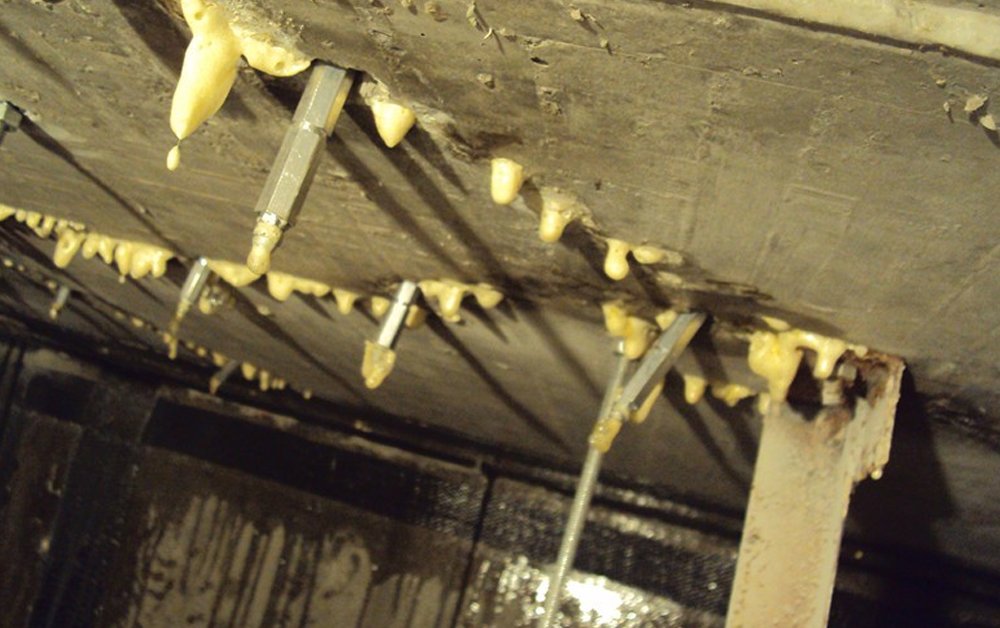
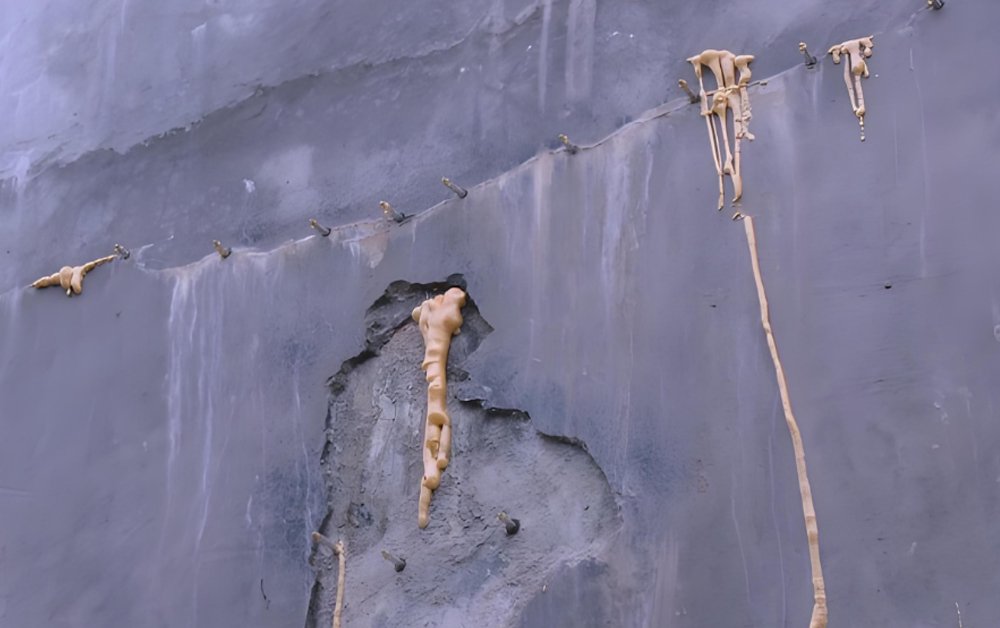
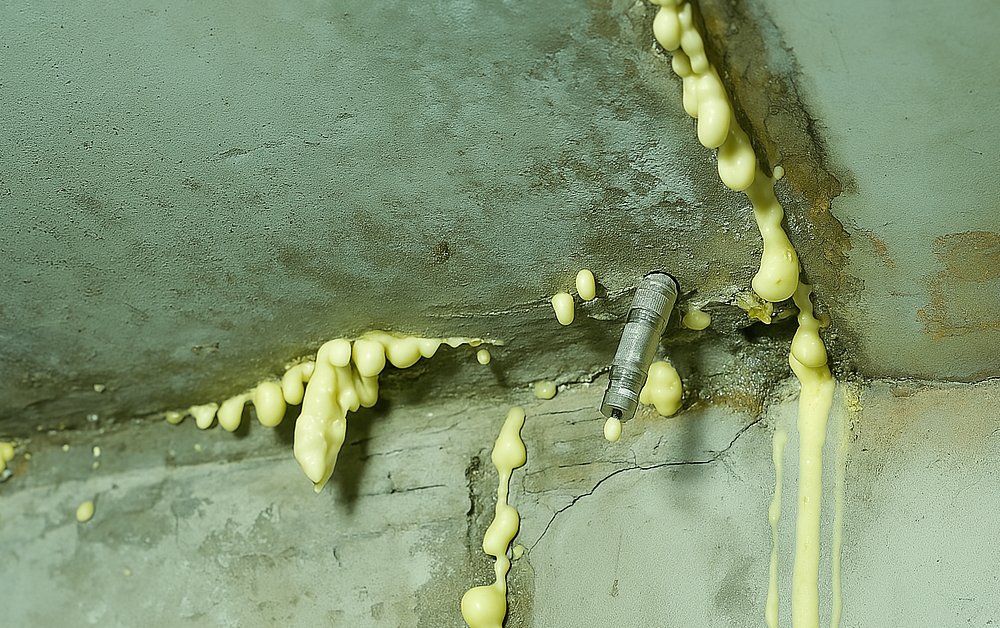
- The material expands aggressively, forming a closed-cell foam.
- The foam hardens into a water-repelling, solid barrier.
1.2 What “Hydrophobic” Actually Means in Practice:
Hydrophobic does not simply mean “water-resistant.”
In engineering terms, it means:
- The cured material does not absorb water.
- Water is physically pushed away from the foam structure.
- Long-term water migration through the cured grout is minimized.
This property is essential in active leakage scenarios, where water pressure is continuous.
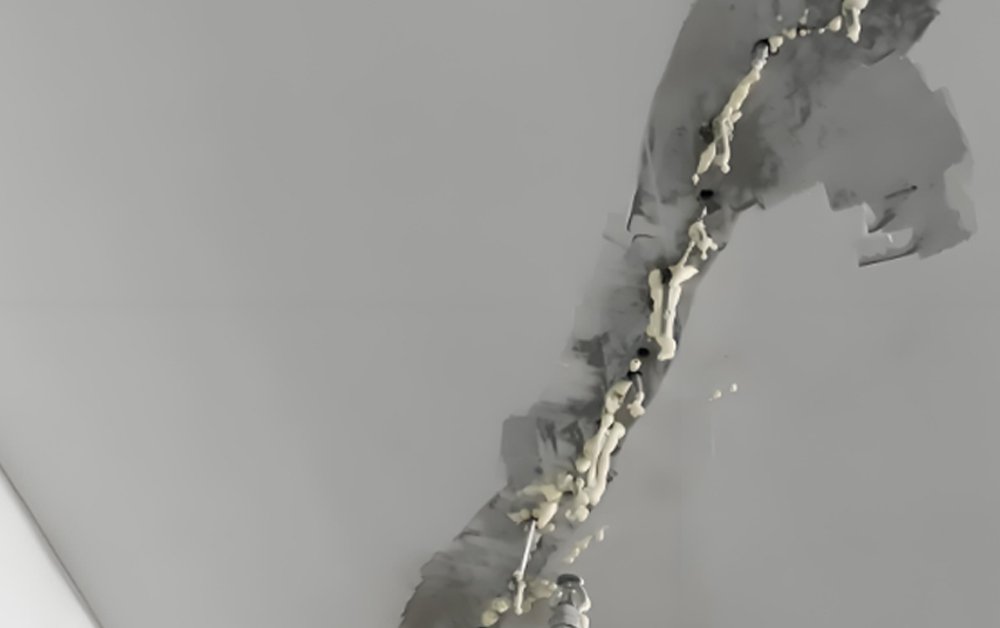
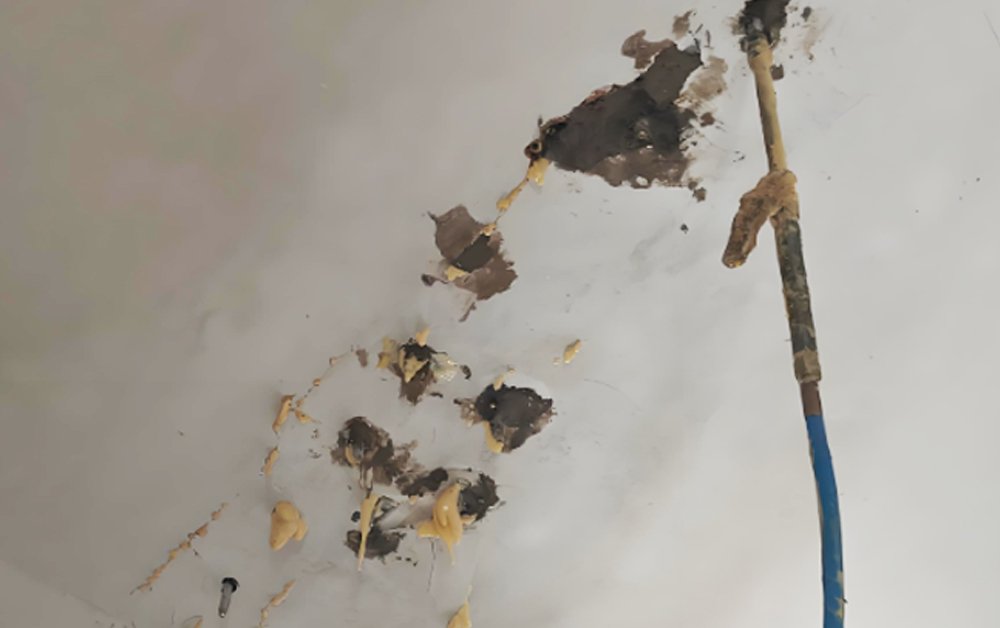
2. Emergency Leak Control: The Ideal Use Case for Hydrophobic PU Grout
Hydrophobic PU grout excels in emergency and high-risk water ingress situations.
2.1 Active, Pressurized Water Leaks
The clearest indication for hydrophobic PU grout is visible flowing water, including:
- Pressurized cracks
- Water jets
- Running seepage through cold joints
In these situations, slower-reacting materials will:
- Be diluted
- Be washed out
- Fail to seal before curing
Hydrophobic PU grout reacts within seconds to minutes, allowing it to:
- Arrest water flow immediately
- Stabilize the work area
- Prevent further erosion
2.2 Situations Where Waiting Is Not an Option
Examples include:
- Underground parking garages flooding during rainfall
- Tunnel leaks disrupting traffic
- Elevator pits accumulating water
- Foundation walls leaking during excavation
In such cases, reaction speed is more important than elasticity.
3. Performance Under High Water Pressure and Dynamic Flow
3.1 Why Hydrophobic PU Works Under Pressure:
The expanding foam generates counter-pressure against the incoming water.
This is critical because:
- Water pressure must be overcome, not merely resisted.
- Passive materials rely on adhesion alone.
- Hydrophobic PU combines chemical reaction + mechanical expansion.
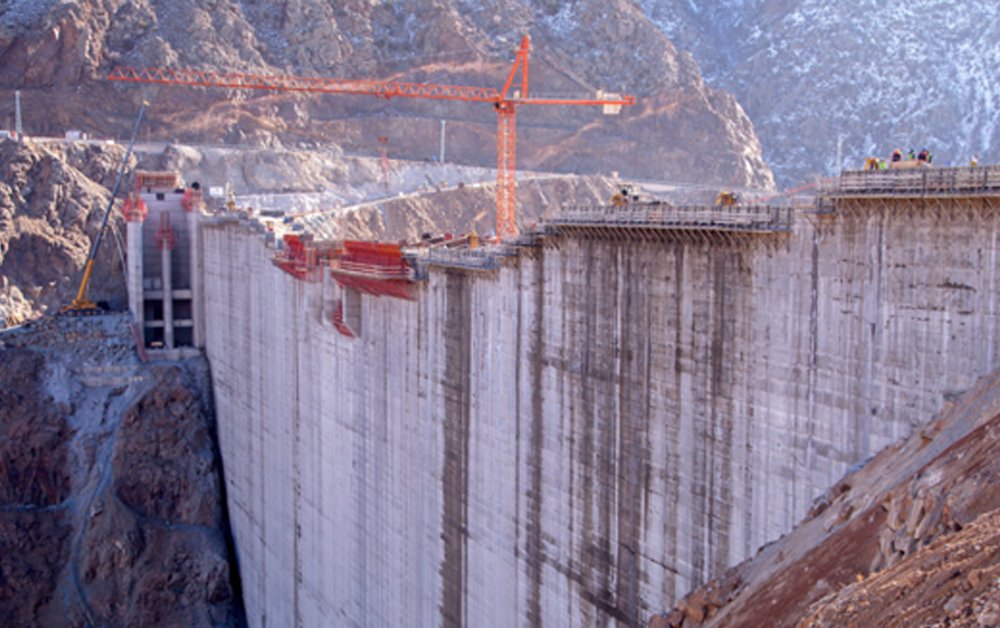
3.2 Typical High-Pressure Applications
Hydrophobic PU grout is widely used in:
- Metro tunnels
- Utility tunnels
- Deep basements
- Dam galleries
- Shaft linings
In these environments, pressure resistance matters more than flexibility.
4. When Hydrophobic PU Grout Should NOT Be Used:
4.1 Structural Cracks Requiring Flexibility
Hydrophobic PU foam typically cures into a rigid or semi-rigid structure.
This makes it unsuitable for:
- Expansion joints
- Moving cracks
- Structures experiencing thermal cycling
Once cured, the material does not accommodate repeated movement well.
4.2 Dry or Intermittently Wet Cracks
Because hydrophobic PU requires water to react:
- Dry cracks may result in incomplete curing
- Intermittent moisture leads to uneven expansion
In such cases, hydrophilic PU or flexible resin systems are more appropriate.
4.3 Drinking Water or Sensitive Environmental Zones
Not all hydrophobic PU formulations are approved for:
- Potable water contact
- Environmentally sensitive sites
Certification and formulation quality matter greatly here.

5. Hydrophobic vs. Hydrophilic PU Grout: A Strategic Combination
5.1 Why One Material Is Rarely Enough:
Modern leak repair follows a two-stage logic:
- Stop the water
- Seal the structure
- Hydrophobic PU excels at Stage 1.
- Hydrophilic PU excels at Stage 2.
5.2 Common Professional Approach
A proven sequence used by experienced contractors:
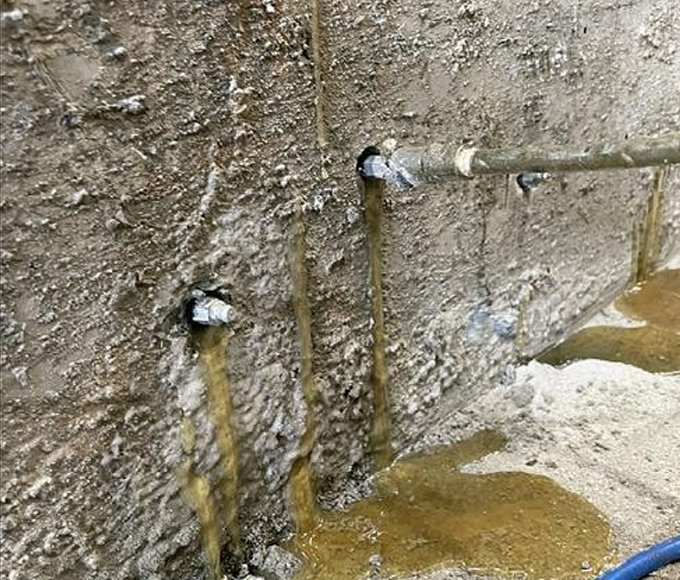
- First injection: hydrophobic PU to stop active flow.
- Second injection: hydrophilic or elastic grout to seal micro-cracks.
This approach reduces failure rates dramatically.
6. Construction Practicality and Risk Control
6.1 Equipment Compatibility
Hydrophobic PU grout:
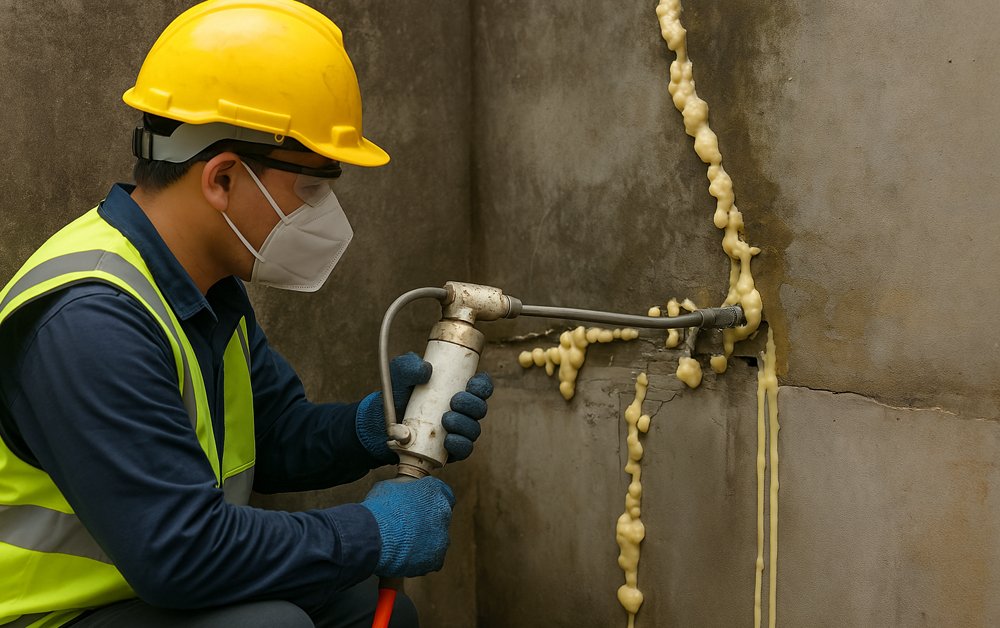
- Works with standard single-component injection pumps.
- Requires moisture presence, not mixing ratios.
This reduces on-site complexity.
6.2 Risks of Over-Expansion
Poor-quality formulations may:
- Expand uncontrollably
- Cause surface cracking
- Damage weak substrates
Therefore, formulation stability is crucial.

7. Durability and Long-Term Performance Considerations
7.1 Water Resistance Over Time
High-quality hydrophobic PU:
- Maintains closed-cell structure
- Resists hydrolysis
- Retains sealing integrity under constant immersion
Low-quality products degrade quickly.
7.2 Dry–Wet Cycling
Repeated wet-dry cycles can:
- Shrink inferior foam
- Create secondary leakage paths
Laboratory aging tests are essential when evaluating suppliers.
8. How to Evaluate a Reliable Hydrophobic PU Grout Supplier?
8.1 Key Technical Data You Should Request
A legitimate manufacturer should provide:
- Expansion ratio range (not just max value)
- Reaction time under controlled water content
- Density after curing
- Compressive strength data
8.2 Red Flags to Watch For:
Be cautious if:
- Only marketing brochures are available.
- No project references are provided.
- No sample testing is allowed.
9. YURU Waterproof: System-Based PU Grouting Solutions
At YURU Waterproof, hydrophobic PU grout is never treated as a standalone product.
Our approach includes:
- Multiple hydrophobic PU formulations for different pressure ranges.
- Matching hydrophilic systems for secondary sealing.
- Technical selection support based on site conditions.
YURU materials are widely used in:
- Municipal infrastructure (eg: Qingdao Metro project)
- Underground engineering (eg: pipe gallery projects)
- Waterproofing and repair projects
Our focus is not just stopping leaks — but making repairs last.
FAQs
1. Is hydrophobic PU grout permanent?
It provides long-term water blocking but should be combined with flexible systems for structural durability.
2. Can hydrophobic PU grout stop high-pressure leaks?
Yes, it is specifically designed for pressurized water ingress.
3. What is the main difference between hydrophobic and hydrophilic PU grout?
Hydrophobic repels water and expands aggressively; hydrophilic absorbs water and remains flexible.
4. Can hydrophobic PU grout be used in dry cracks?
No. It requires water to react properly.
5. How fast does hydrophobic PU grout react?
Typically within seconds to a few minutes, depending on formulation.
6. Does YURU provide both hydrophobic and hydrophilic PU grout?
Yes. YURU offers complete grouting systems for different leak scenarios.
Conclusion
Simply put, Hydrophobic PU grout should be used:
- When water is actively flowing
- When pressure must be countered immediately
- When emergency stabilization is required
It should not be used:
- As a universal crack repair solution
- Where flexibility is critical
- Without understanding site conditions
Correct timing matters more than product strength.
Looking for professional guidance instead of trial-and-error repairs?
Contact YURU Waterproof to receive:
- Application-specific material recommendations
- Sample testing support
- Proven grouting system solutions for your project
YURU Product solutions