When Should You Replaster After DPC Injection? Salts, Drying, and Wall Finishes
Replastering following DPC injection is not determined by a fixed elapsed time.
The decision depends on whether the moisture source has been controlled, the condition and salt load of the existing plaster, the type of wall being repaired, and the restoration system being specified. Some walls need full replastering, some only need localized repair, while sound historic lime plaster may be better retained.
For contractors and technical buyers, the practical question is not just “How long has it been since the DPC was injected?” It is whether the proposed finish can manage the actual wall condition without creating another damp or decorative problem later.
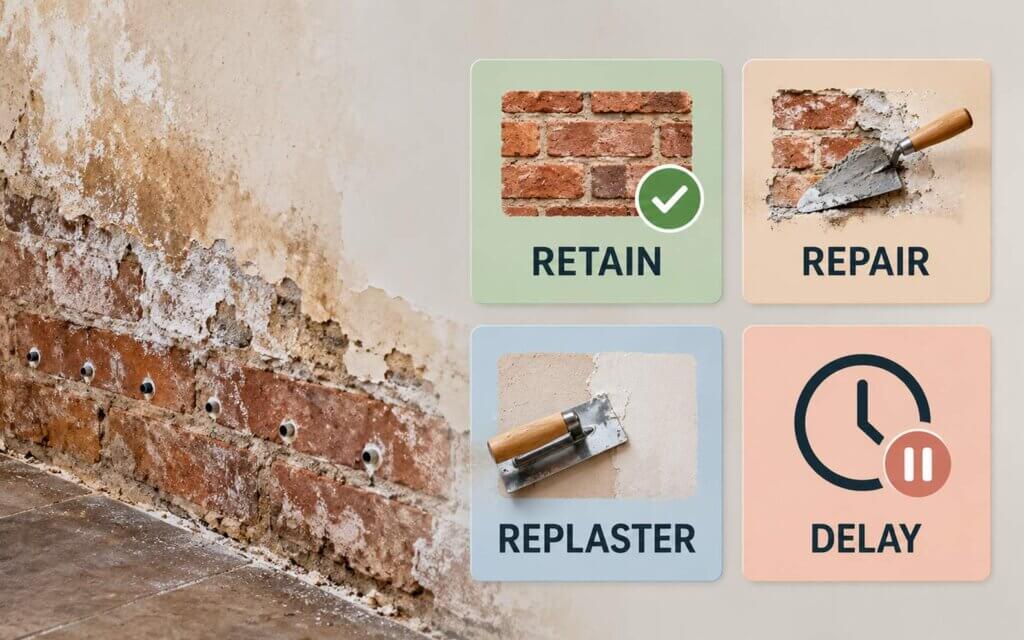
The final decision usually falls into one of four routes:
Retain, Repair, Replaster, or Delay and Reassess.
Quick Answer: When Can You Replaster After DPC Injection?
There is no universal waiting period for replastering after DPC injection.
First confirm that the original moisture source has been controlled or properly understood. Then assess the existing plaster, salt contamination, wall construction and requirements of the proposed restoration system.
A wall does not always have to be completely dry before a compatible remedial system is installed. Some specialist systems are designed for masonry that is still drying after damp treatment. That does not mean ordinary plaster can automatically be applied immediately after every DPC installation.
The condition of the existing plaster matters too. Damaged or heavily salt-contaminated plaster may need replacement, while sound plaster may be retained or repaired.
Replastering after DPC injection is a condition-based decision, not a countdown.
What Should Be Checked Before Replastering Starts?
Before deciding which plaster to use, check whether the wall is ready to be covered again.
The first question is whether the free-water source has been controlled. Current damp-control guidance states that replastering and other rectification work should follow the removal or proper understanding of the moisture source; if free-water ingress remains, the repair strategy is likely to fail.
For a post-DPC project, check:
- whether the DPC treatment has been completed as specified;
- whether high ground levels, bridging or another moisture bypass remains;
- whether rain penetration, plumbing leakage or another water source is active;
- whether the existing plaster is sound, detached, soft or heavily contaminated;
- whether salt contamination is likely;
- whether the wall is conventional masonry or traditional/historic construction;
- and whether the proposed restoration system is suitable for the actual substrate condition.
If the wall is still receiving significant free water, the next decision should not be which plaster to apply.
It should be:
Delay the finish and deal with the moisture problem first.
If the wall is still damp and the cause is uncertain, first review why a wall can remain damp after DPC injection before specifying a new finish.
Does Every Wall Need Replastering After DPC Injection?
No.
Installing a chemical DPC does not automatically mean that all existing plaster must be removed.
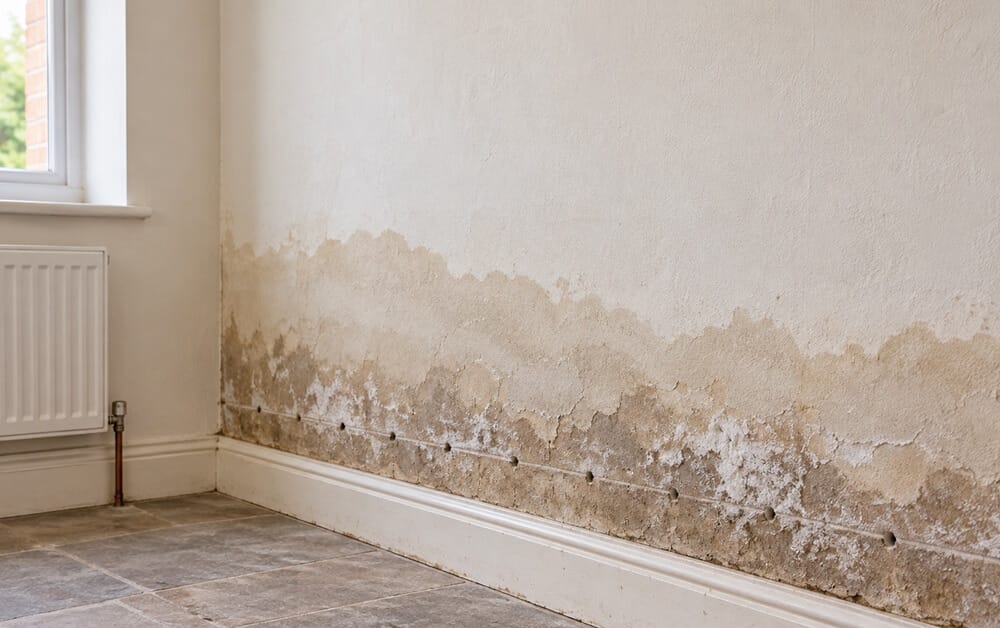
Where plaster is badly deteriorated, soft, blistered, detached or seriously affected by salts, replacement may be appropriate. Localized damage may only require localized repair. Sound plaster that remains compatible with the wall may not need to be removed at all.
This becomes particularly important in traditional buildings, where stripping existing material can cause unnecessary loss of historic fabric.
The useful question is therefore:
- What is actually wrong with the existing plaster?
rather than:
- Has a DPC been installed?
That distinction determines whether the correct route is retain, repair or replaster.
Which Existing Plaster Should Be Removed or Retained?
The answer changes according to both plaster condition and building type.
Salt-Damaged or Unsound Conventional Plaster
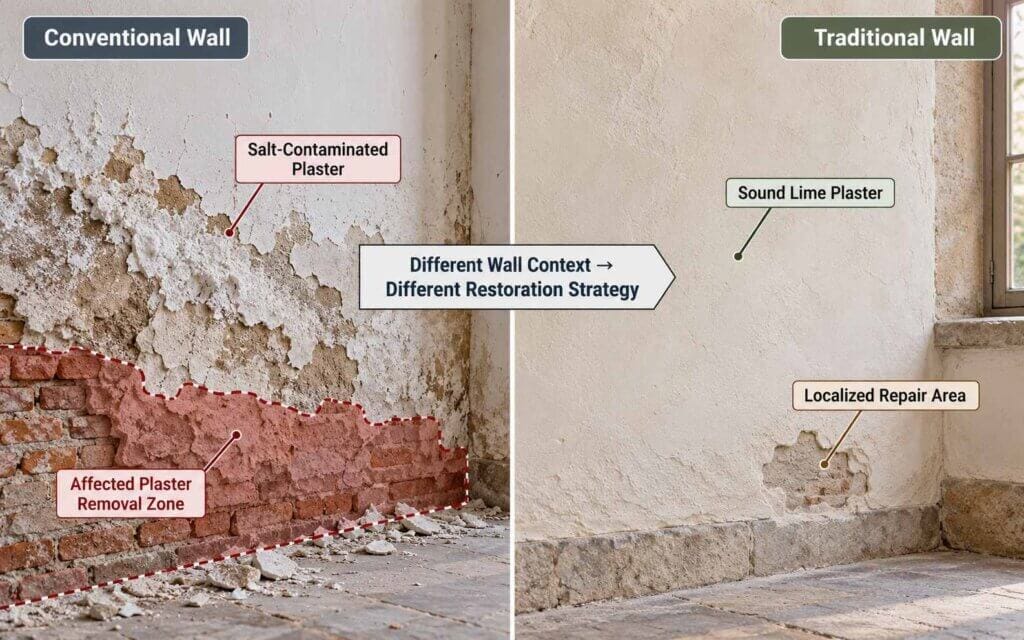
In conventional remedial damp-proofing work, plaster badly affected by hygroscopic salts is often removed before a compatible salt-managing system is installed.
For this type of work, the PCA Code uses removal to at least 300 mm above the last detectable signs of dampness or hygroscopic-salt contamination as a guideline. That does not mean “300 mm above the DPC line” on every project. The actual extent should follow the survey and the selected repair specification.
Some proprietary systems specify different preparation heights or methods. Those are requirements of the individual system, not universal rules for every DPC project.
Sound Historic Lime Plaster
Historic or traditional masonry needs a different assessment.
Current Historic England repair guidance advises against automatically removing sound historic lime plaster and supports local repair or re-anchoring where deterioration is limited. Its guidance is written in a historic-building recovery context, but the underlying conservation principle is highly relevant here: sound compatible historic material should not be stripped simply because a wall has previously been wet.
SPAB gives more specific advice for previously damp old walls and normally favors lime plaster for compatible repairs following rising-damp work.
So the conventional 300 mm salt-removal guideline should not be treated as an automatic instruction to remove valuable, sound historic lime plaster.
Building context changes the restoration strategy.
Do You Need to Wait Until the Wall Is Completely Dry Before Replastering?
Not always.
A damp-affected masonry wall may continue drying for many months. Waiting until every part of the wall is completely dry before carrying out any restoration work is therefore not always practical.
Some specifically designed restoration and isolation materials are intended for use while the underlying masonry continues to dry. One certified dry-lining system, for example, permits installation immediately after the DPC treatments covered by its certification, even though allowing the exposed wall more drying time is preferable.
That demonstrates an important principle:
- Complete masonry drying is not always a prerequisite for every specified restoration system.
It does not mean all plaster can be applied immediately after every DPC installation.
The selected system must be suitable for the actual:
- moisture condition;
- salt exposure;
- masonry type;
- treatment arrangement;
- and intended decorative finish.
If the material specification does not allow application under the current conditions, more drying time may still be necessary.
How Do Salts Affect the New Plaster?
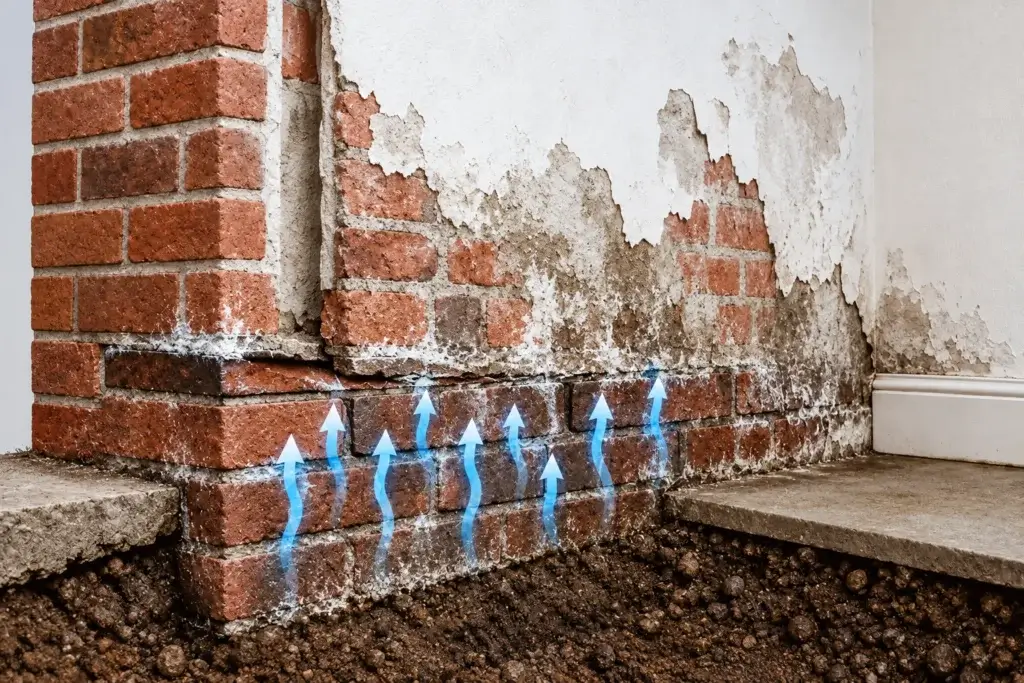
Removing contaminated plaster does not make the masonry salt-free.
During prolonged rising damp, soluble salts can accumulate within both the plaster and the wall behind it. Current professional guidance specifically notes that removing plaster does not remove salts already accumulated in the masonry.
The practical sequence is:
Past rising damp → salts accumulate in masonry → contaminated plaster is removed → salts remain inside the wall → the replacement finish is still exposed to salt and residual-moisture risk.
This is why post-DPC replastering is not simply a cosmetic replacement exercise.
The new system may need to resist, isolate or manage moisture and salt movement from the substrate. A proprietary salt-resistant render, renovation plaster or isolation system can perform that function when specified correctly.
It is also important to separate two jobs:
Stopping the original moisture source and protecting the replacement finish.
A plaster or lining system may help protect the decorative surface, but it does not replace the need to control rising damp or any other active water source.
Which Replastering System Fits This Type of Wall?
There is no single best plaster for every wall after DPC injection.
The complete system should be selected according to wall construction, salt load, residual moisture and the required finish.
Conventional Remedial Masonry
For conventional brick or block construction with damaged or salt-contaminated plaster, a specialist remedial system may be suitable.
Depending on the project, this might involve:
- salt-resistant cementitious render;
- renovation plaster;
- an approved lining or isolation system;
- or another proprietary post-DPC specification.
The key is the word system.
A renovation or remedial plaster specification is not simply a bag of plaster with a different name. WTA, for example, treats renovation mortar systems as a distinct technical category and separately maintains guidance for lime-based plaster used in architectural heritage.
The individual layers and materials should therefore be compatible with each other and with the substrate.
Historic or Traditional Masonry
Traditional masonry places greater emphasis on material compatibility and moisture permeability.
Sound historic lime plaster may be worth retaining. Where repair or replacement is necessary, compatible lime-based materials are often more appropriate because traditional walls manage moisture differently from many modern sealed construction systems. Historic England notes that lime-based plaster and mortar can assist moisture movement through traditional masonry.
That does not mean lime automatically solves every post-DPC problem.
A high salt load can still cause staining or deterioration, so salt condition must be assessed even when a permeable lime finish is preferred.
High-Salt or Difficult Substrates
Some walls are difficult to reinstate using ordinary wet plastering.
Where salt contamination is high, the substrate is irregular, or the decorative finish needs to be isolated while the masonry continues drying, a membrane or dry-lining approach may sometimes be considered.
Professional guidance recognizes these systems as a way to isolate finishes from damp or salt-affected masonry during recovery, but does not treat them as the primary cure for rising damp itself.
That distinction matters:
DPC or moisture treatment controls the moisture route.
An isolation system protects the finish.
They perform different jobs.
How Do Gypsum, Cement-Based Render and Lime Fit Into This?
The material name alone does not determine suitability.
| Material / System | Can Be Appropriate When… | Main Caution |
| Gypsum-based finish | Used on a suitable substrate or within a specified isolation/dry-lining system | Direct exposure to damp or salt-loaded masonry can create problems |
| Salt-resistant cementitious remedial render | Used as part of a designed conventional damp-remediation system | Hard or low-permeability systems may be incompatible with traditional construction |
| Lime plaster | Traditional or historic masonry where compatibility and moisture permeability are priorities | High salt loads can still stain or damage the finish |
| Renovation plaster system | Specifically designed for moisture- and salt-loaded masonry | Must be installed as the complete specified system |
| Membrane / dry lining | Finish isolation is needed while masonry continues drying or salt exposure is difficult | Does not itself eliminate the moisture source |
Gypsum is a good example of why blanket rules do not work. Professional guidance warns against directly fixing plasterboard to walls with a history of damp using traditional gypsum adhesive because the adhesive can provide a route for moisture or salts. Yet certified isolation systems can use gypsum-based skim finishes once the masonry has been separated from the finish by the specified system.
Similarly, salt-resistant cementitious render can be appropriate in conventional remedial work, while a hard, low-permeability cement-rich approach may be unsuitable for some traditional walls.
The correct specification comes from the wall condition and the complete restoration system, not from declaring gypsum, cement or lime universally “best.”
When Can You Paint or Decorate After Replastering?
Replastering does not automatically mean the wall is ready for its final decorative finish.
There are separate stages:
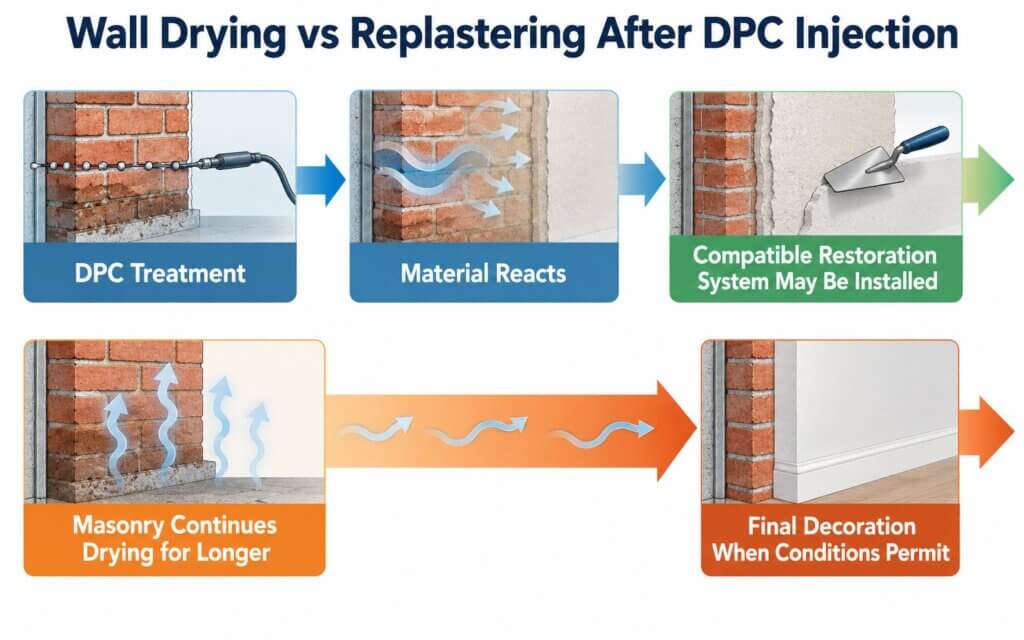
DPC treatment → replastering or restoration → continued wall drying and plaster curing → final decoration
The underlying masonry may continue losing moisture long after the new surface has been installed. Less permeable paints, wallpapers or coatings can interfere with that process if applied too early.
Final decoration should therefore follow the drying and coating requirements of the selected plaster or lining system rather than an arbitrary number of days after DPC injection.
Traditional lime plaster needs particular care. Historic England recommends compatible permeable finishes and warns against coatings that restrict moisture transfer through traditional lime-based construction.
So:
- Ready to replaster does not automatically mean ready for any paint or wall covering.
A Practical Post-DPC Replastering Decision Framework
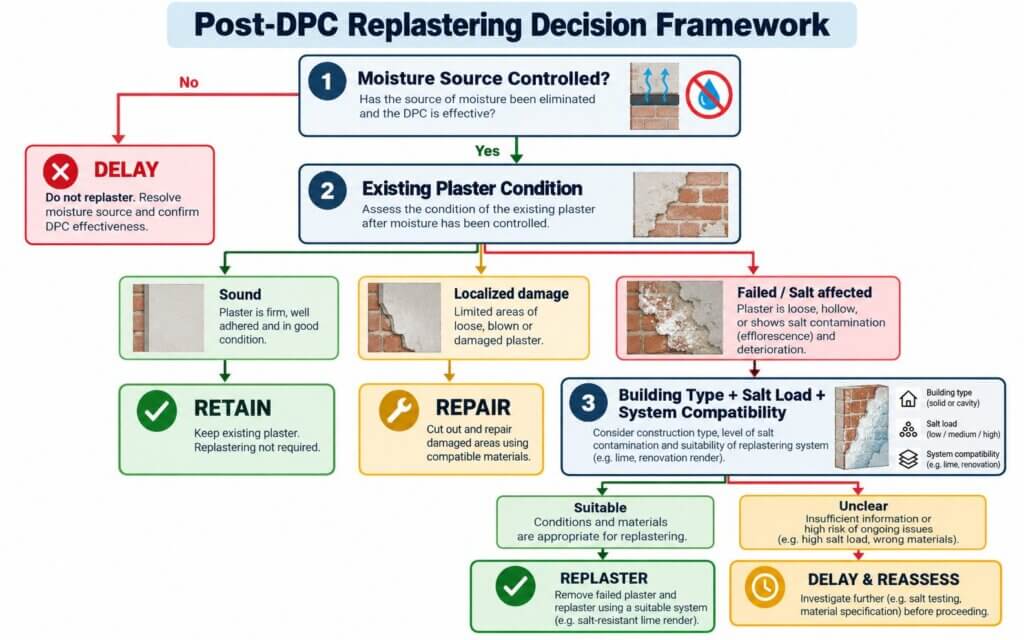
If you need one practical rule from this guide, use the condition of the wall — not the number of days since injection — to decide what happens next.
| Wall Condition | Next Decision |
| Moisture source or free-water ingress is still unresolved | Delay & Reassess |
| Existing plaster is sound, compatible and worth retaining | Retain |
| Damage is localized but surrounding plaster remains serviceable | Repair |
| Plaster has failed or is heavily salt affected and a compatible replacement system has been specified | Replaster |
| Building type, salt load or system compatibility remains unclear | Delay & Reassess |
RETAIN
Retain existing plaster when it remains sound and compatible with the construction, particularly where historic lime plaster has significance and does not need wholesale removal.
REPAIR
Localized cracks, de-bonding or deterioration do not always justify stripping the complete wall. Compatible localized repairs may be sufficient.
REPLASTER
Replastering becomes more appropriate where the existing plaster has failed, salt contamination is significant, or the current finish is incompatible with the restoration strategy.
The replacement should match the substrate, salt condition and type of construction.
DELAY & REASSESS
Delay covering the wall when the moisture source remains unresolved, active free water is present, historic fabric has not been properly assessed, or the proposed system is not suitable for the existing wall condition.
What Does This Mean for YURU Liquid DPC?
YURU’s product data separates material reaction, hole closure and the wider restoration of the wall.
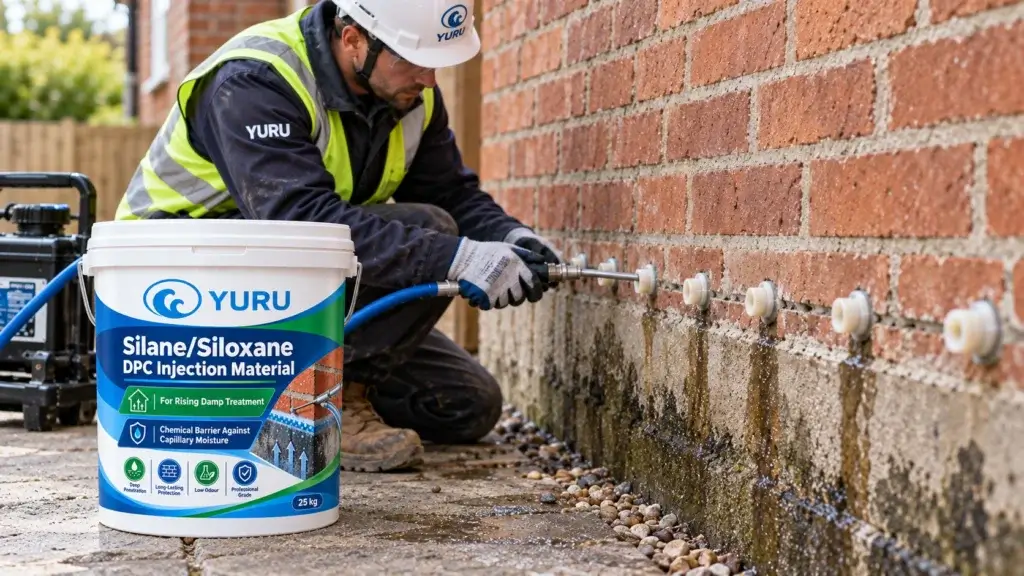
YURU Premium Silane/Siloxane DPC Injection Material catalyzes in approximately 8–10 days, while the injection holes are recommended to be closed 30 days after injection using a gypsum-free mortar or filler.
The wider restoration decision should still be based on:
moisture source → plaster condition → salt load → construction type → specified finish system.
Frequently Asked Questions
How Long Should I Wait Before Replastering After DPC Injection?
There is no universal waiting period.
The moisture source should first be controlled, after which the timing depends on plaster condition, salt contamination, masonry construction and the requirements of the selected restoration system. Some specifically designed systems can be installed while the wall is still drying, while other specifications require a longer initial drying period.
Don’t use one manufacturer’s waiting period as a rule for every DPC and plaster system.
Does the Wall Need to Be Completely Dry Before Replastering?
Not always.
Some remedial or isolation systems are designed for installation while masonry continues drying. Their suitability depends on the complete system specification and the condition of the substrate.
This should not be interpreted as permission to apply any ordinary plaster to damp or salt-contaminated masonry.
Does All Old Plaster Need to Be Removed After DPC Treatment?
No.
Failed or heavily salt-contaminated conventional plaster may need removal, while localized damage may only need repair. Sound historic lime plaster deserves different treatment; current conservation guidance generally favors retaining and repairing serviceable historic material instead of automatically stripping it.
Can Standard Gypsum Plaster Be Used After DPC Injection?
Depends on location and application.
- Not a universal default directly over damp or salt-affected masonry
- Can be part of specified isolation or dry-lining systems
- Requires wall surface appropriately separated from residual moisture and salts.
Not Sure Which Replastering Approach Fits the Wall?
Before specifying a post-DPC finish, send YURU Waterproof the wall construction and approximate building age, DPC treatment date, existing plaster type and condition, visible salt or surface damage, current wall condition, proposed finish and project photos.
We can review the available project information and help identify whether the next step should be to retain the existing plaster, carry out localized repair, specify a compatible replastering system, or delay restoration until the wall condition is better understood.
YURU Product solutions