Why Do Polyurea Waterproofing Costs Vary So Much?
Introduction
Two polyurea waterproofing quotations can look similar on paper and still have a considerable price difference. One supplier may propose a conventional hand-applied coating, whereas another may quote a UV-resistant aliphatic formulation. The required coating thickness, material consumption, and packaging arrangement can make the difference even greater.
We manufacture five polyurea waterproofing formulations at YURU Waterproof. Some are designed for straightforward manual application, while others provide higher UV resistance or require professional spraying equipment. Each has its own technical and purchasing considerations.
When comparing prices, we look at the actual formulation, the amount needed for the project, and what the supplier has included in the quotation. These details generally provide greater explanatory value than price per kilogram alone.
What Is Included in a Polyurea Waterproofing Quote?
Contractors may request polyurea waterproofing price per square meter. An importer may want a factory quote per kilogram or per set. Both concern the same material category — but they involve different calculations.
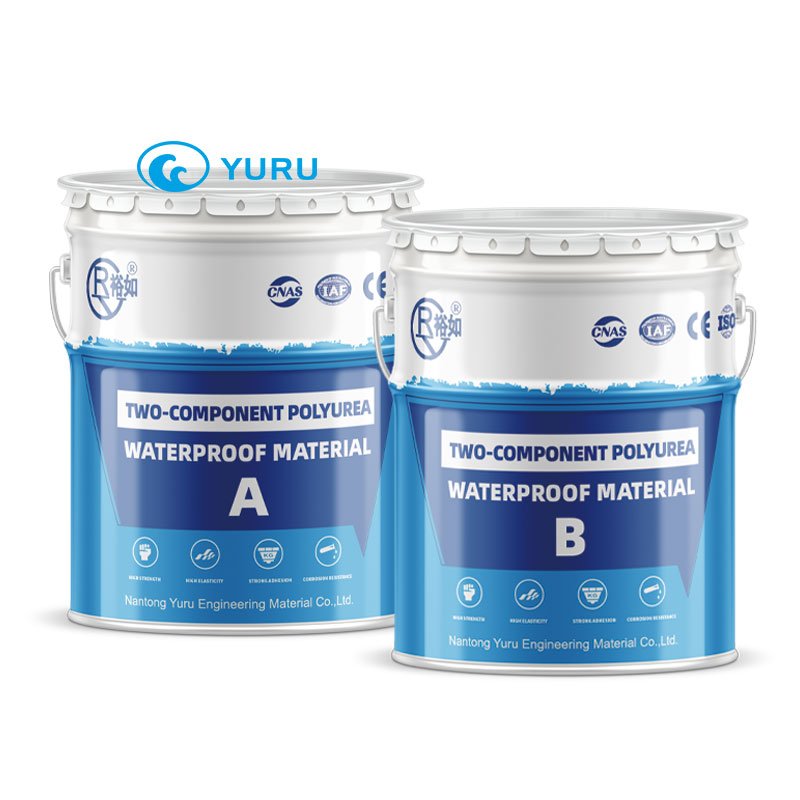
At YURU, a factory material quotation encompasses the specified coating, quantity, packaging, and agreed delivery terms. For two-component products, the quotation must account for correct supply of both A and B components.
A complete waterproofing system may incorporate additional materials. Concrete frequently requires a compatible primer, and certain details may necessitate local reinforcement. Depending on exposure conditions and system design, a protective coating or alternative finishing layer may also be specified.
Contractors must then consider installation costs, including substrate preparation, labor, equipment, and site conditions.
This distinction becomes important when reviewing quotations for exposed roofs. An offer for a UV-resistant coating may have a different material scope from an offer for a membrane that requires a separate protective finish. The final system cost depends on everything needed to meet the project specification.
We prefer to identify the main polyurea coating and any additional system materials separately when discussing supply requirements. Buyers can see exactly which products they are purchasing, while contractors have the information needed to prepare their installation budgets.
How Do Different Polyurea Formulations Affect the Price?
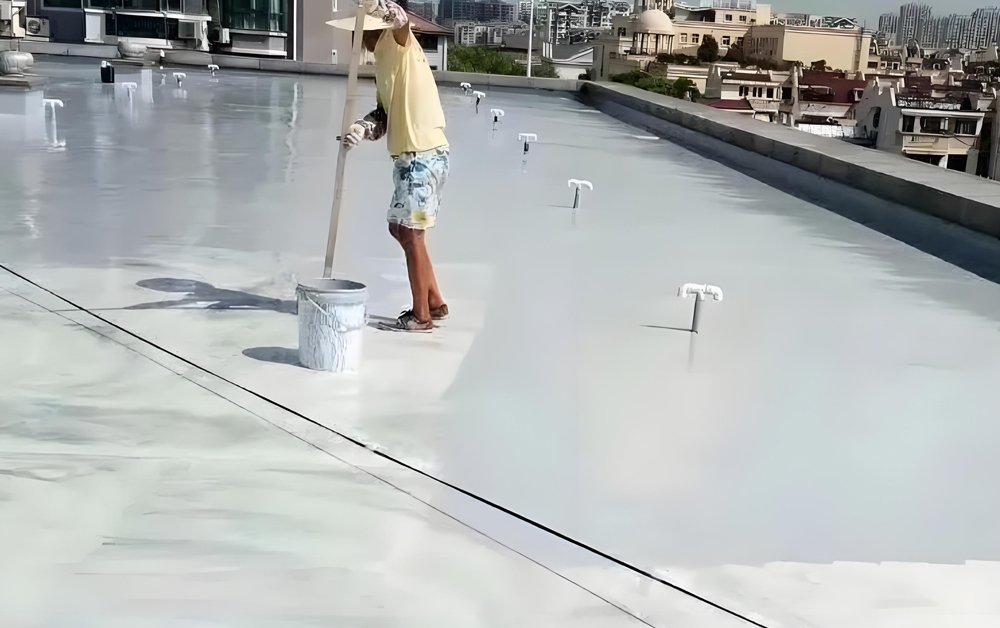
Different polyurea formulations are developed for different performance and application needs. Raw material systems, curing behavior, UV resistance, and installation methods can all vary — even when the finished products are all called polyurea waterproofing coatings.
YURU supplies five formulations. They range from conventional manual-applied coatings to aliphatic systems intended for projects requiring stronger UV resistance.
YURU Polyurea Waterproofing Formulations
| YURU Product | Mixing System | UV Performance | Application | Main Purchasing Consideration |
| One-Component Polyurea Waterproof Material | Single-component | Conventional grade, without dedicated UV-resistant positioning | Manual application | No separate A/B components |
| Two Components Polyurea Waterproof Material | A = 1:1 by weight | Conventional grade, without dedicated UV-resistant positioning | Brush, roller, or scraper | Matched two-component material supply |
| Polyurea Waterproofing Material (Two-Component, Hand-Applied) | A:B = 1:2 designation | Lower UV resistance than the two aliphatic formulations | Hand application | Formulation-specific component proportions and packaging |
| Polyurea Waterproofing Material (Two-Component, Hand-Scraping) | A:B = 1:1 designation | Higher UV resistance; aliphatic | Hand scraping | UV-resistant formulation applied without specialized spray equipment |
| UV-Resistant Polyurea Waterproofing Material (Two-Component, Spray-Applied) | A:B = 1:1 | Higher UV resistance; aliphatic | Professional spray application | Spray-compatible formulation and equipment requirements |
Single-component coating is supplied without a separate hardener component, that simplifies one part of material preparation.
The conventional two-component products have different A/B arrangements and working characteristics, their relative cost cannot be determined from the mixing ratio alone.
The two aliphatic formulations are especially relevant for customers purchasing materials for exposed waterproofing. Our hand-scraped version provides higher UV resistance and can be applied without professional polyurea spray equipment. For this combination of performance and application convenience, it is one of the products we most often recommend evaluating.
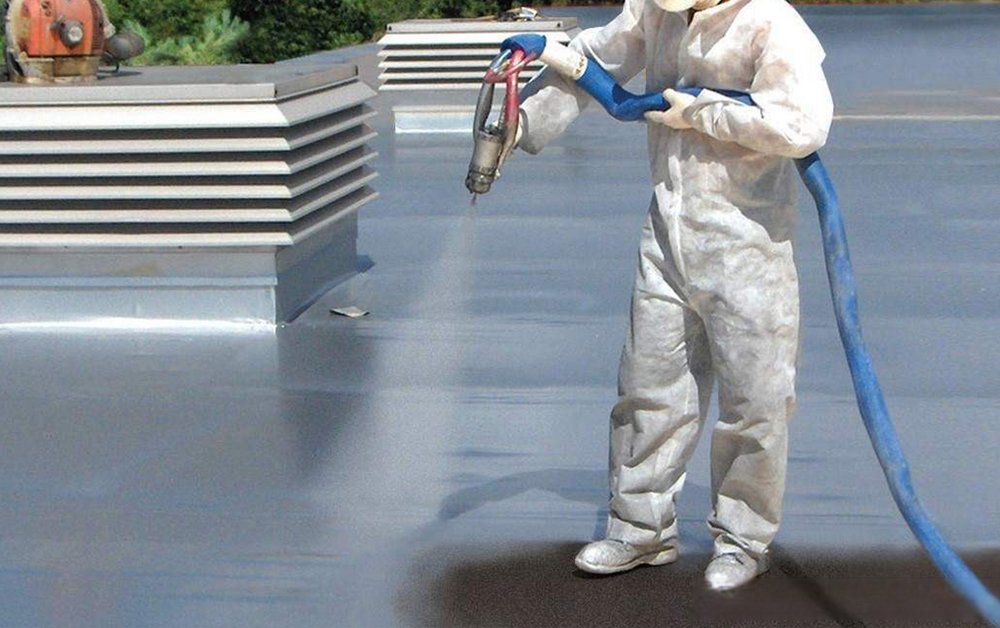
The aliphatic spray-applied formulation serves projects where professional spray application is required or already available. Equipment and operating requirements differ from those of the hand-applied product.
For a distributor, these distinctions also affect the product range offered to customers. A market focused on small roofing contractors may have different requirements from one supplying large industrial projects with specialized spray teams.
Retail and wholesale prices differ; therefore, we first need to clarify product specifications and ordering terms in order to provide a firm and reliable price based on all relevant factors.
How Does UV Exposure Affect the Total Waterproofing System Cost?
When used in exposed conditions, sunlight may alter the materials required for the waterproofing project.
A waterproofing layer installed beneath a paved surface, tile, or other protective covering operates in an environment different from that of a roof coating directly exposed to sunlight. The exposed coating must have suitable weathering performance for that application.
YURU’s conventional single-component and standard two-component polyurea coatings are intended for applications that do not require the dedicated UV resistance of our aliphatic grades.
Our other two-component hand-applied formulation also has weathering resistance. Its UV performance, however, is lower than that of the aliphatic hand-scraped and spray-applied formulations.
For projects with prolonged sunlight exposure, we generally begin by evaluating the two aliphatic products and their compatibility with the overall waterproofing design.
The cost difference can extend beyond the main membrane. A coating with lower UV resistance may require an additional compatible finish when used in an exposed system. That finish brings its own material consumption and application requirements.
For example, Sika’s Sikalastic-853 R AP, a hybrid polyurea roofing membrane, requires an aliphatic topcoat for fully exposed roof applications. This is a product-specific system requirement, but it illustrates why the main waterproofing membrane price may represent only part of the specification.
The selection of a UV-resistant waterproofing product does not automatically negate the need for primers, protective layers, or other essential components. Ultimately, the specific configuration must be determined based on the requirements of the project and the demands of the site conditions.
For exposed work, the useful comparison is the material cost of the complete specified system. A lower-priced membrane can require additional products before the installation meets the same exposure requirements.

Why Can a Lower Price per Kilogram Cost More per Square Meter?
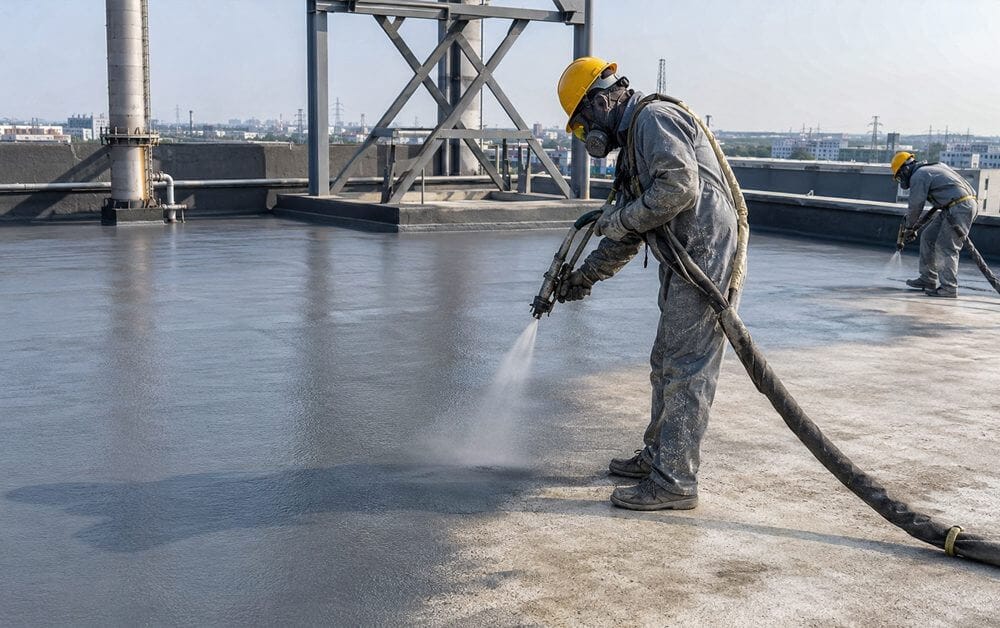
Material consumption has a direct effect on the cost of polyurea waterproofing.
An importer usually receives a quotation in kilograms or complete product sets. A contractor, however, needs enough material to cover a defined area at the required thickness. The price per kilogram becomes useful for project costing once the expected consumption is known.
YURU’s standard two-component hand-applied polyurea and UV-resistant aliphatic spray-applied polyurea both have a nominal consumption figure of approximately 1.2 kg/m² per millimeter of coating thickness in their respective product data sheets.
For these two products, the documented reference quantities are:
- 1.0 mm reference thickness: approximately 1.2 kg/m²
- 1.5 mm reference thickness: approximately 1.8 kg/m²
- 2.0 mm reference thickness: approximately 2.4 kg/m²
These are nominal planning figures from the individual product documents, they should not be applied automatically to YURU’s other polyurea formulations or treated as guaranteed site consumption.
The basic calculation is:
- Estimated coating material cost per m² = Material price per kg × Estimated practical consumption in kg/m²
For example, when a contractor is estimating the materials required for a 1.5 mm-thick coating, the nominal coverage rate can serve as a reference; however, when placing an actual order, one must also account for the additional material needed for areas such as corners, parapets, pipe penetrations, and concrete repair zones. Therefore, it is not sufficient to rely solely on the figures provided in the technical documentation.
Substrate condition matters as well. Surface roughness, uneven areas, and application losses can all affect the practical consumption. Hempel’s coating consumption guidance explains why practical material requirements differ from theoretical calculations.
One further consideration: a supplier’s quoted price may already be based on complete A/B sets. Before calculating cost per kilogram, the buyer requires total usable material quantity and correct component proportions.
For the finished waterproofing system, calculate primer and other required materials separately. Their coverage rates and unit prices may be different from those of the main polyurea coating.
This is where two quotations can change order. A product with a lower unit price may require more material or a more extensive system to meet the same project specification. The comparison should use the specified thickness and practical material quantities for each proposed system.
How Do Order Quantity and Delivery Terms Affect Polyurea Prices?
The quantity and delivery arrangement can also explain why two buyers receive different polyurea prices.
A contractor ordering for one project may need only a limited number of standard packages. An importer supplying local distributors might buy a container shipment covering several formulations — with specific requirements for labels, package sizes, and product documentation.
At YURU, we discuss packaging and OEM requirements according to the product and order. Our polyurea waterproofing product series can be packaged according to customer requirements.
Actual pricing still depends on the quotation. Larger volumes may create different purchasing arrangements.
For overseas buyers, the quoted delivery term is another part of the calculation.
Under EXW, the buyer takes on substantial responsibility for arranging collection and onward transportation. FCA sets a different arrangement involving handover to the nominated carrier at the agreed place. Under CIF, the seller arranges freight and specified insurance to the named destination port — while the risk-transfer point follows the applicable Incoterms rule.
The International Chamber of Commerce’s Incoterms 2020 guidance explains how these rules allocate transport responsibilities, costs, and risks.
An EXW factory price and a CIF destination-port price therefore cover different obligations. Buyers need to compare them using a consistent delivery basis and account for the charges falling outside each quotation.
Packaging configuration also affects shipment planning. Separate A and B containers, pallet arrangements, and the number of formulations in an order all need consideration.
Purchase quantity, packaging requirements, destination, and agreed-upon delivery terms are all key factors we consider when formulating bulk price quotes for polyurea products.

Why Should Buyers Check the Full A/B Kit Before Comparing Prices?
Two-component polyurea coatings are supplied as matched material systems. Each formulation comprises its own A and B components, mixing instructions, and application requirements.
The mixing ratio is crucial; different ratios result in different product specifications, which in turn affect the required order quantity and the final price.
Our 1:2 hand-applied polyurea documentation lists a 10 kg container of component A and a 20 kg container of component B. The UV-resistant aliphatic hand-scraped product lists 10 kg of each component.
These are the packaging arrangements recorded in the supplied product documents. The mixing basis and current packaging should be checked against the specific formulation being ordered.
For purchasing departments, this means confirming the complete usable A/B set before comparing material prices. A quotation should identify the product formulation, both components, and the quantity supplied.
Especially during application, it is essential to follow the manufacturer’s instructions regarding the mixing ratio. Failure to do so can lead to poor performance or even the complete failure of the waterproofing system. Components from different formulations are not interchangeable, even where nominal mixing ratios appear identical. For professional spray application, accurate proportioning is essential; Graco’s technical guidance explains how off-ratio material delivery can affect spraying.
For OEM customers, correct A/B identification also needs to carry through to the final product labels and instructions. This helps distributors supply the intended formulation and gives contractors the information required for material preparation.
What to Check Before Accepting a Polyurea Quotation
| What to Check | Why It Matters |
| Product formulation and UV performance | Two polyurea coatings may be intended for different exposure conditions. |
| Materials included in the quotation | Check whether the price covers the coating alone or includes primers, protective finishes, or other system materials. |
| Coating thickness and estimated consumption | A lower unit price may lose its advantage if more material is needed to meet the project specification. |
| A/B mixing basis and packaging | For two-component products, confirm that the quotation covers the correct matched materials and usable quantities. |
| Order quantity and delivery terms | Compare offers on an equivalent purchasing basis, including agreed delivery location and transportation responsibilities. |
In many cases, the differences become clear once the product specification, material quantity, and supply terms are set out properly.
For distributors, this also facilitates communication with customers. Beyond simply providing price quotes, they can explain which formulation is best suited to a customer’s specific application and clarify exactly which products the customer will ultimately receive.
YURU Waterproof can review these requirements prior to quotation preparation. Provide project application, approximate area, exposure conditions, required thickness, and expected purchase quantity. We will assist in identifying the relevant polyurea waterproofing formulation and discuss available packaging and supply options.
Frequently Asked Questions
Why do polyurea waterproofing material prices vary?
Price depends on formulation, required performance, material specification, and purchasing conditions. Conventional hand-applied polyurea and UV-resistant aliphatic grades have different characteristics. Packaging, order quantity, and delivery terms can also affect the quote.
Is cheaper polyurea always cheaper per square meter?
No. A coating with a lower price per kilogram may require a different material quantity or additional system layers. Compare the practical consumption needed for the specified thickness and include other required materials when calculating the cost per square meter.
Does UV-resistant polyurea waterproofing always cost more?
There is indeed a cost difference between UV-resistant formulations and standard ones; however, the final cost depends on the entire application system. If the coating requires additional protective materials, this often leads to an increase in both material consumption and application costs.
Why can two polyurea coatings with a 1:1 mixing ratio have different prices?
The mixing ratio refers solely to the proportion of the components, not the complete formulation. Taking YURU products as an example, a 1:1 spray-applied polyurea waterproofing system cures faster than a hand-applied, two-component polyurea; differences in certain properties and application requirements can, in turn, affect costs.
What information does YURU need for a polyurea waterproofing quotation?
Required information includes intended waterproofing application, substrate, exposure conditions, approximate area, required thickness, and preferred application method. For wholesale or project procurement, order quantity, packaging requirements, destination, and delivery terms are also relevant.
Conclusion: Comparing Polyurea Waterproofing Costs
Polyurea waterproofing costs become easier to compare when the material formulation, required system, coating thickness, and purchasing conditions are clearly defined. The cheapest price per kilogram may not produce the lowest material cost for the project.
For exposed applications where manual installation is practical, YURU’s UV-resistant aliphatic hand-scraped polyurea is one of our preferred formulations. Our aliphatic spray-applied product serves projects with suitable professional equipment, while other formulations can be evaluated for different exposure and construction requirements.
Contact YURU Waterproof with your project specifications and estimated purchase quantity. We can review the appropriate material options and provide the relevant product information, packaging details, and quotation.
YURU Product solutions