How Does Joint Geometry Affect Injection Grout Distribution and Penetration?
Two concrete cracks can look almost identical at the surface but behave very differently during injection.
One may accept grout smoothly and allow the material to move toward the target area. Another may have a similar visible width but restrict the grout after a short distance, redirect it toward another outlet, or distribute it into several hidden paths.
The reason is that the crack width we see at the surface is only the entrance. Inside the concrete, the pathway may narrow, widen, branch, bend, become rough, connect to a larger void, or lose continuity.
Crack width tells us the size of the visible opening. Joint geometry tells us the path the grout must actually travel.
This distinction is important when contractors are evaluating penetration, diagnosing incomplete injection, or comparing injection grouting materials for a concrete joint.
How Does Joint Geometry Affect Injection Grout Penetration?
Quick Answer: Joint geometry affects where grout can move, how the available pathway changes, how the material is distributed, and whether it can reach the intended zone. Visible crack width alone cannot describe the complete internal injection path.
A relatively straight joint with a consistent internal opening generally presents a simpler flow path than one that narrows, branches, becomes tortuous, contains rough surfaces, or connects to larger internal spaces.
Geometry is only one part of the injection system. Grout viscosity, working or gel time, pressure, water conditions, material chemistry, and pathway connectivity also influence the final result.
This is why viscosity alone should not be treated as a complete measure of penetrability. ASTM D4016-02 notes that viscosity by itself is not necessarily an exact index of grout penetrability.
The more useful engineering question is therefore not simply: How wide is the crack?
It is: What kind of pathway does the grout actually need to travel through?
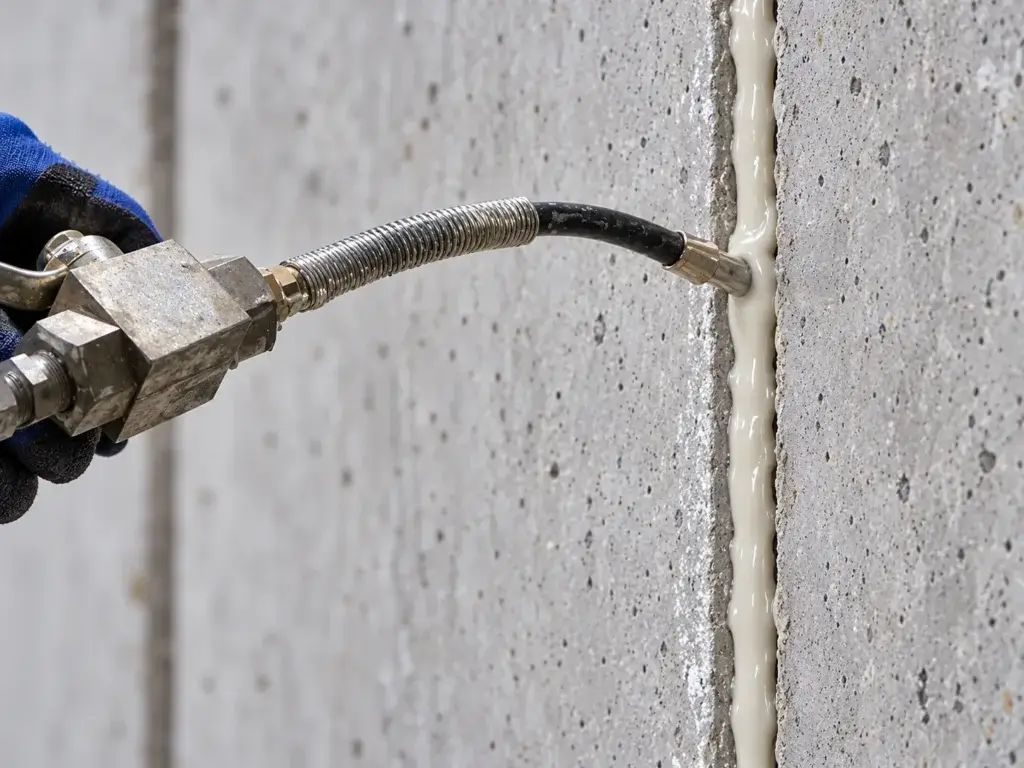
1. Why Is Surface Crack Width Not Enough to Predict Grout Penetration?
Surface crack width is useful information, but it represents only one visible section of the injection path.
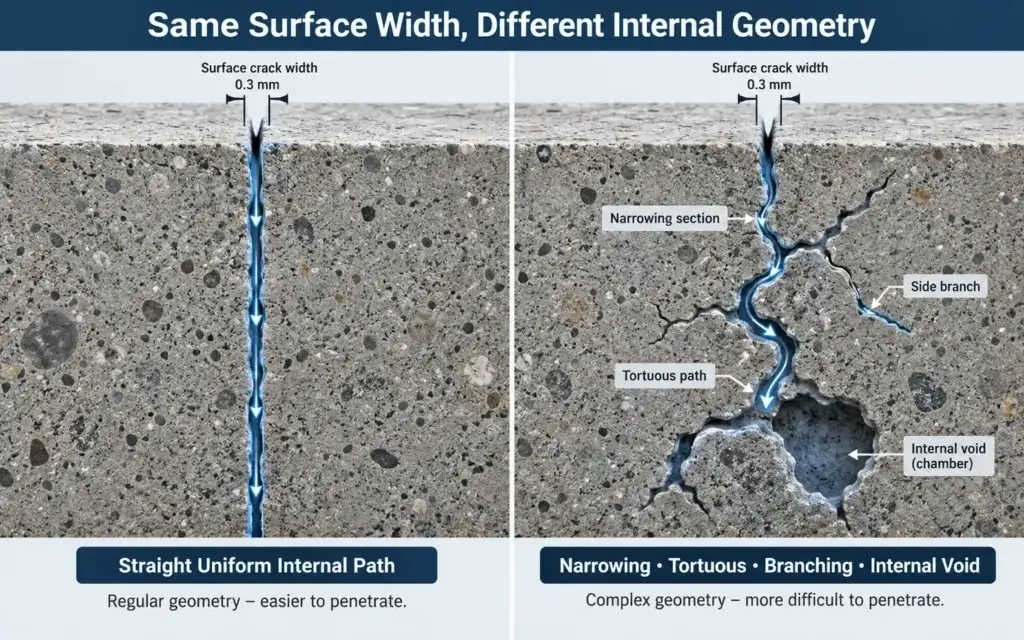
Two joints may show a similar surface opening while having very different internal geometries. One may remain relatively straight and uniform. The other may narrow below the surface, change direction, divide into branches, or connect to another internal space.
That difference matters because the grout must travel through the entire available pathway, not just cross the visible entrance.
The visible crack width is an entrance measurement, not a complete map of the injection path.
A surface measurement may help describe the initial opening, but it cannot by itself identify the narrowest internal point, hidden branches, tortuosity, roughness, connected cavities, or whether the expected pathway remains continuous.
This is also why a penetration problem should not immediately be diagnosed as “the grout is too viscous.” The internal pathway may be contributing just as much to the observed injection behavior.
2. How Does Changing Aperture Affect Grout Distribution?
A joint does not necessarily maintain one consistent opening from the injection point to the target area.
Its internal aperture may increase or decrease along the pathway.
A relatively uniform opening provides a simpler geometric condition, although material properties and site conditions still determine how the grout behaves.
A wide surface entrance that narrows internally is more difficult to interpret. The grout may initially enter easily but encounter a restrictive section deeper inside the joint. Whether it continues through that section depends on the material’s flow behavior, reaction window, pressure conditions, and the shape of the restriction.
The opposite condition can also occur. A narrow entrance may connect to a larger internal cavity. Once the material reaches that space, the local spread pattern and grout take can change significantly. An unexpected increase in material consumption does not automatically mean the grout is being wasted; it may indicate that the connected internal space is larger than the visible crack suggested.
Importantly, aperture does not affect every grout system in exactly the same way.
An experimental study on grouted concrete cracks investigated crack aperture, roughness, grouting pressure, and materials including polyurethane and epoxy resin. Under those specific test conditions, changes in crack geometry affected the tested materials differently.
The study should not be interpreted as evidence that one grout chemistry is universally superior to another. The more useful conclusion is that the practical effect of joint geometry can differ between grout systems.
For that reason, crack aperture alone is not enough to rank polyurethane, epoxy, acrylate, polyurea, microcrystalline polyurea, or other injection materials.
3. What Happens When a Crack or Joint Branches?
A straight path gives grout one main direction to follow. A branching joint creates several possible routes.
That turns penetration into a distribution problem.
If one internal crack divides into several branches, the grout should not be assumed to divide evenly between them. Those branches may differ in opening, length, orientation, roughness, connectivity, water movement, obstruction, or downstream void space.
As a result, one pathway may accept grout more readily while another remains poorly filled.
A branching joint creates competing flow paths; equal distribution should not be assumed.
This helps explain a common field observation: grout introduced at one packer may appear at an unexpected leakage point or adjacent packer instead of travelling in the direction suggested by the visible surface crack.
For the contractor, the important point is that a crack should not be treated as a simple pipe. What appears to be one line at the surface may form a much more complicated pathway inside the structure.
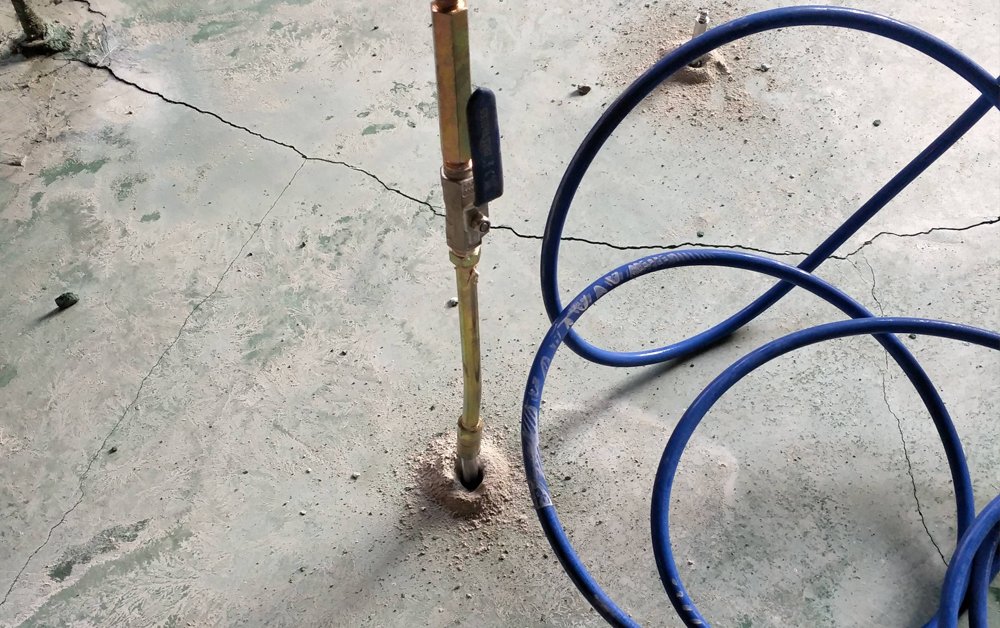

4. Why Do Tortuosity and Surface Roughness Matter?
Not every internal joint follows a straight route. A pathway may bend, offset, curve, or repeatedly change direction. This is commonly described as tortuosity.
A target may appear to be a short straight-line distance from the injection point while the actual internal route is considerably longer and less direct.
The geometric distance from the packer to the target is not necessarily the actual flow distance the grout must travel.
That matters because the material must remain capable of useful movement throughout the real path, not simply across the straight-line distance visible on a drawing or concrete surface.
Surface roughness creates another type of geometric complexity. Real concrete crack faces are not two perfectly smooth, parallel plates. Local protrusions, depressions and irregular openings can change the filling environment and create nonuniform grout distribution.
The experimental concrete-crack study referenced above also found that different grout systems did not respond to aperture and roughness in exactly the same way.
It would therefore be too simplistic to say that a rougher crack automatically means poorer penetration.
A more accurate conclusion is: Roughness changes the flow and filling environment, while the final effect depends on grout chemistry and project conditions.
This is another reason two materials with similar initial viscosities should not automatically be expected to distribute identically through the same irregular joint.
5. How Do Connected Voids and Discontinuities Change Grout Spread?
Joint geometry also determines whether the available pathways are actually connected.
A narrow crack can lead into a larger internal cavity. When grout reaches that space, the local volume demand may increase and the material may spread in directions that were not obvious from the surface.
This can appear during injection as greater-than-expected grout take, communication with another outlet, or material emerging at a location away from the visible crack line.
The opposite problem occurs when the expected pathway is obstructed or poorly connected to the target area. Previous repair material, local closure, debris, or an internal discontinuity may restrict access even when adequate pumping equipment is available.
In that situation, increasing pressure does not guarantee that the grout will reach the intended zone.
The material may instead enter another connected pathway, emerge somewhere unexpected, or produce a pressure response indicating that the original assumption about the internal crack path was incomplete.
The key question is therefore not only whether a crack exists, but whether there is a usable connected pathway between the injection point and the area that needs to be treated.
6. How Does Joint Geometry Interact with Viscosity, Working Time, and Injection Pressure?
Joint geometry does not act independently from the material or the injection setup.
Viscosity describes the material. Geometry describes the pathway. Pressure provides the driving force. Working time limits how long useful movement can continue.
Lower viscosity may improve the potential for movement through restrictive pathways, but it does not remove narrowing, branching, roughness, tortuosity, obstruction, or poor connectivity.
For a deeper explanation of the material side of this relationship, see our guide on how injection grout viscosity affects penetration.
Working or gel time introduces a different limitation. A long or complex path may require the material to remain mobile for longer than a short, direct route. A grout that begins reacting before it has travelled through the required pathway may show good initial flow but still provide incomplete distribution.
Pressure provides the force needed to move grout, but it should not be treated as a universal correction for poor penetration. The practical relationship is best summarized as follows:
Penetration is a system outcome, not the result of one parameter acting alone.
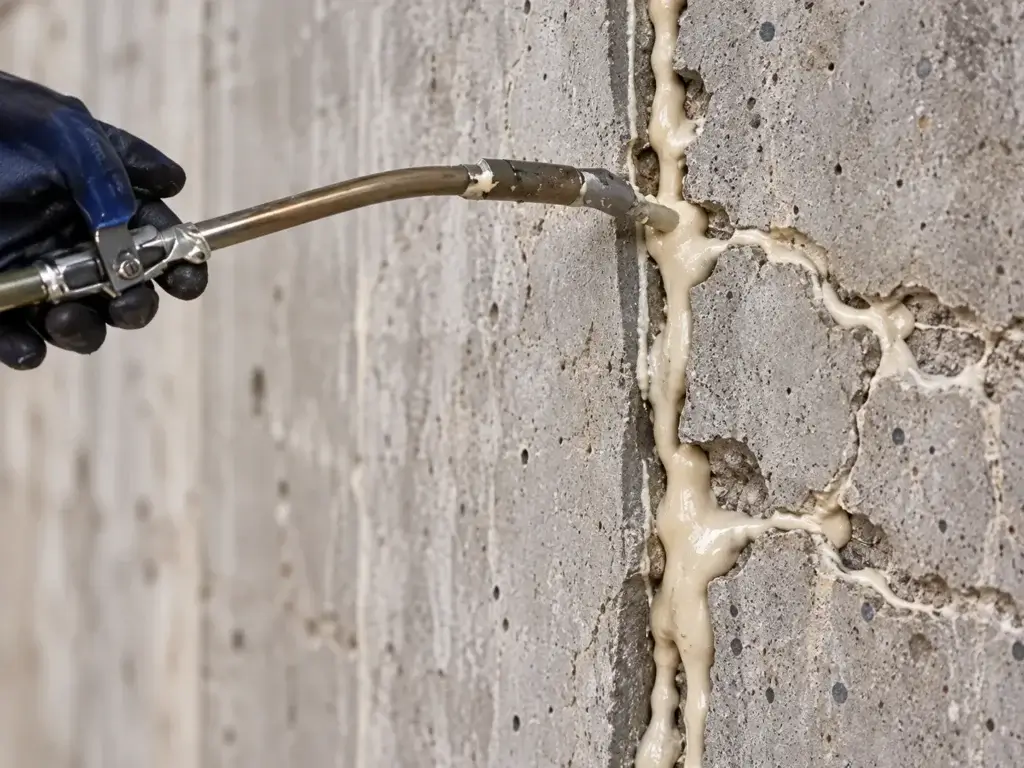
7. How Should Contractors Evaluate an Unknown Injection Path Before Full-Scale Grouting?
The main difficulty with joint geometry is that most of it is hidden.
Surface inspection can provide useful evidence, but it rarely gives a complete three-dimensional picture of the internal pathway. The practical objective is therefore to reduce uncertainty before making major assumptions about material performance or injection strategy.
What Can Be Observed Before Injection?
Useful site information includes visible joint width and direction, obvious branching, leakage points, water movement, previous repairs, known drilling information, and whether the joint is static or subject to movement.
These observations establish an initial picture of the problem, but they do not prove what happens deeper inside the structure.
What May Still Be Unknown?
Important uncertainties can include internal narrowing, hidden branches, tortuosity, changing roughness, larger voids, obstructions, or poor connectivity.
What Can the Injection Response Tell You?
Where project conditions justify a limited initial or trial injection, pressure development, grout take, communication between packers, material appearing at leakage outlets, and unexpected grout emergence may provide additional clues about the internal pathway.
These observations do not reveal the exact geometry. They provide project-specific evidence that helps test whether the original injection assumption remains reasonable.
When Should the Injection Plan Be Reconsidered?
If the actual response is significantly different from the expected one, automatically increasing pressure is not necessarily the next step.
The contractor may need to reconsider the injection point, packer spacing, sequence, material behavior, water condition, or the possibility of an unexpected internal pathway.
That is where field observation becomes more useful than relying on a single TDS value.
Joint Geometry vs. Injection Behavior
| Joint Geometry | Likely Engineering Concern | What to Check Next |
| Relatively straight, uniform path | Comparatively simple flow condition | Viscosity and usable working time |
| Narrowing path | Local flow restriction | Narrowest accessible section and injection response |
| Branching path | Uncertain grout distribution | Connectivity, water movement and grout emergence |
| Tortuous path | Longer effective travel route | Working time and pressure response |
| Rough internal surface | Irregular local filling behavior | Grout chemistry and injection response |
| Narrow entrance connected to larger void | Sudden change in grout take | Injected volume and outlet communication |
| Obstructed or discontinuous intended path | Incomplete access to target zone | Connectivity, injection point and injection sequence |
This table is a diagnostic framework, not a formula. Real injection behavior depends on the interaction between joint geometry, material properties, water conditions, temperature, injection conditions and the repair objective.
Illustrative Engineering Example: Same Surface Width, Different Internal Path
Consider two concrete joints with approximately the same visible surface opening.
Joint A remains relatively straight, reasonably uniform, and continuous.
Joint B narrows below the surface, changes direction, divides into branches, and eventually connects to a larger internal void.
Even if the same grout and a similar injection setup are used, there is no sound reason to expect identical distribution.
Joint A presents a simpler pathway. Joint B introduces changing restriction, a longer effective travel route, competing branches, and a larger connected volume.
The important lesson is not that Joint B will produce one specific result. It is that the same surface crack width does not justify assuming the same penetration behavior.
This is an illustrative engineering example, not a YURU project case or laboratory result.
Frequently Asked Questions
Does a Wider Crack Always Allow Deeper Grout Penetration?
No. A wider visible opening may provide easier initial access, but the grout still has to pass through the internal pathway. Narrowing, branching, tortuosity, obstruction, working time, viscosity, pressure and water conditions can all affect how far it ultimately travels.
Can I Select Injection Grout Based on Crack Width Alone?
No. Crack width is useful information, but material selection should also consider the internal pathway, water condition, joint movement, required penetration, working or gel time, cured material behavior and the purpose of the repair. Different grout chemistries may also respond differently to similar joint geometry.
Can Higher Injection Pressure Overcome a Narrow or Tortuous Joint?
Not necessarily. Higher pressure increases the available driving force, but poor connectivity, obstruction, early reaction, material rheology and complex geometry can still limit distribution. Pressure should be evaluated as part of the entire injection system rather than used as a substitute for understanding the pathway.
How Can Contractors Know the Internal Geometry of a Concrete Joint?
The complete internal geometry usually cannot be determined from surface inspection alone. Visible crack patterns, leakage points, drilling observations, previous repairs and injection response can provide useful evidence. Where appropriate, limited initial injection or further project-specific investigation can help reduce uncertainty.
Need Help Evaluating an Injection Path?
For a technical material-selection review, useful project information includes crack or joint photos, visible width, estimated depth, expected injection distance, leakage and water conditions, whether the joint is static or moving, previous repair history, site temperature, the current material or TDS if one has already been selected, and any unusual pressure or grout-take observations.
YURU Waterproof can use this information to help compare the project conditions with the available injection material options and identify the technical questions that should be checked before full-scale injection.
Send Your Injection Conditions or Request Injection Material Selection Support.
Technical Review: YURU Waterproof Technical Team
This article explains general engineering principles related to injection grout distribution and joint geometry. Exact viscosity, working time, reaction behavior, injection conditions, and application limits should be confirmed from the technical documentation for the specific grouting material and the requirements of the individual project.
YURU Product solutions