What Should Distributors Check Before Approving a Private-Label Injection Grout?
Quick Answer
Before approving a private-label injection grout, distributors should confirm the product’s application fit, approved technical specification, TDS and SDS, sample-to-bulk consistency, batch traceability, packaging and labeling, supply terms, and the rules for future product changes. Private-label approval should cover the product behind the brand, not only the artwork on the container.
What Should Distributors Check Before Approving a Private-Label Injection Grout?
Putting your logo on an injection grout is relatively easy. Approving the product behind that logo is the more important part.
For distributors, private-label approval should extend beyond packaging design, logo placement, minimum order quantity, or artwork printing capability. Prior to commercial production, distributors should verify:
- What product has been approved?
- Which specification defines it?
- What documentation supports it?
- How will future batches be controlled?
- How will complaints be traced?
- Is the finished package suitable for the destination market?
Private-label approval is not just packaging approval; it is product, specification, evidence, consistency, labeling, and supply approval.
The goal is not to create unnecessary paperwork. It is to make sure that the product sold under your brand remains identifiable, repeatable, and suitable for the market you intend to serve.


1. Is the Injection Grout Actually Suitable for Your Target Application?
The first question should not be:
Can the supplier print my logo?
It should be:
Is this injection grout actually suitable for what my customers will use it for?
Injection grout is not a single interchangeable material category. Polyurethane, acrylate, epoxy, standard polyurea, microcrystalline polyurea, and other systems can differ significantly in viscosity, reaction behavior, flexibility, expansion, bonding, water response, penetration, and cured performance.
That means distributors should first define the intended use:
- What type of crack or joint will be treated?
- Is the structure dry, damp, seeping, or exposed to active water?
- Is joint movement expected?
- Is the objective penetration, flexible sealing, water stopping, or structural bonding?
- What reaction or working behavior does the application require?
A material should be approved against the intended application, not simply because its general product category sounds familiar.
Private-label approval starts with application fit, not artwork approval.
This is also why different injection grout families should retain their own technical boundaries. A product suited to a moving joint should not automatically be presented as a structural crack-repair resin, and a flexible injection material should not automatically be marketed as an emergency high-pressure water-stop product.
2. What Product Specification Does the Approved Sample Represent?
A common workflow is:
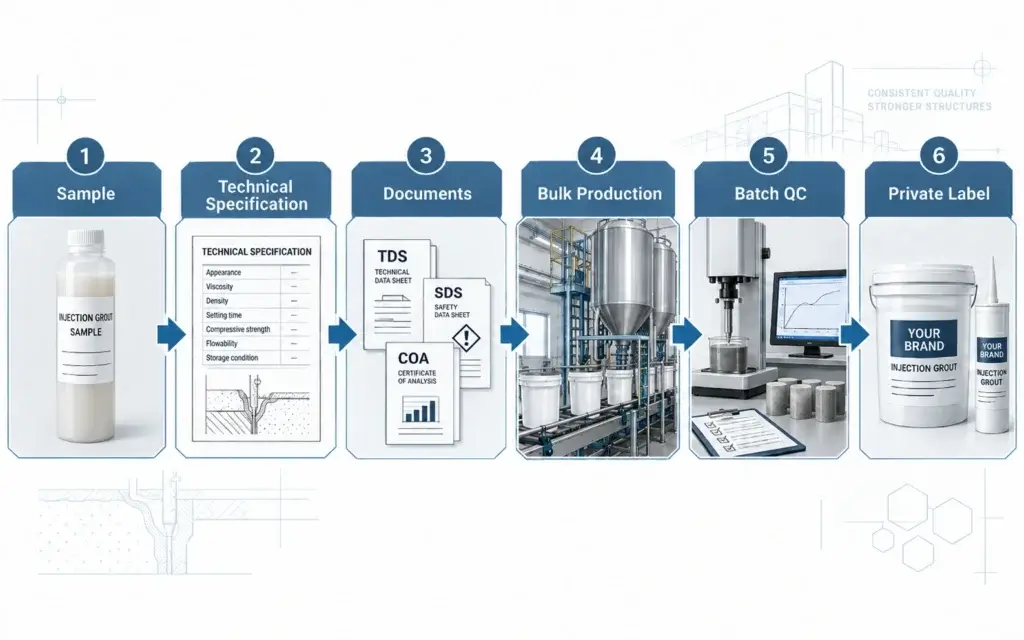
Sample received → sample tested → sample accepted → bulk order placed
One step is often missing:
- What written product specification does that sample represent?
A physical sample is useful, but it is not a complete commercial specification.
Depending on the injection grout system, the approved baseline may include items such as:
- appearance;
- density;
- viscosity;
- working, reaction, gel, or curing time;
- solid content;
- expansion behavior;
- flexibility or elongation;
- bonding properties;
- packaging size;
- storage conditions;
- and other product-specific technical ranges.
Not every grout needs the same parameters. A foaming polyurethane grout, an acrylate gel, an epoxy injection resin, and a flexible polyurea grout should not be approved against one generic parameter list.
Quality-management principles emphasize the use of controlled specifications, instructions, inspection plans, and retained records to define requirements and provide evidence of results. The useful procurement lesson is that the approved product should be described by something more durable than an informal sample comparison.
A distributor should not approve only the sample; the distributor should approve the specification that the sample represents.
That specification becomes the baseline against which future commercial production can be reviewed.

3. Have You Reviewed the TDS, SDS, and Batch-Specific Quality Documents Separately?
These documents address different questions and should not be regarded as interchangeable.
| Document | Main Question It Answers | What It Does Not Prove |
| TDS | What technical properties, intended uses, and application information does the supplier declare? | That every future production batch will automatically be identical |
| SDS | What chemical hazards and safe-handling requirements apply? | Injection performance |
| COA / Batch QC Record | What was checked for a specific production batch? | Application suitability by itself |
TDS
A TDS is generally the manufacturer’s technical document for the product. It may include declared properties, intended applications, technical parameters, application guidance, storage information, and test data.
Because TDS formats are not universally standardized in the same way as SDS formats, distributors should look at the details rather than simply confirm that a TDS exists.
Check whether:
- the document revision is current;
- units are clear;
- values are identified as typical values or specification limits;
- relevant test methods are stated;
- and important test conditions are included where they affect interpretation.
SDS
An SDS has a different purpose. It is primarily a hazard-communication and safe-handling document.
OSHA’s Hazard Communication Standard establishes SDS and labeling requirements for applicable hazardous chemicals in the United States, addressing chemical identification, hazards, handling and storage, exposure controls, first aid, firefighting, stability, and toxicological information.
The SDS explains hazards and safe handling; it does not substitute for technical performance data or batch-specific quality records.
COA or Batch QC Record
A COA connects test results to a specific sample or production batch. WHO defines a certificate of analysis around tests performed, results obtained, acceptance criteria applied, and specification compliance. FDA’s Q7 guidance similarly associates COAs with batch identity, tests, acceptance limits, and numerical results where applicable.
These WHO and FDA examples originate from regulated pharmaceutical manufacturing. They illustrate batch-specific quality-control principles; they do not imply that pharmaceutical GMP requirements apply to injection grout.
For distributors, the practical question is simpler:
What batch-specific quality information can the supplier provide, and how does it relate to the specification you approved?
4. How Will You Verify Sample-to-Bulk and Batch-to-Batch Consistency?
Once the approval baseline is defined, the next question is whether future production continues to meet it.
There are two different consistency checks.
Sample-to-Bulk Consistency
Does the first commercial production batch still correspond to the product that was approved during sample evaluation?
Batch-to-Batch Consistency
Do later orders continue to meet the same agreed specification?
Before launch, a distributor should understand:
- which specification controls production;
- which key properties are checked before release;
- which results are recorded by batch;
- what batch-specific QC information is available;
- and what happens if an important result falls outside the agreed range.
A good sample is therefore the beginning of approval, not proof that every future batch will automatically match.
The approved sample establishes the baseline; future production should be checked against the specification behind that baseline.
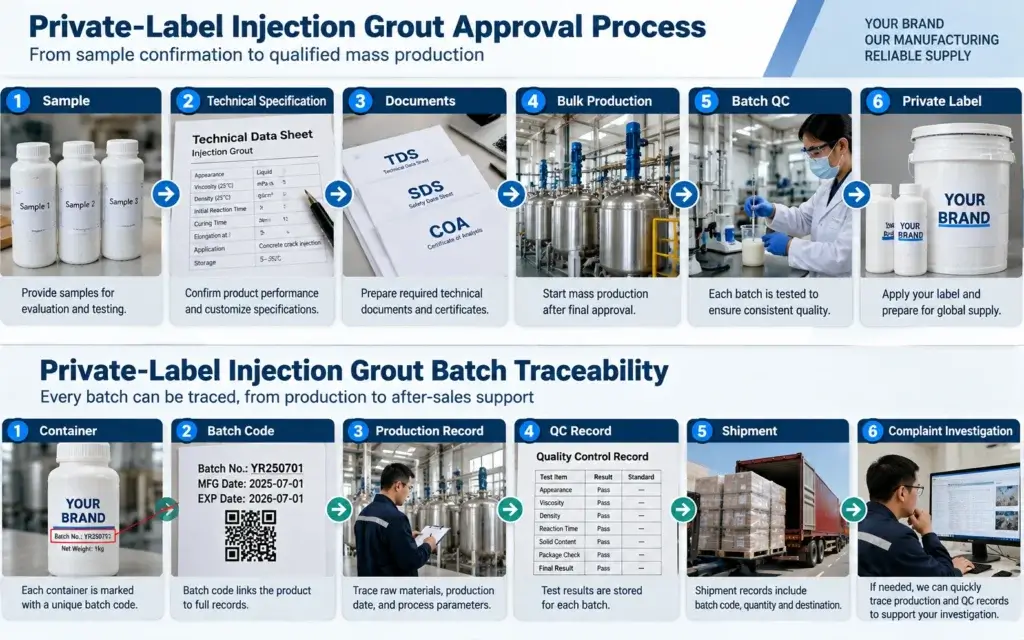
5. Can Every Private-Label Batch Be Traced Back to Its Production Records?
Consistency tells you whether a batch meets the approved baseline.
Traceability answers a different question:
- Which batch is this product actually from?
A useful private-label traceability chain looks like this:
Private-label container
→ Batch or lot identifier
→ Production batch
→ Relevant production / QC records
→ Shipment
→ Customer complaint
WHO quality terminology defines a batch number as a distinctive identifier that can connect a batch with labels, batch records, and corresponding certificates of analysis. FDA’s regulated manufacturing guidance similarly uses distinctive batch or receipt codes to identify material and record its status. Again, these are regulated-manufacturing examples, but the traceability principle is broadly useful.
Illustrative Complaint Example
Suppose a contractor reports:
“This shipment is curing differently from the previous one.”
With a batch identifier, the distributor can ask:
- Which production batch was supplied?
- Are other complaints connected to the same batch?
- What QC information exists for that batch?
- Was there a storage or transport issue?
- Was any specification or production change made?
Without a usable batch identifier, it becomes much harder to distinguish between a single-container problem, a storage issue, a shipment problem, a batch issue, or a broader product-specification problem.
This is an illustrative example, not a YURU complaint case.
Batch identification allows a private-label product to be linked back to production and quality records when a complaint or quality question occurs.

6. Are the Packaging and Label Approved for Both Branding and Market Requirements?
Private-label packaging approval has two parts.
One is commercial.
The other concerns the information required for the destination market.
Commercial Packaging Approval
The commercial review may include:
- brand name;
- logo;
- product name;
- package size;
- net content;
- container type;
- closure;
- barcode;
- artwork;
- language;
- and distributor or importer information where relevant.
YURU can support private-label packaging and label customization for injection grout projects, but the final package should be confirmed for the actual product and target market rather than copied automatically from another order.
Hazard and Destination-Market Review
Where chemical hazard-labeling rules apply, branding cannot be reviewed separately from the required hazard information.
For example, OSHA requires applicable shipped hazardous-chemical containers in the United States to carry elements such as the product identifier, signal word, hazard statements, pictograms, precautionary statements, and responsible-party information. European requirements follow a different regulatory framework, and ECHA publishes country-specific language requirements for labels and safety data sheets.
So these are two different questions:
- Can the supplier print my label?
and:
- Has the final label been reviewed for the market where I plan to sell the product?
A supplier’s ability to print your brand does not by itself prove that the finished product or label is ready for your market.
Label, SDS, language, importer, hazard-communication, and other applicable requirements should therefore be checked for the actual destination market before final artwork approval.
7. Have the Commercial Supply Conditions Been Approved Before Launch?
A product can pass the technical review and still create problems for a distributor if the supply model is unclear.
Private-label programs may introduce additional conditions around:
- product MOQ;
- packaging MOQ;
- printed-label MOQ;
- production lead time;
- reorder lead time;
- packaging inventory;
- shelf-life information;
- storage requirements;
- shipping conditions;
- and document availability.
These are commercial questions, but they directly affect whether the product can be sold reliably.
For example, the MOQ for a chemical formulation and the MOQ for a custom printed container may not be the same. Packaging may also add lead time to repeat orders even when the chemical product itself is available.
For YURU private-label projects, MOQ and lead time should therefore be confirmed for the specific product, formulation, package, and label configuration rather than assumed from a previous order.
A technically approved private-label product can still fail commercially if reorder conditions are unclear.
Before launch, distributors should know not only how to place the first order, but how the second and third orders will work.
8. What Changes Require Notification or Re-Approval After Launch?
Approval should also define what happens when something changes later.
Changes that may be relevant include:
- formulation or product grade;
- an important technical range;
- packaging;
- label or safety information;
- manufacturing conditions that may affect the approved product;
- or another supply change that could alter what the distributor originally accepted.
Not every change automatically makes a product unsuitable.
The issue is whether the distributor is informed and has an opportunity to review a change that may affect the approved commercial product.
Quality systems use change-control principles for exactly this reason: changes to composition, manufacturing, quality controls, or labeling may need to be evaluated because they can affect an already approved state. WHO defines change control within its regulated-product framework around formal evaluation of changes that may affect validated or approved conditions.
For a private-label injection grout program, the practical version is much simpler:
If something important changes after approval, the distributor should know before the revised product enters the market under its brand.
Private-label approval should define which future product, specification, packaging, or label changes require notification or re-approval.

Private-Label Injection Grout Approval Matrix
| Approval Area | What to Confirm | Evidence / Record |
| Application Fit | Intended use matches product capability | TDS + technical review |
| Product Specification | Approved grade and technical ranges are defined | Agreed specification |
| Sample | Sample represents the intended commercial product | Sample approval record |
| Safety Documentation | Applicable hazards and handling are documented | Current SDS |
| Batch Quality | Batch-specific checks can be reviewed | COA / QC record where applicable |
| Traceability | Supplied product can be linked to a production batch | Batch / lot identifier |
| Packaging | Container, size, and closure are approved | Packaging specification |
| Label | Artwork and required information are reviewed | Final approved artwork |
| Market Review | Destination-market requirements are checked | Destination-market compliance review |
| Supply | MOQ, lead time, and reorder terms are clear | Commercial agreement |
| Change Control | Notification and re-approval rules are agreed | Supplier agreement |
This matrix is a procurement framework, not a universal legal checklist. Exact technical, documentation, labeling, and market requirements depend on the grout chemistry and destination market.
Before You Approve the Product
Confirm these ten points before moving into commercial production:
- Does the grout fit the intended application?
- Which written specification does the approved sample represent?
- Are the TDS and SDS current?
- What batch-specific QC information is available?
- How is each production batch identified?
- How will bulk production be checked against the approved specification?
- Is the final packaging approved?
- Has the label been reviewed for the destination market?
- Are MOQ, lead time, and reorder conditions clear?
- Which future changes require notification or re-approval?
If one of these cannot yet be answered, resolve it before treating the private-label product as fully approved.

FAQs
Is a Good Sample Enough to Approve a Private-Label Injection Grout?
No. A successful sample shows that the tested material may be suitable under the conditions evaluated, but it does not define every future commercial batch.
The sample should be tied to an agreed product specification that can be used as the baseline for bulk production.
What Is the Difference Between a TDS, SDS, and COA?
They should be assessed together. Initial viscosity governs how readily grout begins to flow, while working time determines how long useful flow can continue.
Does a Private-Label Supplier Need to Provide a COA for Every Batch?
There is no single universal global rule requiring every construction chemical in every market to use the same COA format.
The distributor should agree with the supplier on what batch-specific quality information is required for the product and destination market. A COA is one common way to report batch-specific tests and results, but the required format and scope may differ.
Can the Same Private-Label Label Be Used in Every Country?
Not necessarily.
Language, hazard communication, importer or responsible-party information, and other labeling requirements can differ by jurisdiction. The final artwork should therefore be reviewed for the actual destination market before production.
Planning a Private-Label Injection Grout Program?
For a technical private-label review, useful information includes:
- destination market;
- target application;
- preferred injection grout family;
- required technical properties;
- sample requirements;
- packaging size;
- label language;
- branding requirements;
- expected order quantity;
- and any existing technical specification used in your market.
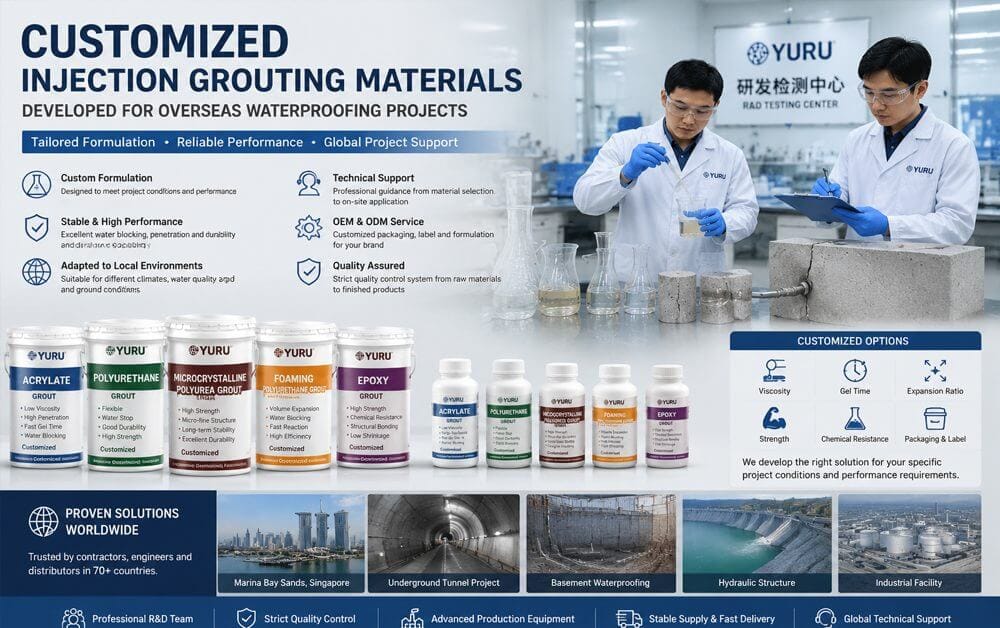
YURU Waterproof supports OEM/ODM and private-label injection grout projects with product-selection support, packaging and labeling customization, technical documentation, and product-specific customization depending on the material and project requirements.
Technical Review
Reviewed by: YURU Waterproof Technical Team
This article provides general procurement and private-label approval guidance. Technical specifications, hazard communication, labeling, documentation, and market-entry requirements should be verified for the specific grout system and destination market before commercial production.
YURU Product solutions