How Does Injection Grout Viscosity Affect Penetration into Concrete Joints?
When comparing injection grouts, the lower-viscosity product often looks like the obvious choice for deeper penetration.
This conclusion, however, may be incorrect.
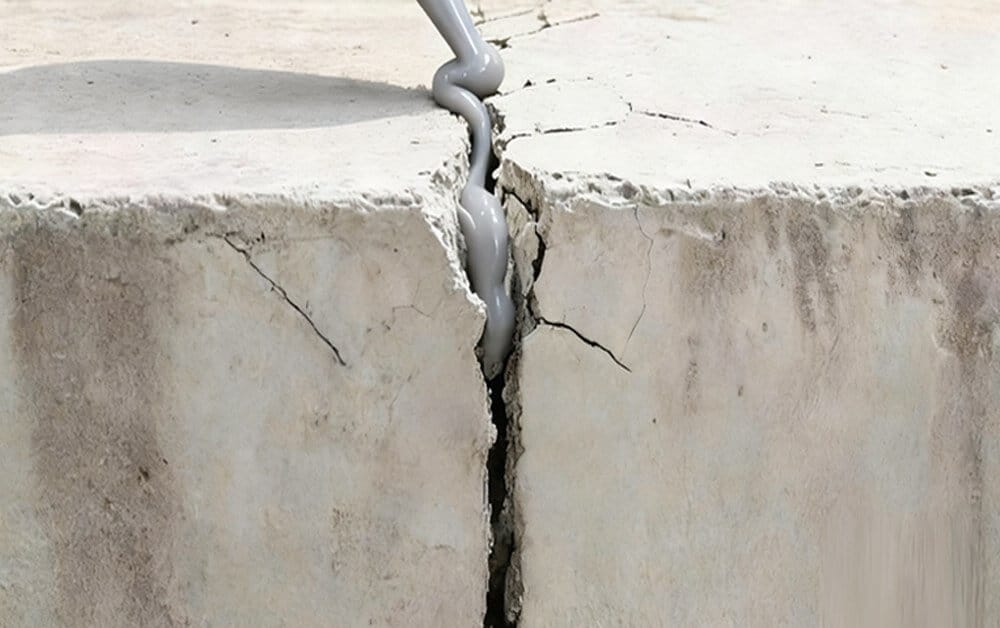
Lower viscosity can facilitate entry into narrow cracks, joints, and connected voids. However, penetration depends on more than the initial viscosity reported on a TDS. Working time, viscosity development, joint geometry, water conditions, injection pressure, material chemistry, and repair objectives all influence actual behavior within the concrete.
In engineering terms, viscosity and penetration are related, but they are not interchangeable.
Viscosity describes resistance to flow. Penetration describes whether the grout can actually travel through the required pathway under real project conditions.
The best injection grout is not simply the one with the lowest viscosity. It is the one whose flow behavior, reaction window, and cured performance match the injection path and repair objective.


Quick Answer: Does Lower Viscosity Mean Deeper Grout Penetration?
Lower viscosity generally provides injection grout with greater potential to penetrate narrow cracks, fine joints, and interconnected pathways, owing to reduced flow resistance.
But actual penetration also depends on:
- working time or gel time;
- how quickly viscosity changes after injection begins;
- crack or joint geometry;
- required injection distance;
- water condition;
- injection pressure;
- packer arrangement;
- grout chemistry;
- final repair objective.
A low initial viscosity is useful only if the material remains suitably injectable long enough to reach the target area.
The International Concrete Repair Institute defines grout penetrability as the ability of a grout to fill a porous mass and notes that it is primarily related to lubricity and viscosity.
1. What Does Viscosity Actually Tell Me About an Injection Grout?
Viscosity is the resistance a material offers to flow.
In practical injection work, lower viscosity generally means the material can begin moving through a narrow pathway more easily. Higher viscosity produces greater resistance to that movement.
The number itself is only useful when the test conditions are understood.
When comparing two technical data sheets, check:
- reported viscosity;
- test temperature;
- test method;
- whether the value refers to freshly mixed material;
- whether the grout changes rapidly after mixing or reaction begins.
This matters because resin viscosity can change with temperature and time.
A value measured under one laboratory condition should not automatically be treated as equivalent to another value generated under different conditions.
- A viscosity number without its test conditions is a weak basis for comparing injection grouts.
ASTM D4016, a laboratory method for measuring chemical-grout viscosity, makes an especially important point: viscosity by itself is not necessarily an exact measure of grout penetrability.
That principle is central to material selection.
2. Why Can Lower Viscosity Help Grout Enter Narrow Cracks and Joints?
A narrow pathway creates greater resistance to grout movement.
When the material itself has lower resistance to flow, it generally has better potential to:
- enter narrow crack openings;
- spread through connected fine channels;
- move through irregular pathways;
- travel farther before flow resistance becomes excessive.
That is why low-viscosity injection resins are often considered for fine-crack work.
The important word is potential.
Final penetration still depends on what happens after the grout enters the structure.
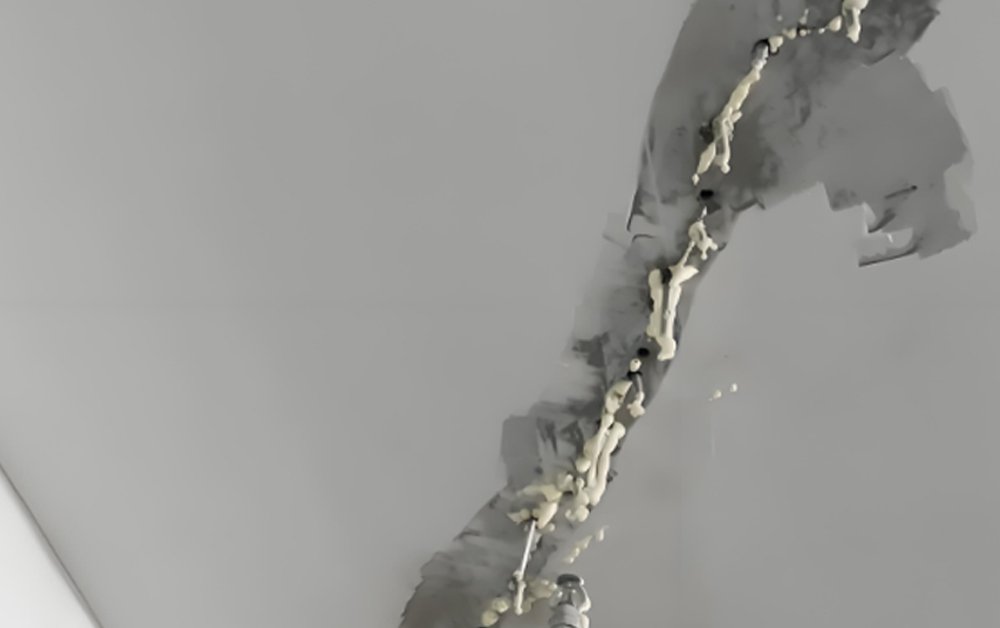
Crack Width Is Only the Entrance
Visible crack width is useful, but it does not describe the entire internal path.
A crack may:
- widen below the surface;
- split into several branches;
- connect to another void;
- contain debris or deposits;
- narrow deeper inside;
- stop unexpectedly.
A visible joint can behave the same way.
- The visible crack width describes the entrance condition, not the complete injection pathway.
Surface width alone is therefore a weak basis for selecting grout viscosity.
3. Why Is the Lowest Viscosity Not Always the Best Choice?
Penetration is only one stage of the repair.
The material still has to remain within or fill the intended repair zone and provide the required cured performance.
Penetration Is Not the Same as Repair Performance
Different projects may require:
- waterproof sealing;
- flexible joint sealing;
- bonding of a static crack;
- void filling;
- leakage control;
- movement accommodation.
A grout that flows easily may still be unsuitable if its cured properties do not match the repair objective.
Good penetration does not automatically mean good material selection.
The Flow Path May Be Difficult to Control
In open or highly connected void systems, very easy flow can also allow material to migrate away from the intended zone.
That makes pathway geometry important before injection begins.
Even when two grouts have similar viscosity, penetration can still differ if the internal joint path narrows, branches, becomes tortuous, or connects to larger voids. See our guide on how joint geometry affects injection grout penetration.
Chemistry Determines What Happens After Entry
Polyurethane grout, acrylate grout, epoxy injection resin, standard polyurea grout, and microcrystalline polyurea grout are not interchangeable systems.
Similar viscosity values do not mean they will:
- react the same way;
- tolerate the same water conditions;
- cure at the same rate;
- provide the same flexibility;
- deliver the same bonding behavior.
Viscosity helps evaluate flow. Chemistry determines much of the behavior before, during, and after the material reaches the target.
4. Initial Viscosity and Working Time Must Be Evaluated Together
A single viscosity number tells only part of the injection story.
Initial Viscosity
Initial viscosity indicates how easily the grout starts to move.
Working Time, Gel Time, or Reaction Window
The usable reaction window determines how long that movement can continue.
This distinction matters.
- Initial viscosity tells me how the grout starts to move. Working time tells me whether it can keep moving long enough to reach the target.
A material can begin with low viscosity but still provide poor deep penetration if its viscosity rises too quickly during injection.
For a short local repair, that may not be critical.
For a deep or branching pathway, it can be.
Viscosity Can Change During Injection
Flow behavior may change after:
- mixing;
- contact with water;
- temperature change;
- chemical reaction;
- gelation or curing begins.
Two materials described as “low viscosity” can therefore behave very differently several minutes after injection starts.
The better question is not only:
- What is the initial viscosity?
It is:
- How long does the grout retain useful flow characteristics under the actual project conditions?
For polyurea systems specifically, temperature is one variable that can change the effective working window, so that relationship should be evaluated using polyurea-specific data rather than generalized across every injection grout family.

5. Joint Geometry Can Matter as Much as Viscosity
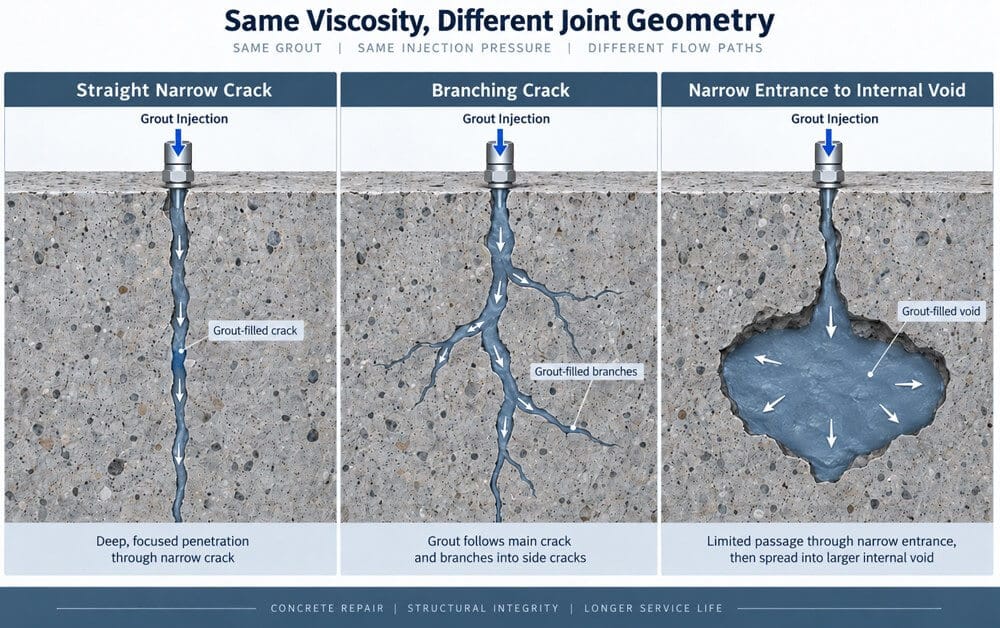
Injection pathways inside concrete are rarely simple straight lines.
They may include:
- straight narrow cracks;
- branching cracks;
- narrow entrances leading to larger voids;
- discontinuous joints;
- porous zones;
- connected cavities.
The same grout can behave very differently in each geometry.
Straight Narrow Crack
Lower viscosity may improve entry and movement if the material remains injectable long enough.
Branching Crack
The grout may divide between several paths, changing pressure distribution and material flow.
Packer location becomes more important.
Narrow Entrance with a Larger Internal Void
The entrance may demand good penetrability, but after the grout reaches the larger cavity, material volume and retention become more important.
Discontinuous Path
Higher pressure cannot create a continuous path if the internal crack is not physically connected.
Grout does not flow through the viscosity number printed on a TDS. It flows through a real three-dimensional pathway inside the structure.
6. How Do Water Conditions Affect Grout Penetration?
Water condition can change both material selection and injection behavior.
It is useful to distinguish:
- dry cracks;
- damp cracks;
- wet joints;
- seepage;
- moving water;
- severe active leakage.
Different grout chemistries react very differently under these conditions.
Polyurethane Grout
Many polyurethane injection systems are designed to interact with water, but polyurethane grouts are not all the same.
Hydrophilic and hydrophobic systems may behave differently, and viscosity should be reviewed together with:
- water condition;
- reaction speed;
- foaming behavior;
- working time.
A low starting viscosity alone does not tell the contractor what will happen after water contact.
Acrylate Grout
Acrylate grouts are often evaluated where very fluid injection behavior and access to fine pathways are important.
Viscosity should still be considered together with:
- gel time;
- water condition;
- final gel behavior;
- application objective.
Epoxy Injection Resin
For epoxy injection, viscosity is often important for crack penetration, but the repair objective frequently includes bonding.
Relevant factors include:
- crack condition;
- moisture compatibility;
- structural or bonding requirement;
- curing behavior;
- whether the crack is static or moving.
A low-viscosity epoxy may enter a fine crack effectively and still be the wrong choice for a movement joint.
Polyurea Grout
For standard polyurea injection grout, flow behavior should be evaluated together with working time and movement requirements.
Flexible movement joints such as deformation and expansion joints may require a different material logic from structural crack reinforcement or emergency high-pressure leakage control.
Microcrystalline Polyurea Grout
Microcrystalline polyurea grout should be treated as a separate material system.
Its viscosity, reaction behavior, working time, water response, and application limits should be evaluated from its own technical documentation.
Water condition is part of material selection, not merely an application detail after the grout has already been chosen.
7. Can Higher Injection Pressure Compensate for Higher Viscosity?
Only to a limited extent.
Higher injection pressure can increase the driving force behind the grout, but it cannot solve every cause of poor penetration.
Restricted penetration may result from:
- high viscosity;
- rapidly increasing viscosity;
- premature reaction;
- blocked pathways;
- incorrect packer positioning;
- discontinuous cracks;
- unsuitable material selection.
If the material has already lost the flow characteristics needed for the pathway, more pressure will not restore those characteristics.
- Injection pressure can help move grout, but it cannot compensate for every material or pathway mismatch.
Pressure also has engineering limits.
Excessive pressure may drive material into unintended areas or place unnecessary stress on the surrounding substrate.
Injection pressure should therefore be selected according to the structure, pathway, material system, equipment, and repair method.
8. How Does Viscosity Matter Across Different Injection Grout Families?
Viscosity should be interpreted within the context of the material chemistry.
| Injection Grout Family | Why Viscosity Matters | What Must Be Evaluated Together |
| Polyurethane Grout | Influences movement into cracks and voids before reaction develops | Hydrophilic/hydrophobic type, water condition, reaction speed, foaming behavior, working time |
| Acrylate Grout | Important for movement through fine pathways and leakage channels | Gel time, water condition, final gel behavior, application objective |
| Epoxy Injection Resin | Affects penetration into cracks before curing | Crack condition, bonding objective, moisture compatibility, cure behavior |
| Polyurea Grout | Influences flow before reaction limits further movement | Working time, movement requirement, flexibility, application boundary |
| Microcrystalline Polyurea Grout | Must be evaluated using its own material behavior | Product-specific viscosity, reaction, working time, water response, application limits |
This is not a ranking of which grout has the “best” viscosity.
Different material families solve different engineering problems.
The better question is:
Which combination of flow behavior, reaction, and cured properties fits the project?
9. What Should Buyers Check on a TDS Before Comparing Viscosity?
For procurement, the viscosity value should be read together with the conditions behind it.
The most useful checks are:
Viscosity Value
What value is reported?
Test Temperature
At what temperature was it measured?
Test Method
Was a recognized or comparable method used?
Working, Gel, or Reaction Time
How long does useful flow continue?
Application Temperature
What range does the product-specific documentation allow or recommend?
Water or Moisture Condition
Does the material require, tolerate, or react with water?
Relevant Cured Properties
Does the final material need flexibility, bonding, sealing ability, or another specific property?
Application Boundary
Is the material actually intended for this repair condition?
Do not compare two viscosity values until you know whether they were generated under comparable conditions.
That simple check can prevent a misleading product comparison.
10. Injection Grout Penetration Decision Table
Before choosing a grout, use the project conditions to interpret the viscosity value.
| Project Question | Why It Matters |
| How narrow is the entry path? | Helps determine the required initial flowability |
| How deep must the grout travel? | Longer paths may require a longer usable flow window |
| Is the pathway straight or branching? | Internal geometry changes grout distribution |
| Is water present or moving? | Water may change reaction behavior and material selection |
| Is the joint static or moving? | Determines the cured behavior required |
| What is the initial viscosity? | Indicates starting resistance to flow |
| How quickly does viscosity change? | Determines how long useful penetration can continue |
| What pressure can safely be used? | Influences movement but cannot correct every mismatch |
| What grout chemistry is being considered? | Different material families react and cure differently |
| What is the final repair objective? | Penetration alone does not determine suitability |
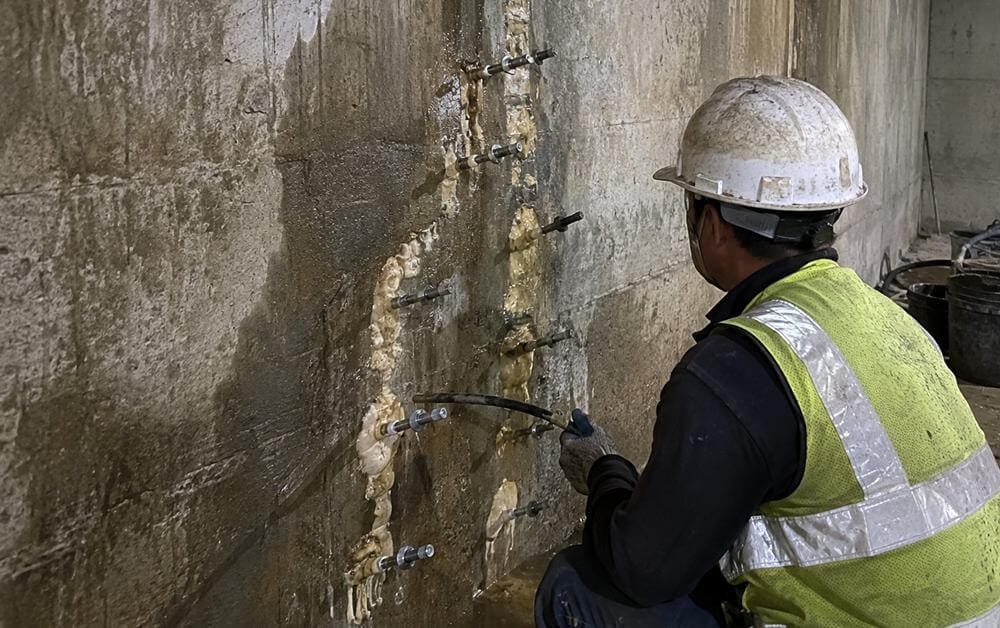
| Has a trial injection been completed? | Confirms actual behavior under project conditions |
A trial injection can be especially valuable when:
- the internal pathway is uncertain;
- water conditions are variable;
- the project temperature differs from laboratory conditions;
- the required penetration distance is long;
- a new material is being evaluated.
When Does Viscosity Matter Most?
| Project Situation | Importance of Viscosity | Other Critical Factor |
| Fine narrow crack | High | Working time |
| Long injection path | High | Reaction or gel window |
| Branching joint | High | Geometry and packer layout |
| Moving water | Medium to High | Material chemistry and water response |
| Movement joint | Medium | Cured flexibility |
| Static bonding crack | Medium | Adhesion and cured mechanical performance |
| Large connected void | Medium | Material retention and volume control |
This table helps explain why the “lowest viscosity wins” approach is unreliable.
A Practical Example: Why One Viscosity Number Is Not Enough
Assume Material A has a lower initial viscosity than Material B.
At first glance, Material A appears better for a deep concrete joint.
Then the project conditions show:
- a long injection path;
- several internal branches;
- moving water;
- a joint that continues to move after repair.
Now the comparison has to include:
- how long Material A remains injectable;
- whether water changes its reaction;
- whether it can fill the intended repair zone;
- what cured flexibility it provides;
- whether the material is intended for movement.
Material B may begin with slightly more resistance to flow but provide a longer usable injection window or more suitable cured behavior.
That does not make Material B automatically better.
It simply shows that:
Initial viscosity is one selection variable, not the selection decision itself.
FAQs:
Does Lower Viscosity Always Mean Better Grout Penetration?
No. Lower viscosity generally improves flow potential through narrow pathways, but working time, geometry, injection distance, water condition, pressure, and material chemistry also affect penetration.
What Is More Important: Viscosity or Working Time?
They should be assessed together. Initial viscosity governs how readily grout begins to flow, while working time determines how long useful flow can continue.
Can Higher Injection Pressure Overcome High Viscosity?
Only partly. Pressure can increase driving force, but it cannot correct premature reaction, blocked pathways, discontinuous joints, or an unsuitable material system.
Can I Directly Compare PU, Epoxy, Acrylate, and Polyurea Grout Viscosity?
Only with caution. Different grout families use different chemistries, test conditions, reaction mechanisms, cured properties, and application objectives. A lower number does not automatically indicate a better material.
Need Help Matching Injection Grout to Your Project?
If you are comparing polyurethane grout, acrylate grout, epoxy injection resin, polyurea grout, microcrystalline polyurea grout, or another injection material, viscosity should be only one part of the evaluation.
You can send YURU Waterproof:
- crack or joint type;
- approximate width;
- depth;
- expected injection distance;
- water condition;
- static or movement condition;
- project temperature;
- repair objective;
- current material specification or TDS;
- current viscosity data, if comparing an existing product.
Our technical team can review the project conditions and help compare relevant injection material options before sample testing or project use.
Technical Review
Technical Review: YURU Waterproof Technical Team
This article discusses general engineering principles for evaluating injection grout viscosity and penetration.
ICRI describes grout penetrability as a property related primarily to lubricity and viscosity, while ASTM D4016 specifically cautions that viscosity alone is not necessarily an exact index of grout penetrability.
Specific viscosity, working time, gel time, reaction behavior, moisture compatibility, application temperature, injection pressure, and application limits should always be confirmed using the current technical documentation for the exact injection material being considered.
Polyurethane grout, acrylate grout, epoxy injection resin, standard polyurea grout, and microcrystalline polyurea grout are different material systems. Technical properties or application boundaries from one family should not automatically be applied to another.
YURU Product solutions