
A high-fluidity liquid injection material designed to form a chemical damp-proof barrier against capillary rising moisture in masonry walls.
Single-component, solvent-free system for professional rising damp treatment in brick, stone and other porous masonry.
Active Ingredient Content
Water Absorption Reduction
Single-component System
Professional DPC Injection
Silane/Siloxane DPC Injection Material is a liquid chemical damp-proof course used to control rising damp caused by capillary moisture in masonry walls. After injection into drilled holes near the base of the wall, the material penetrates the porous masonry and forms a water-repellent chemical barrier that reduces further upward moisture movement.
YURU Premium Silane/Siloxane DPC Injection Material is a single-component system based on reactive polydimethylsiloxanes in emulsion. Its high fluidity and wettability help the material distribute through porous masonry while maintaining the original breathability and appearance of the treated wall.
Important Application Note
This product is specifically designed for capillary rising damp. Moisture caused by plumbing leaks, condensation, rain penetration or lateral groundwater pressure should be diagnosed separately before selecting a DPC injection treatment.
| System | Single-component |
| Base Chemistry | Reactive polydimethylsiloxanes in emulsion |
| Main Function | Chemical barrier against capillary rising damp |
| Active Ingredient Content | ≥85% |
| Water Absorption Reduction | ≥97% |
| Catalysis Time | Approx. 8–10 days |
Need complete technical parameters and application data?
A chemical DPC injection system targets moisture that rises through porous masonry by capillary action, helping interrupt the upward movement of water within the wall.
Moisture rises from the ground through the capillary pores of brick, stone and other porous masonry where an effective damp-proof course is missing or no longer performing as intended.
Rising moisture can transport soluble salts through masonry, leading to visible salt deposits on wall surfaces and contributing to ongoing deterioration.
Persistent dampness and salt movement can contribute to peeling, powdering or flaking plaster in the lower part of affected walls.
After the chemical barrier is established, further capillary moisture rise is reduced and the wall can begin to dry naturally over time.
Typical signs do not always mean rising damp
Damp staining, peeling finishes or salt deposits can have different causes. The moisture source should be identified before selecting a chemical DPC injection material.
See our guide on rising damp diagnosis before DPC injection.
Chemical DPC injection is intended for masonry affected by capillary rising damp. Suitability depends on the moisture source, wall construction, masonry type and the ability of the injection material to distribute through the wall section.
| Wall / Moisture Condition | Suitability | Selection Consideration |
|---|---|---|
| Capillary rising damp from ground level | Recommended Application | Designed specifically to form a chemical barrier against upward capillary moisture movement. |
| Missing or ineffective damp-proof course | Suitable for Evaluation | Chemical injection can create a horizontal moisture-control zone within the masonry. |
| Red brick masonry | Suitable | Red brick is included among the treatable masonry materials in the product instructions. |
| Solid / hollow concrete blocks | Suitable | Suitable where the wall construction allows effective injection and material distribution. |
| Stone or rubble masonry | Suitable | Designed for porous mineral masonry including stone-based wall materials. |
| Condensation | Not Primary Solution | Condensation is not caused by capillary rising moisture and requires separate moisture diagnosis. |
| Plumbing leakage | Not Primary Solution | The water source should first be repaired or isolated. |
| Rain penetration | Separate Diagnosis | External water entry should be diagnosed and addressed independently from rising damp. |
| Lateral groundwater pressure | Different Waterproofing Strategy | Lateral water pressure is different from capillary rising damp and may require another waterproofing system. |
Send us the wall material, wall thickness, moisture condition and available project photos for preliminary material evaluation.
The liquid injection material penetrates porous masonry and develops a water-repellent chemical barrier that helps interrupt further capillary moisture rise.
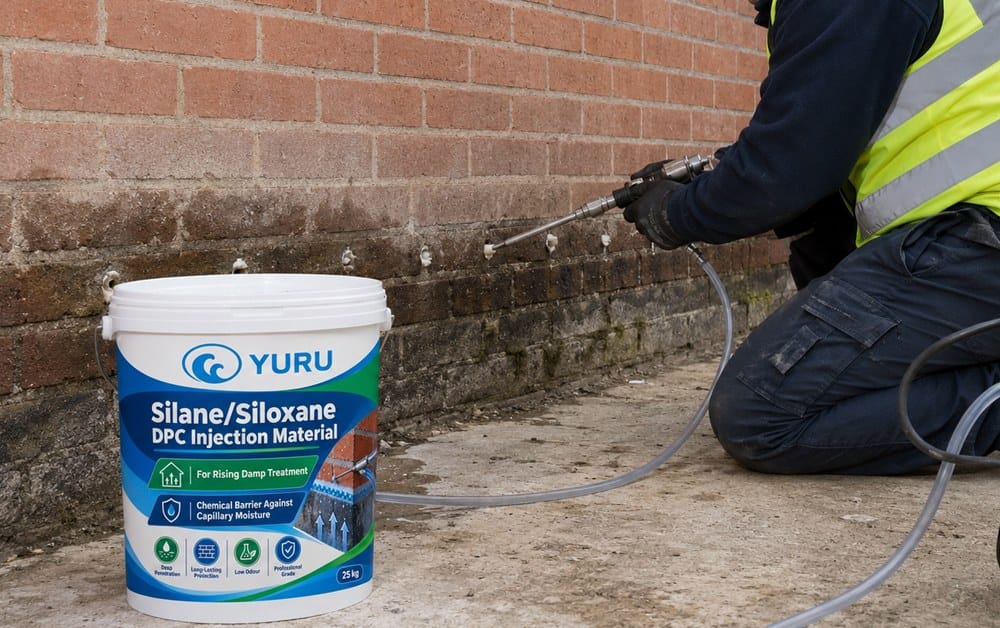
The liquid material is introduced into drilled holes near the base of the affected wall using pressure injection or gravity feed, depending on the wall condition and application method.
Not sure which route fits the wall? Read our pressure injection vs gravity feed selection guide.
Its high fluidity and wettability help the material spread through porous masonry and reach the wall section surrounding the injection zone.
The reactive siloxane system develops a water-repellent chemical zone within the masonry, helping reduce the upward movement of moisture caused by capillary action.
Once the chemical barrier is established, further rising moisture is reduced and the existing damp wall can begin to dry naturally. Drying time varies according to wall thickness, masonry type and existing moisture conditions.
Catalysis Time: Approx. 8–10 Days
The product catalyzes within approximately 8–10 days. This does not mean the entire wall will be dry within 8–10 days; wall drying continues gradually after the chemical barrier develops.
Designed for professional rising damp treatment, the system combines high fluidity, strong water-repellent performance and compatibility with porous masonry while maintaining wall breathability.
Active ingredient content of ≥85% provides a strong technical basis for professional chemical DPC applications.
A water absorption reduction of ≥97%, supporting its function as a water-repellent chemical barrier against capillary moisture.
The liquid material is designed to penetrate porous masonry and distribute through the wall section, helping create a continuous treatment zone.
The treated wall retains its original breathability, helping avoid formation of a dense surface film.
After treatment, the surface does not become glossy, sticky or greasy, and the original wall color is not altered.
Single-component, solvent-free formulation simplifies professional handling and avoids the need for on-site multi-component mixing.
Key technical parameters for evaluating YURU Premium Silane/Siloxane DPC Injection Material before specification, sample testing or bulk purchasing.
| Property | Specification |
| System | Single-component |
| Base Chemistry | Reactive polydimethylsiloxanes in emulsion |
| Appearance | Colorless or yellowish liquid |
| pH | 12.5 ± 1 |
| Active Ingredient Content | ≥85% |
| Water Absorption Reduction | ≥97% |
| Solvent Content | Solvent-free |
| Stability | No delamination, oil separation or obvious precipitation |
| Permeability Pressure Ratio | ≥300% |
| Penetration Height Ratio | ≤30% |
| 48 h Water Absorption Ratio | ≤65% |
| Reinforcement Corrosion | No corrosion effect |
| Main Function | Chemical barrier against capillary rising damp |
| Catalysis Time | 8–10 days |
Request the latest product data sheet, application information and product sample for technical evaluation before project use or bulk ordering.
Technical Data Note
Actual application performance can be influenced by masonry type, wall porosity, moisture condition and installation method. Refer to the latest TDS and application instructions before project use.
The high-fluidity silane/siloxane system is designed for professional injection into a range of porous masonry materials affected by capillary rising damp.
Suitable for different brick masonry formats listed in the product instructions, including red, solid, hollow and Roman brick.
Designed for porous stone-based masonry where the liquid can penetrate and distribute through the treated wall section.
Applicable to solid and hollow concrete block masonry as specified in the product application fields.
Suitable for porous mineral masonry such as tuff and calcarenite.
Suitable for sandstone and limestone masonry where wall porosity and injection conditions allow effective material distribution.
Can be applied to clay blocks, cavity masonry and selected mixed masonry constructions listed in the application guidance.
Consumption and distribution can vary significantly with wall material, thickness, porosity and internal void structure. For irregular, cavity or historic masonry, preliminary assessment and sample application are recommended before confirming project consumption.
Recommended drilling and injection parameters for professional installation of a chemical DPC barrier in masonry affected by rising damp.
| Parameter | Recommendation |
| Hole Diameter | Approx. 12 mm |
| Hole Spacing | 10–12 cm |
| Hole Depth | Approx. 2/3 of wall thickness |
| Packer Size | 12/16 mm multi-hole packer |
| Injection Method | Pressure injection or gravity feed |
| Pressure Equipment | Pneumatic or electric variable-pressure pump |
| Hole Cleaning | Blow out drilling dust before injection |
| Typical Hole Position | Near the lower wall zone |
| Hole Closure | Approx. 30 days after injection |
| Closure Material | Gypsum-free mortar or suitable filler |
Professional Application Required
The product is intended for professional use. Final hole spacing, injection pressure and material quantity should be adjusted according to masonry porosity, internal voids, wall thickness and moisture condition.
Estimate the required DPC injection liquid according to wall thickness before confirming project quantity or bulk purchasing.
Estimated theoretical quantity based on the product data sheet.
0.25 L × 20 cm = approximately 5 L of material per linear metre of wall.
0.25 L × 30 cm = approximately 7.5 L of material per linear metre of wall.
0.25 L × 40 cm = approximately 10 L of material per linear metre of wall.
Wall thickness: 30 cm
Wall length: 20 m
Standard packaging: 25 L container
Calculation: 0.25 × 30 × 20 = 150 L
Theoretical material requirement = approximately 6 × 25 L containers
Actual consumption can vary with masonry type, porosity, internal voids, wall thickness and injection method. Irregular, rubble or cavity masonry may require additional material compared with dense and uniform masonry.
Both liquid and cream-based DPC systems are used in rising damp treatment, but they differ in material form, installation method and how they distribute through masonry. The appropriate system depends on wall construction, porosity, equipment and project requirements.
| Selection Factor | YURU Liquid DPC Injection | DPC Injection Cream |
| Material Form | High-fluidity liquid | Cream / paste-like material |
| Application Method | Pressure injection or gravity feed | Commonly introduced through drilled holes using cartridge or injection equipment |
| Distribution | Designed to absorb and distribute through porous masonry | Designed to disperse from the drilled injection zone |
| Professional Pump Use | Supported | Often not required, depending on system |
| Gravity Application | Supported | Generally not the main application method |
| Masonry Assessment | Porosity and internal voids affect consumption and distribution | Masonry condition also affects product distribution |
| Material Quantity | Calculated according to wall thickness and length | Usually determined by hole size, spacing and manufacturer guidance |
| Best Selection Basis | Wall structure, porosity, injection method and project requirement | Wall structure, application simplicity and product-specific guidance |
Don’t select a DPC system only by whether it is liquid or cream. Wall thickness, porosity, cavity structure, internal voids, installer equipment and required distribution should be evaluated first. YURU Premium Silane/Siloxane DPC Injection Material is designed as a high-fluidity liquid system for professional pressure or gravity injection.
Supports absorption and distribution through porous masonry.
Allows different professional injection approaches according to wall conditions.
Designed to spread through the treated masonry section rather than remain only around the drilled opening.
Active ingredient content is an important specification when comparing chemical DPC injection materials, but it should not be used as the only basis for product selection. Chemistry, water-repellent performance, masonry compatibility and application behavior should also be reviewed.
≥85%
YURU Premium Silane/Siloxane DPC Injection Material specifies an active ingredient content of ≥85%.
However, active content alone does not describe how a DPC material will perform inside masonry. Buyers should also review the base chemistry, water absorption data, penetration and distribution behavior, suitable masonry types and recommended injection method.
Active content should not be evaluated alone. The current YURU product data sheet also specifies a water absorption reduction of ≥97%.
A DPC injection liquid must also penetrate and distribute through the masonry. High fluidity, wettability, wall porosity and internal void structure influence practical application behavior.
Distributors and project buyers should compare active content together with the latest TDS, application instructions, water absorption data and sample evaluation.
When evaluating DPC injection materials, review active ingredient content together with base chemistry, water absorption reduction, masonry compatibility, injection method, technical documentation and sample performance where appropriate.
Important Technical Distinction
“Active ingredient content ≥85%” should not be interpreted as “85% silane.” Product specifications should therefore be compared using the exact terminology stated in the technical documentation.
Before selecting a chemical DPC injection material, compare the product chemistry, verified performance data, masonry compatibility, application method and technical documentation — not only the product name or active content.
Confirm that the moisture source is capillary rising damp.
Match chemistry, masonry compatibility and application method.
Review measurable performance data and technical documents.
A product should only move to sample evaluation or bulk purchasing after these three checks are reasonably satisfied.
Standard packaging and purchasing information for project buyers, distributors and building-material importers evaluating YURU Premium Silane/Siloxane DPC Injection Material.
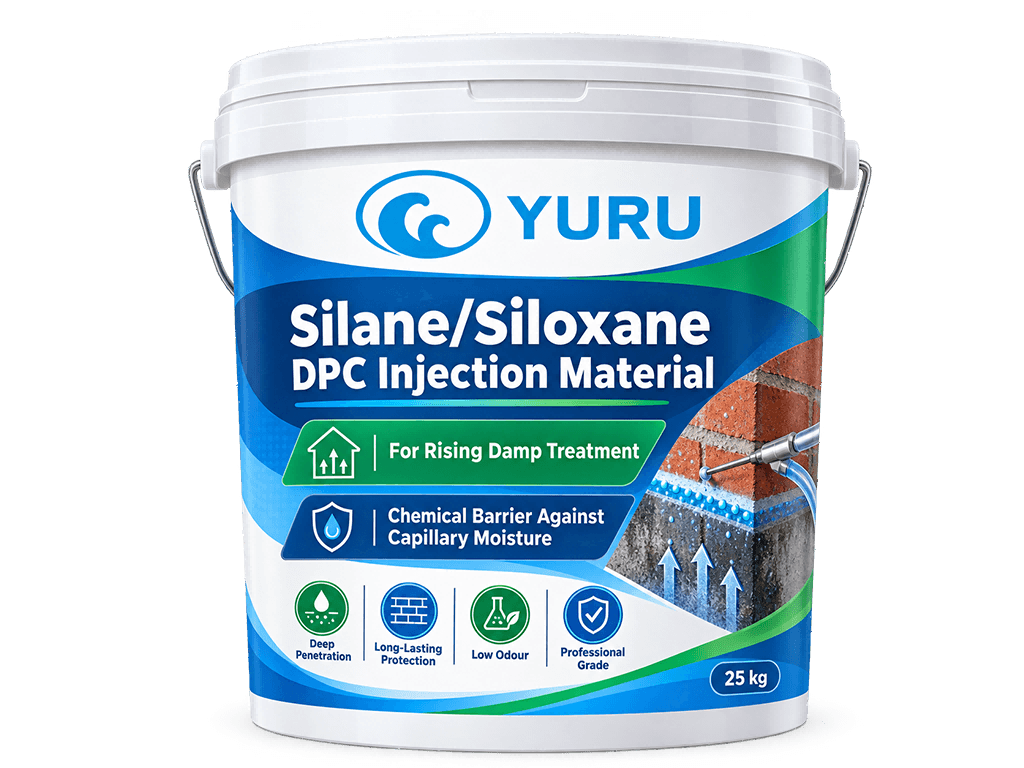
25 L
Product Form: High-fluidity liquid
System: Single-component
Solvent Content: Solvent-free
Main Application: Chemical DPC injection
For distributors, importers and private-label building-material brands, YURU Waterproof can support OEM and branded supply programs based on confirmed packaging, labeling and market requirements.
Support for customer branding and private-label presentation can be discussed according to the target market and order requirements.
Label content, branding layout and packaging presentation can be reviewed before bulk production.
Product data sheet, application information and Safety Data Sheet can be provided for technical review and market preparation.
Where appropriate, buyers can evaluate the product before confirming a distributor program or bulk order.
Target market, application and expected quantity.
Confirm label, branding and packaging requirements.
Review technical information and product evaluation.
Confirm final product and packaging details.
Arrange supply according to final order terms.
Premium Silane/Siloxane DPC Injection Material is intended for professional rising damp treatment and supply channels serving masonry repair, damp-proofing and building maintenance markets.
Distributors supplying professional waterproofing and damp-proofing materials to contractors and local construction markets.
Importers looking for a specialized liquid DPC injection product for rising damp and masonry treatment portfolios.
Professional contractors carrying out chemical DPC injection and rising damp treatment in brick, stone and block masonry.
Contractors working on older or moisture-affected masonry where capillary rising damp has been identified.
Maintenance providers managing damp-wall remediation in residential, commercial or public buildings.
Building-material brands seeking OEM or private-label DPC injection products for local distribution.
Professional Use Only
This product is intended for professional application. Moisture diagnosis, masonry assessment and appropriate injection equipment should be considered before use.
Technical and purchasing questions commonly considered when evaluating liquid DPC injection material for rising damp treatment.
It is designed to create a chemical damp-proof barrier against capillary rising damp in porous masonry walls such as brick, stone and concrete blocks.
YURU Premium Silane/Siloxane DPC Injection Material is a high-fluidity liquid system, not a paste-type injection cream. It can be applied by pressure injection or gravity feed.
Brick, stone masonry, rubble masonry, tuff, clay blocks, hollow brick and solid or hollow concrete blocks among the treatable materials.
The current product instructions recommend approximately 10–12 cm spacing, with holes about 12 mm in diameter and drilled to roughly two-thirds of the wall thickness.
Yes. The product can be applied either by pressure injection or by gravity using suitable equipment, depending on the selected application method and wall condition.
The theoretical estimate is approximately 0.25 L for each centimetre of wall thickness per linear metre. Actual consumption varies with wall type, porosity, thickness and internal voids.
A catalysis time of approximately 8–10 days. This does not mean the entire wall will be dry within that period; wall drying continues gradually afterward.
Buyers can request technical product information and discuss sample evaluation, bulk supply and private-label requirements before confirming an order.
Whether you are evaluating a rising damp project, sourcing for distribution, or developing a private-label product line, YURU Waterproof can support your next step with technical product information, sample evaluation and purchasing discussion.
Review product specifications, application information and technical parameters before selection.
Evaluate the liquid DPC injection material before bulk purchasing or distributor cooperation.
Send your required quantity, destination country and project or distribution requirement.
Discuss branding, labeling and packaging requirements for your target market.
Not sure which information to prepare? Send us your project photos or basic purchasing requirement and our team can help you identify the next step.
Download our catalog to check all of our products, select the right waterproof products for your projects.