DPC Pressure Injection vs Gravity Feed: Which Method Fits the Wall?
Introduction:
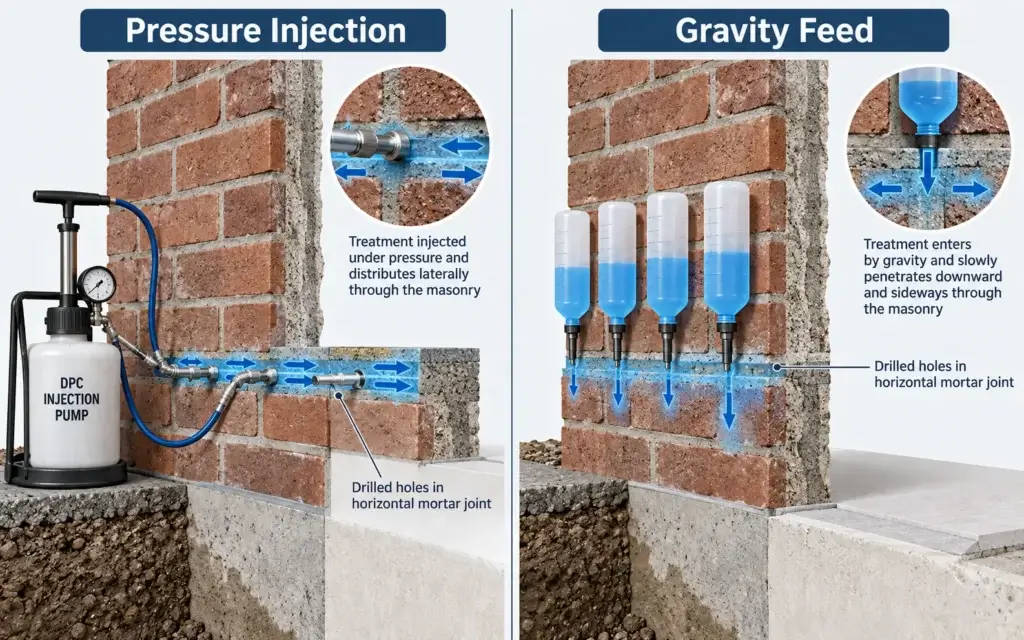
Pressure injection and gravity feed are both used to introduce liquid chemical damp-proof course (DPC) materials into masonry, but they do not deliver the material in the same way.
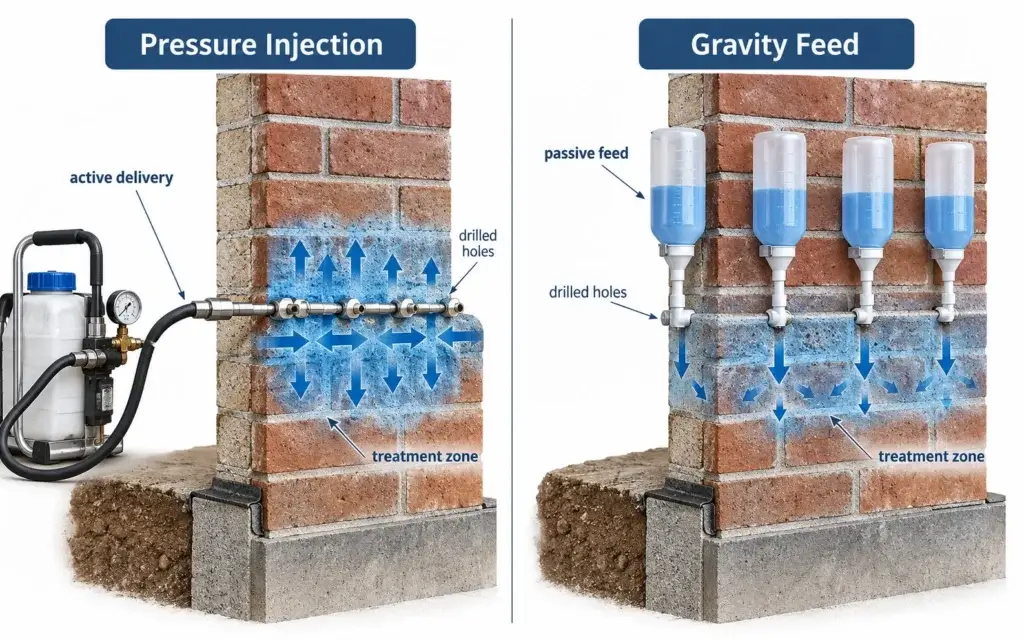
With DPC pressure injection, a pump actively delivers the liquid through drilled holes. Gravity feed works without external pump pressure and relies more on gravity and the masonry’s ability to absorb the fluid.
Neither method is automatically better. The right application method depends first on what the specific DPC product allows, then on how the wall absorbs liquid, its moisture condition, thickness, internal structure, and the level of delivery control required on site.
For a real project, the decision is not simply pressure versus gravity. Sometimes the correct result is pressure, sometimes gravity, and sometimes reassess the wall before choosing either method.
Quick Answer: Pressure Injection or Gravity Feed for Liquid DPC?
Neither pressure injection nor gravity feed is universally better for liquid DPC.
Pressure injection gives the applicator active control over how the material is delivered into the treatment holes. Gravity feed relies more on gravity, capillary uptake, and the wall’s own absorption behavior.
Start with the product TDS: does it permit pressure application, gravity feed, or both? Then check masonry absorption, moisture, wall thickness, access, internal voids, and what happens when the wall begins accepting the liquid.
If distribution is too unpredictable, method selection should wait until the wall condition is better understood.
What Is the Real Difference Between Pressure Injection and Gravity Feed?
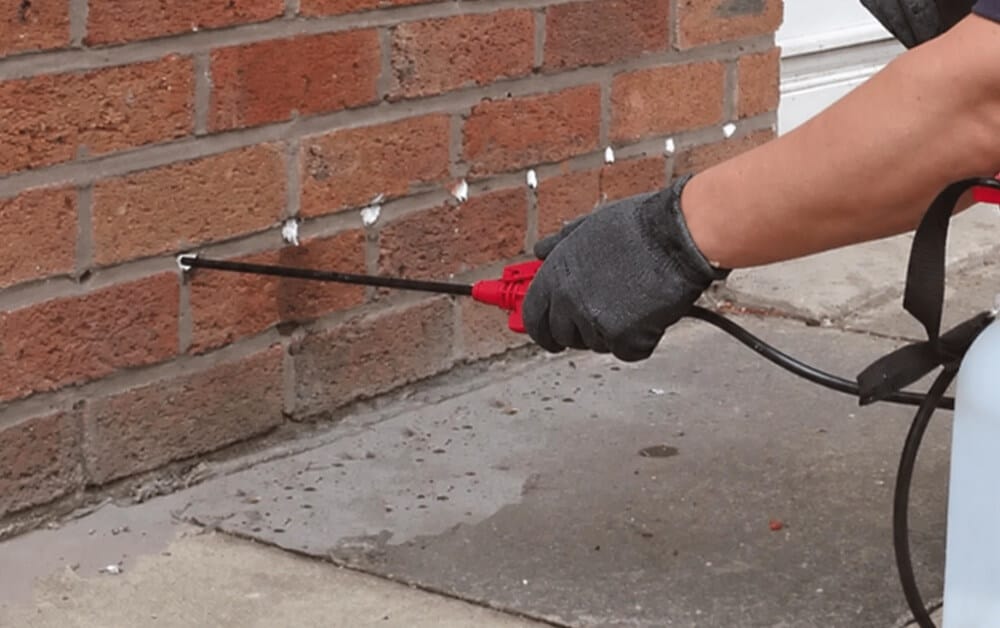
Both methods have the same basic objective: introduce a chemical treatment into the masonry so that a sufficiently continuous damp-proof course can develop across the wall.
If you first need to understand why the same liquid DPC can spread differently from one wall to another, see our guide to what affects liquid DPC penetration and distribution in masonry.
The difference is the delivery mechanism.
Research into chemical DPC treatments recognizes pressure-assisted injection as well as non-pressure impregnation methods. Regardless of how the material enters the wall, successful treatment still depends on sufficient spreading around the injection points to create an effective barrier against capillary moisture.
Pressure Injection Uses Active Delivery
A pressure system normally uses a pump together with an injection gun, nozzle, packer, or another sealed connection to the drilled hole.
The pump provides an external driving force, allowing the contractor to control the way the liquid is introduced. Depending on the product system, pressure, delivery time, or material quantity may be adjusted as the wall responds.
That control is the main technical distinction.
It should not be confused with a guarantee of deeper penetration or better damp-proofing performance.
Gravity Feed Relies More on Wall Uptake
Gravity-fed application removes the pump pressure from the process. The liquid is supplied through an applicator, bag, bottle, or reservoir and is taken into the masonry through gravity and capillary absorption.
A commercial silane/siloxane fluid system from Tech-Dry, for example, uses applicators that allow the liquid to gravity-feed into brickwork. Its guidance also notes that absorption time varies according to brick porosity and moisture condition. That timing belongs to that particular system, but it illustrates how strongly gravity application can depend on the wall’s uptake behavior.
In simple terms, pressure gives the applicator a more active delivery mechanism, while gravity makes masonry uptake a larger part of the delivery process.
Pressure and gravity are both delivery routes for liquid systems. If the project has not yet reached that stage and you are still choosing the material format, compare liquid DPC vs DPC cream first.
What Does Pressure Injection Actually Let You Control?
The practical value of pressure injection is controlled delivery, not simply higher pressure.
A suitable pressure system allows the applicator to introduce liquid through a sealed injection point and adjust the procedure when different parts of the wall behave differently.
A useful product-specific example comes from Antel’s aqueous pressure-injection system. Its published application instructions specify a normal pressure for that particular product but allow the pressure to be reduced for very porous brickwork. The same instructions also modify drilling and injection procedures for blockwork and stone according to density, porosity, and construction.
This example does not establish a universal pressure setting. It shows something more useful: pressure is an application variable that may need to respond to the substrate.
Higher Pressure Does Not Automatically Mean Better DPC Performance
If liquid enters a wall slowly, simply increasing the pressure is not a reliable solution.
Slow uptake may be related to the masonry structure, moisture level, drilling position, formulation, or another feature inside the wall. Increasing pressure without understanding the cause does not guarantee that the treatment will spread where it is needed.
This is especially important when comparing different products. One manufacturer’s pressure recommendation should not be transferred directly to another formulation.
For YURU’s liquid DPC material, the PDS specifies pneumatic or electric equipment with variable pressure and multi-hole packers, but it does not provide one universal pressure value for every wall condition.
Pressure should therefore be treated as a controllable delivery parameter, not as a performance score.
What Does Gravity Feed Depend On?
Gravity feed places more emphasis on how the masonry itself accepts the product.
Without pump pressure, uptake depends on the interaction between the liquid formulation and the available pore network in the wall. Absorption rate, moisture, porosity, and internal geometry all become important field observations.
How Does Wall Uptake Affect Gravity Feed?
During gravity application, the contractor can observe whether neighboring treatment points accept the liquid at similar rates.
Consistent uptake can support the planned application process. Very slow uptake may mean the product needs more time, while unusually rapid uptake at an isolated location may indicate a different internal path, a highly absorbent area, or a void.
Those observations need interpretation. Fast absorption is not automatically good, and slow absorption is not automatically failure.
A laboratory study of gravity-applied chemical barriers found that the tested treatments reduced water absorption, but the researchers also identified sufficient spreading across the wall section as a practical challenge. The tested products were crystallizing systems rather than YURU’s silane/siloxane formulation, so the study should not be used to predict YURU performance directly. It does, however, support the broader point that material entering a wall does not by itself prove that a continuous treatment zone has formed.
Which Wall Conditions Matter When Choosing Pressure or Gravity?
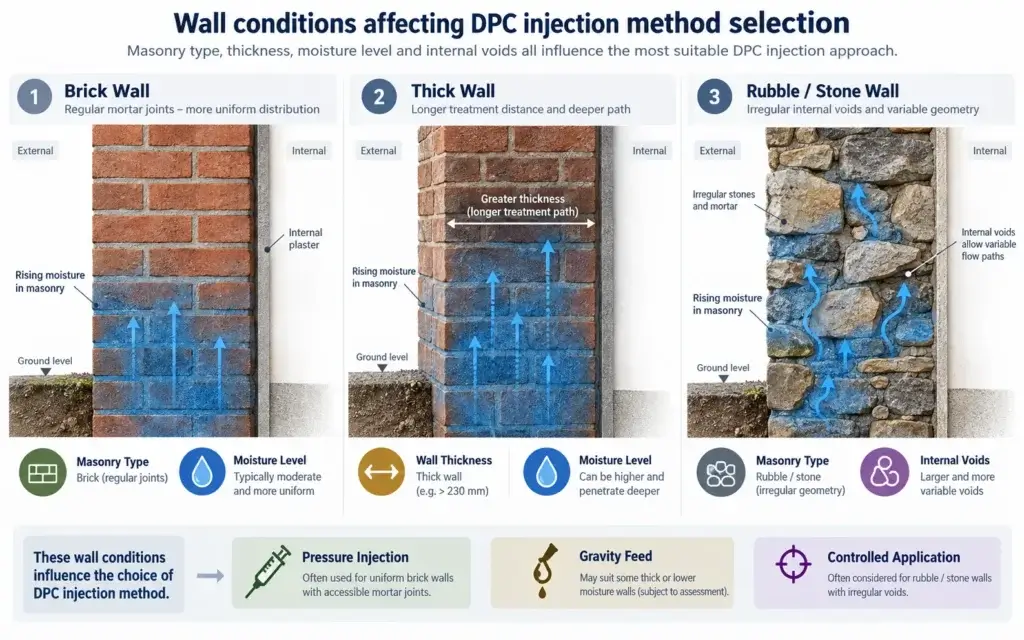
The wall should influence how the method is evaluated, but individual properties should not be turned into simplistic selection rules.
A porous wall does not automatically mean gravity. A thick wall does not automatically mean pressure. The relevant question is how those conditions affect delivery and whether the chosen product is designed to work under them.
Porosity and Absorption
Brick, mortar, and their interfaces do not necessarily absorb the same liquid in the same way.
Experimental research using mortar-and-brick combinations found clear differences in spreading and effectiveness between substrates and product types. Differences in pore-size distribution and the interface between masonry materials influenced how chemical treatments moved.
Porosity therefore matters because it changes uptake behavior.
It should influence how a pressure or gravity application is monitored or adjusted, but it should not be used as a standalone rule for choosing one method.
Moisture Condition
Wall moisture also changes how an injection product behaves.
A study comparing 15 chemical injection products at different water saturation levels found substantial differences in spreading and effectiveness. In wet substrates, the carrier or solvent system had a strong influence on product behavior.
For method selection, the key point is straightforward: a wet wall is not simply the same wall with more water in it. Moisture changes the environment in which the product has to move.
That still does not produce a universal rule such as “wet wall = pressure” or “wet wall = gravity.” The wall condition needs to be checked against the specific formulation and its application instructions.
Wall Thickness and Access
Thickness changes the geometry of the treatment more directly than it selects the delivery method.
A thicker wall may change drilling depth, treatment distance, material requirement, and whether access is needed from one or both sides. Product-specific pressure systems can also use different drilling strategies for thicker walls or restricted access.
For YURU’s liquid DPC material, the PDS specifies drilling to approximately two-thirds of the wall thickness, while theoretical yield varies according to masonry type and thickness. The same product permits both pressure and gravity application.
Wall thickness therefore changes the application design. It does not prove that one delivery method is automatically required.
Voids and Irregular Construction
Internal voids create a more serious uncertainty.
Published research on chemical damp-proof courses warns that large voids and cracks can allow injected material to drain away from the intended treatment area. Rubble masonry is specifically identified as a condition where this risk can occur.
YURU’s product data also lists cavity or rubble masonry among its intended substrate types. These points are not necessarily contradictory: “rubble masonry” describes a broad construction type, while the size and connectivity of actual internal voids determine how predictable liquid distribution may be.
When the internal wall condition is unclear, the immediate task is to understand the likely material path before selecting pressure or gravity.
When Should You Reassess Before Choosing Either Method?
Not every project is ready for a pressure-versus-gravity decision.
Reassessment is appropriate when the intended delivery method is not supported by the product instructions, the masonry construction is unclear, large voids are suspected, neighboring holes show sharply different uptake, material appears to disappear unpredictably, or the required drilling and access arrangement cannot be achieved.
Method selection also assumes that the moisture problem has already been identified correctly. If that is still uncertain, first check how to tell if a wall has rising damp before DPC injection.
These conditions do not automatically rule out liquid DPC, they indicate that the assumptions behind the treatment plan need to be checked before the contractor changes pressure, adds more liquid, or switches application method.
This is an important distinction because choosing the wrong answer to an uncertain wall is not the same as solving the uncertainty.
A Practical Pressure-vs-Gravity Selection Framework
Method selection can be reduced to five checks.
| Check | What to verify |
| Product | Does the TDS allow pressure, gravity, or both? |
| Wall uptake | Does the masonry accept the liquid steadily, slowly, or inconsistently? |
| Geometry | What are the wall thickness, access conditions, cavities, and likely internal voids? |
| Delivery | Is the approved pressure or gravity method practical with the available equipment and wall conditions? |
| Field response | Is material uptake behaving as expected, or is there unexplained loss or major variation? |
After these checks, the project should lead to one of three outcomes.
Pressure is reasonable when the product permits pressure application and the wall and site conditions support controlled pump-assisted delivery.
Gravity is reasonable when the product permits gravity application and the wall can be treated through the approved gravity/capillary uptake process.
Reassess is the better result when the wall structure, material uptake, or application conditions make distribution too uncertain to justify either choice.
The goal is not to force every wall into one method. It is to select a delivery route only when the product and the masonry give enough information to support it.
If those checks support a liquid DPC approach, the next step is to review the YURU liquid DPC application data against the actual wall conditions.
How Does This Apply to YURU Liquid DPC?
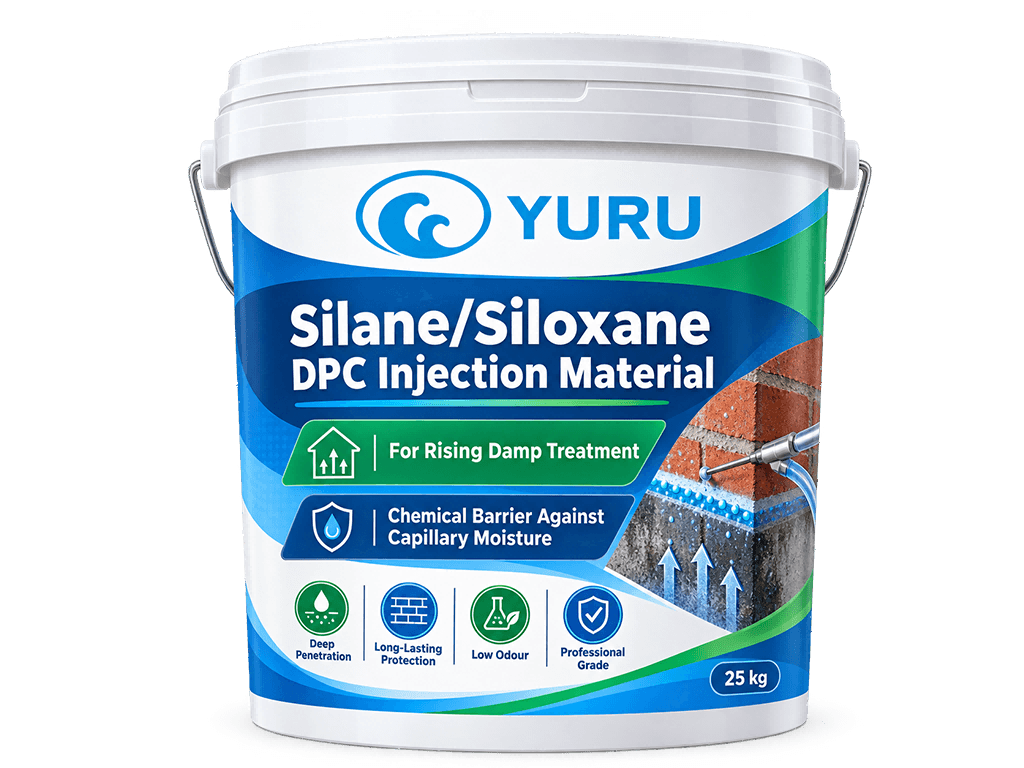
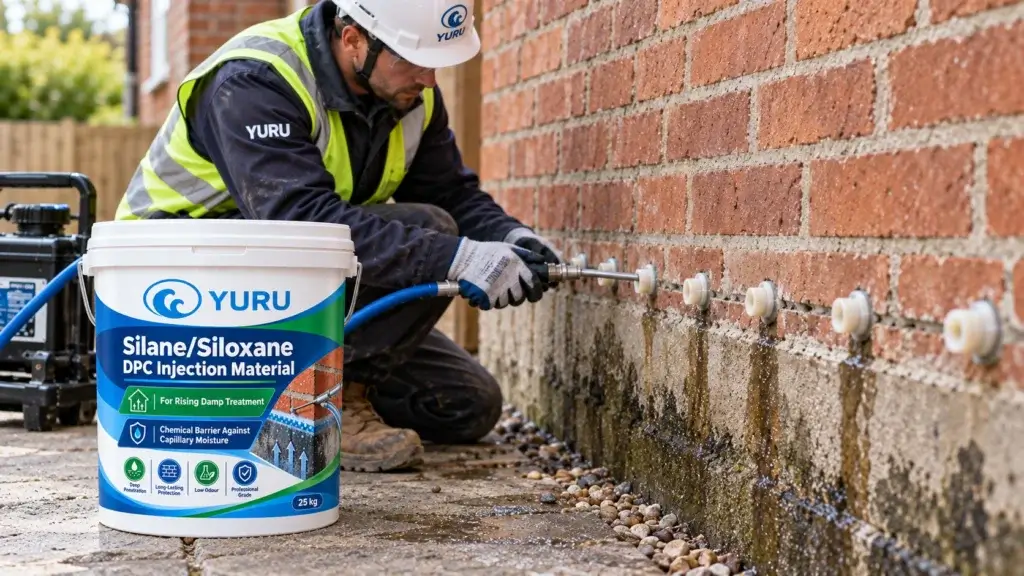
YURU’s Premium Silane/Siloxane DPC Injection Material allows both pressure and gravity application.
For pressure injection, the PDS specifies pneumatic or electric pumps with variable pressure and 12/16 mm multi-hole packers. Gravity application can be carried out with suitable bags or bottles.
The same product data gives application guidance of approximately 12 mm hole diameter, 10–12 cm spacing, and drilling to about two-thirds of the wall thickness.
These are YURU product-specific parameters, not universal settings for every liquid DPC system.
Because both delivery routes are available for this product, the final choice should be made together with the masonry condition, wall geometry, access, observed liquid uptake, and project application requirements.
Frequently Asked Questions
Is Pressure Injection Better Than Gravity Feed for DPC?
Not universally. Pressure injection provides active delivery control, while gravity feed relies more on gravity and masonry uptake. Product instructions, wall condition, geometry, and actual field behavior should determine which method is appropriate.
Can Gravity Feed Be Used for Liquid Silane/Siloxane DPC?
Yes, when the specific product is designed for gravity application. YURU’s liquid silane/siloxane DPC system permits both pressure injection and gravity feeding.
Should DPC Injection Pressure Be Increased If the Wall Absorbs Liquid Slowly?
Not automatically. Slow uptake may result from masonry density, moisture, pore structure, formulation, drilling position, or another wall condition. Check the product instructions and investigate the reason before increasing pressure.
Can Pressure or Gravity DPC Be Used in Rubble Masonry?
Potentially, but the actual internal structure matters. YURU lists rubble masonry among its intended substrates, while published research warns that large connected voids can make chemical distribution less predictable. The wall should therefore be assessed before the delivery method is finalized.
Not Sure Whether to Use Pressure or Gravity?
If you are evaluating a liquid DPC system, send YURU Waterproof the wall type, thickness, moisture condition, known cavities or rubble construction, available access, intended equipment, and project photos or drawings.
We can review these conditions against the relevant product application requirements before the delivery method is finalized.
YURU Product solutions