Liquid DPC Injection vs DPC Cream: Which Is Better for Rising Damp?
Once a wall has been confirmed as a genuine rising damp problem, another question follows quickly:
Should you use a liquid DPC injection system or a DPC cream?
Cream usually requires less equipment and is easy to place through drilled holes with an applicator. Liquid DPC can be delivered by pressure or gravity, depending on the product, and may fit contractors already working with pumps, packers, and bulk injection materials.
But product form alone does not tell you which system will perform better.
The choice also depends on the formulation, masonry structure, moisture condition, wall thickness, internal voids, drilling design, and the way the treatment is introduced into the wall.
For contractors and buyers, the useful question is:
Which system fits this wall, this application method, and this project?
Quick Answer: Liquid DPC or DPC Cream?
DPC cream usually simplifies installation because many systems can be applied with a cartridge or application gun and do not require a pressure pump. Liquid DPC provides pressure- or gravity-fed application options and can suit professional injection workflows where fluid delivery is preferred.
Neither format is the right choice for every wall.
Compare:
- active chemistry;
- product carrier;
- masonry type;
- wall thickness;
- moisture saturation;
- internal voids;
- available equipment;
- dosage control;
- and the manufacturer’s technical data.
Liquid and cream describe different product forms and delivery methods. They do not, by themselves, tell you which product will perform better.
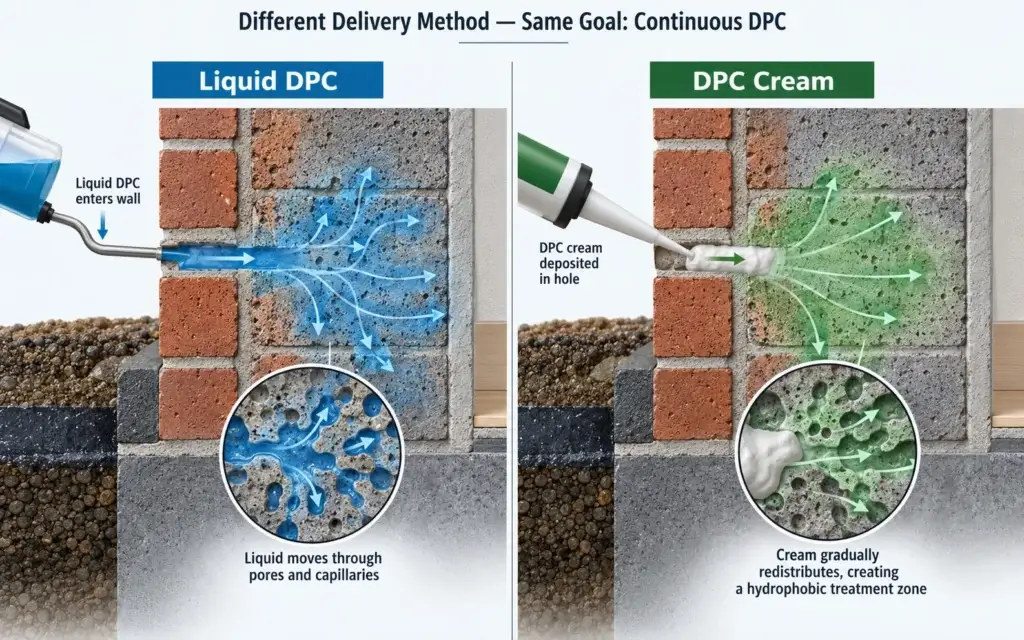
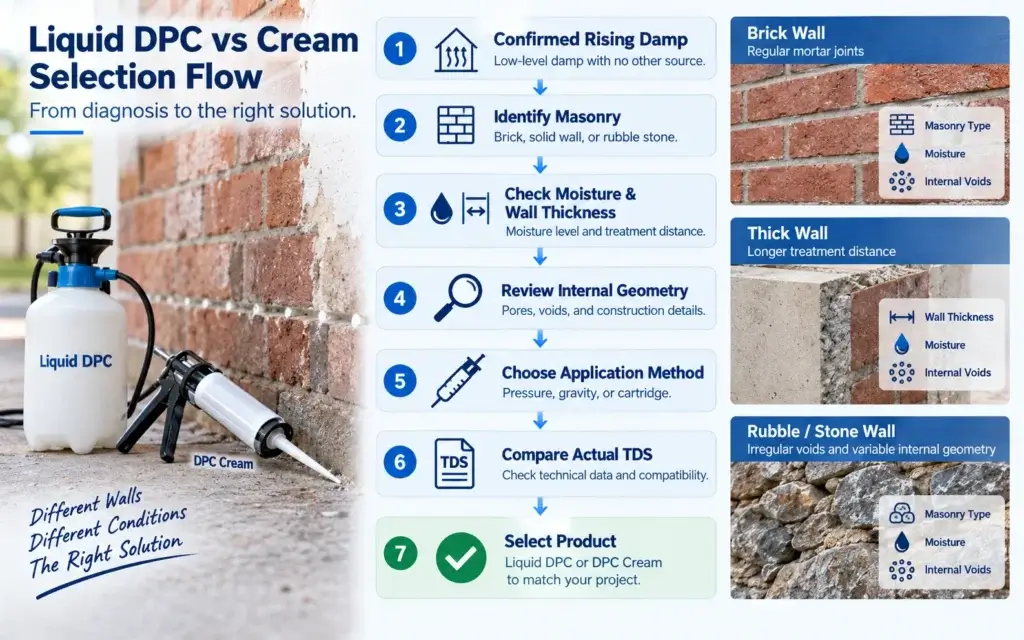
1. What Is the Real Difference Between Liquid DPC and DPC Cream?
The most obvious difference is physical form.
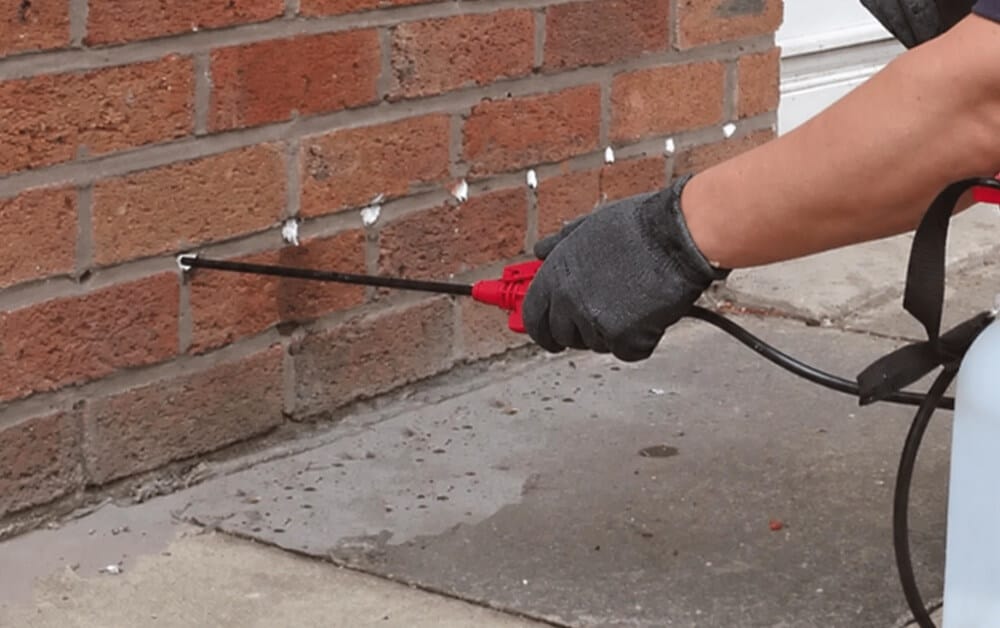
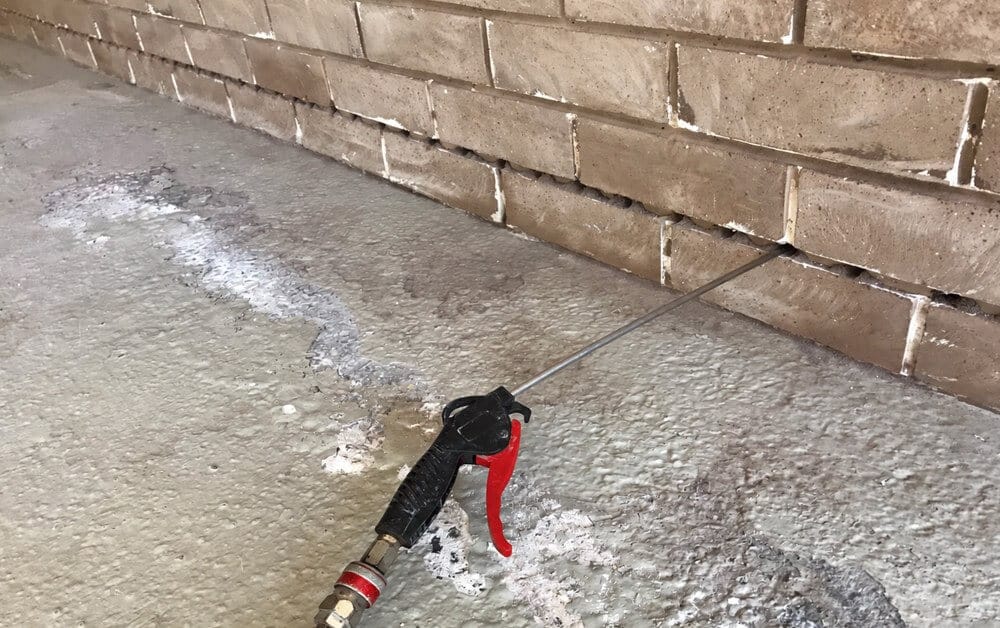
A liquid DPC injection material is introduced as a fluid. Depending on the system, it may be delivered under controlled pressure or by gravity.
A DPC cream has a thicker consistency and is normally placed into drilled holes or mortar joints using a cartridge or applicator. The active material then redistributes into the surrounding masonry according to the formulation.
There is another distinction that matters just as much:
Product form is not the same as active chemistry.
A cream can still be silane-based. A liquid can contain silane, siloxane, or related reactive components. Research comparing chemical DPC products has also included silane, siloxane, siliconate, liquid, emulsion, micro-emulsion, cream, and gel systems as separate variables. That shows why “cream” or “liquid” should not be treated as a chemistry label.
So a buyer should not stop at:
- Is it a liquid or a cream?
Also check:
- the active components;
- active ingredient content;
- water-based or solvent-based carrier;
- stated masonry compatibility;
- and the conditions under which the product is designed to spread and react.
The form tells you how the product is delivered. The formulation tells you much more about how it may behave inside the wall.
2. How Do Liquid DPC and DPC Cream Move Through Masonry?
A chemical DPC has to develop a sufficiently continuous water-repellent zone through the masonry.
Cream and liquid systems reach that zone in different ways.
Liquid DPC Injection
Liquid systems enter the wall as a fluid.
Depending on the product, application may involve:
- pressure injection;
- gravity feed;
- pumps;
- packers;
- or other fluid-delivery equipment.
Once inside the wall, distribution is influenced by the masonry itself, including:
- pore structure;
- mortar joints;
- brick or stone interfaces;
- moisture in the pore network;
- and internal voids.
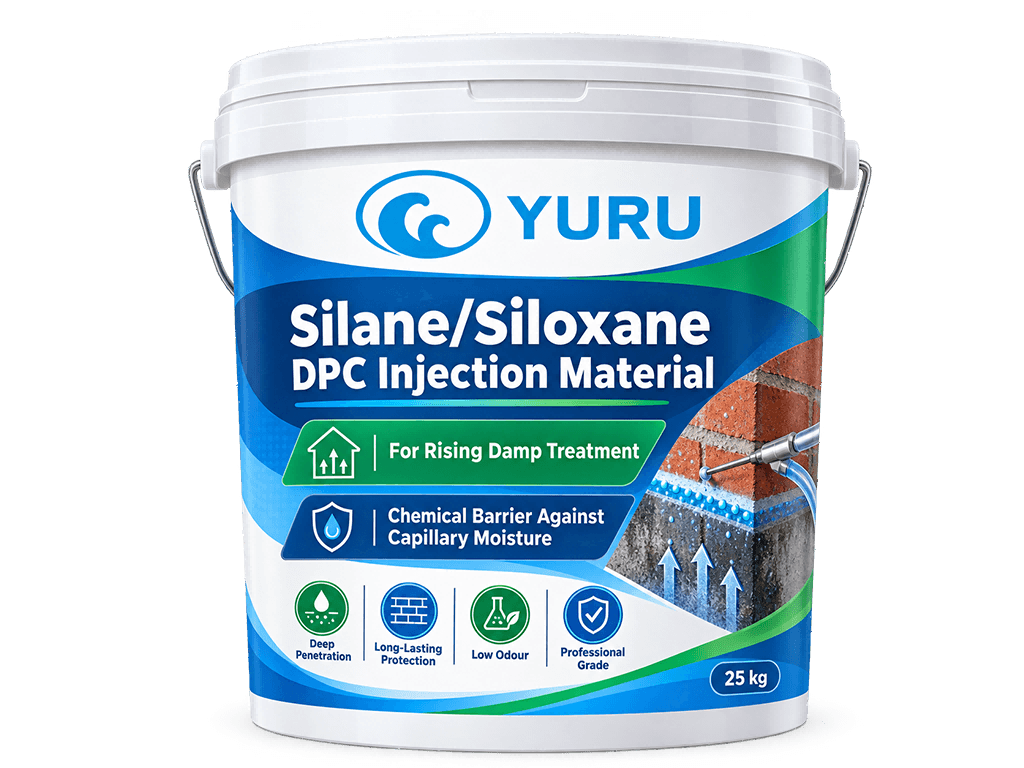
YURU’s Premium Silane/Siloxane DPC Injection Material, for example, is designed for pressure or gravity application and can be used with pneumatic or electric variable-pressure equipment and multi-hole packers.
DPC Cream
Cream is placed directly into the drilled injection line rather than pumped through the wall as a free-flowing fluid.
Depending on the formulation, the active components then migrate or redistribute into the surrounding masonry.
This reduces the amount of fluid moving freely during installation, but the wall still controls how effectively the treatment spreads.
Material distribution is controlled by both the product and the masonry.
Brick, mortar, moisture, pore structure, and internal geometry all influence what happens after installation.
3. Does Liquid DPC Penetrate Better Than Cream?
Not as a universal rule.
It is easy to assume that a more fluid product must penetrate farther, but chemical DPC performance is not controlled by viscosity alone.
Laboratory research comparing injection products has shown that spreading can change with:
- product form;
- carrier or solvent system;
- active chemistry;
- and substrate saturation.
In one comparative study, some water-based liquid silane/siloxane products showed very uniform spreading in wet brick specimens and strong reductions in water uptake.
That is useful evidence for those tested systems, not proof that every liquid DPC outperforms every cream.
Real walls vary in:
- porosity;
- mortar composition;
- salts;
- moisture;
- wall thickness;
- and internal continuity.
Liquid does not automatically penetrate better, and cream does not automatically distribute poorly.
The more useful comparison is between the actual formulations and the wall they need to treat.
4. How Do Wall Type and Wall Thickness Change the Choice?
The DPC is being introduced into a physical wall, not an empty injection channel.
That makes masonry construction part of the selection decision.
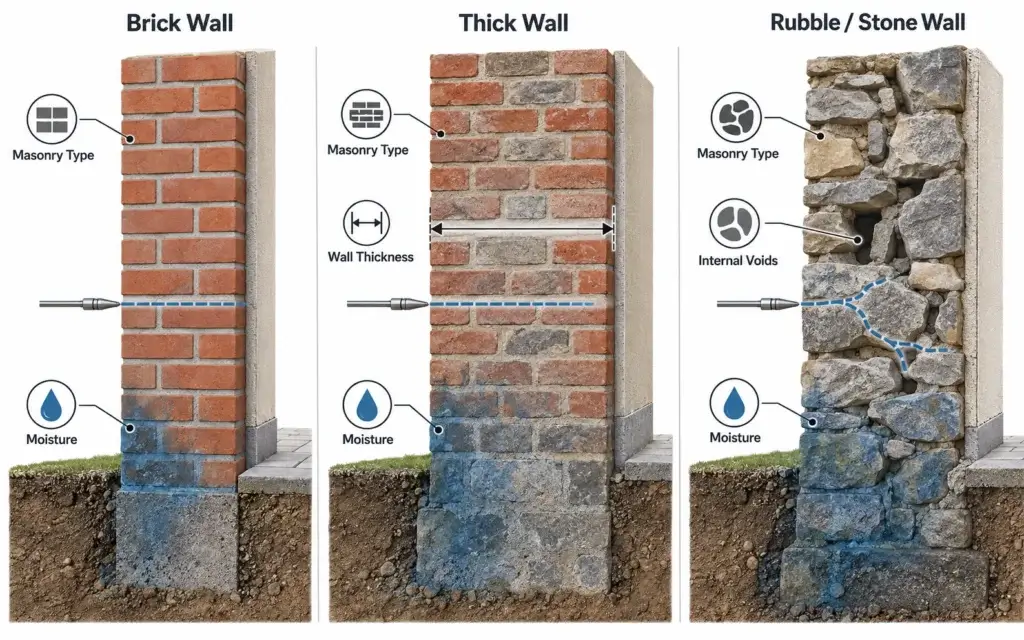
Brick and Mortar Walls
Brick and mortar can have different pore structures and absorption behavior.
The interface between them can also affect how an injected treatment spreads.
A wall that looks uniform from the outside may therefore contain several different transport paths internally.
A continuous DPC depends on the treatment spreading beyond isolated injection points and forming an effective treatment zone across the wall.
Stone and Rubble Masonry
Irregular stone and rubble walls introduce another problem: their internal structure can be difficult to predict.
They may contain:
- voids;
- loose infill;
- variable thickness;
- discontinuous joints;
- and uneven absorption.
Both liquid and cream systems therefore require careful application planning.
Irregular masonry increases the importance of drilling layout, void assessment, material distribution, and treatment continuity.
YURU’s liquid DPC material system lists stone and cavity/rubble masonry among its intended substrates, but substrate suitability still needs to be assessed against the actual wall condition.
Thick Walls
Greater wall thickness increases the distance over which the treatment must develop.
It can also affect:
- drilling depth;
- material quantity;
- injection layout;
- and treatment continuity.
YURU’s product data specifies hole depth at approximately two-thirds of wall thickness and estimates consumption in relation to wall thickness.
Wall thickness changes the application design for both liquid and cream systems. It does not decide the winner by itself.
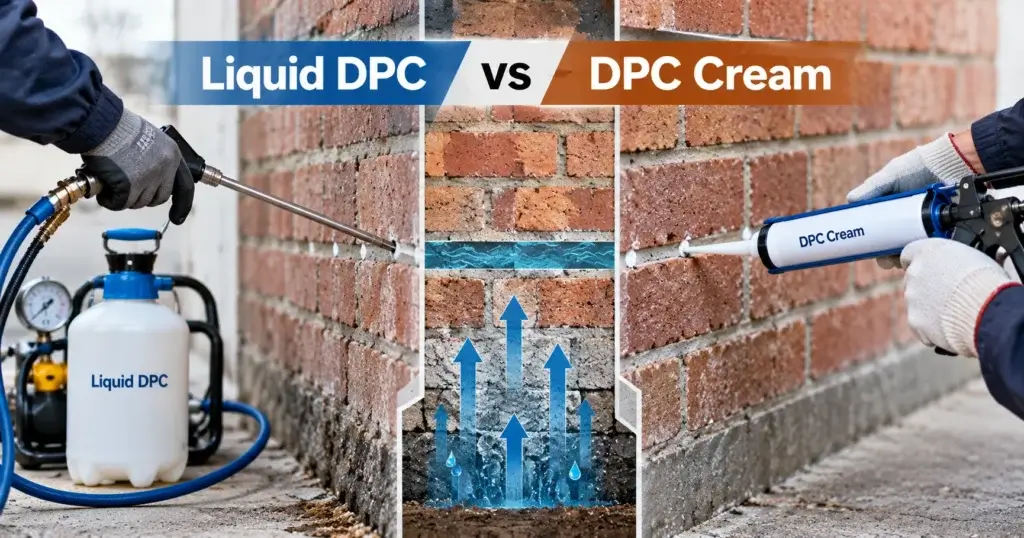
5. Which System Requires More Equipment and Application Control?
This is one of the clearest practical differences between the two formats.
Liquid DPC
A pressure-injected liquid system may use:
- an injection pump;
- packers;
- hoses;
- pressure control;
- and material-flow monitoring.
YURU’s liquid DPC system supports variable-pressure pump application and gravity feed, depending on the installation method.
This gives the contractor active control over how the liquid is introduced into the wall. It also means more equipment and setup.
DPC Cream
Many cream systems use a simpler workflow.
Cream material is placed into drilled holes using a cartridge, sausage pack, or applicator without the same pump setup required for pressure-fed liquid systems.
This can make installation easier to organize, particularly where contractors prefer a cartridge-based method.
The practical distinction is straightforward:
Cream usually reduces equipment at the wall. Liquid can give the contractor more active control over pressure- or gravity-fed delivery.
Which advantage matters more depends on the wall and the contractor’s application method.
6. How Does Masonry Moisture Affect Liquid and Cream DPC?
Moisture inside the wall changes the environment through which the treatment has to move.
Research into chemical DPC products has shown that substrate saturation can affect spreading, and that different carrier systems and product forms can behave differently in wet masonry.
Cream systems can also depend on changes that take place after the product has been placed in the wall. For some formulations, redistribution develops as the cream structure changes and the active material becomes more mobile.
That makes drying conditions relevant to certain products.
This should not be simplified into “cream does not work in wet walls.” Commercial cream systems exist for very damp masonry, and their limits vary by formulation, the same applies to liquid products.
A highly fluid material still has to move through pores that may already contain substantial water.
Moisture condition is part of product selection, not just a site-preparation detail.
Check the individual TDS for:
- permitted moisture conditions;
- substrate requirements;
- curing or redistribution behavior;
- and any limits related to saturation or drying.
7. Which System Gives Better Dosage and Material Control?
Liquid and cream systems control material differently.
DPC Cream: Per-Hole Placement
Cream is normally placed directly into each drilled hole.
That makes the quantity at each injection point relatively easy to see and repeat.
For contractors, this can simplify:
- per-hole placement;
- cartridge planning;
- and control of free-flowing material during installation.
Liquid DPC: Volume and Flow Control
Liquid injection can be controlled through the amount of material delivered and, in pressure systems, through injection behavior.
YURU’s PDS gives an estimated consumption of approximately 0.25 L per centimetre of wall thickness per linear metre.
Actual consumption can still vary with masonry type and internal structure.
For example, an unexpected void may accept more liquid than the theoretical calculation suggests.
Cream often makes per-hole placement easier to standardize. Liquid can be controlled by volume and flow, but actual consumption is more sensitive to what is happening inside the wall.
This is why estimated material consumption should remain an estimate rather than a guaranteed quantity.
8. Which DPC Format Fits Different Contractor Workflows?
Technical suitability is only part of the decision.
A contractor already using pumps, packers, and other injection materials may find a liquid DPC system easy to integrate into existing work.
Another contractor may prefer cream because cartridge application requires less injection equipment.
For distributors, the same question appears at market level:
- What do local contractors already use?
- Are injection pumps widely available?
- Does the market prefer cartridges or bulk containers?
- Will contractors need additional training?
- What packaging format is easier to stock and sell?
A technically suitable material can still be a poor commercial fit if the local installer network is not set up to use it.
9. When Does a Liquid DPC System Make More Sense?
A liquid DPC system is worth considering when fluid injection fits both the wall and the contractor’s workflow.
That may include projects where:
- pumps and packers are already available;
- controlled pressure injection is preferred;
- gravity feed is appropriate;
- bulk liquid packaging fits the supply model;
- injected volume needs to be monitored;
- and the chosen formulation is suitable for the masonry.
YURU’s Premium Silane/Siloxane DPC Injection Material is one example of this approach.
The system is a single-component, high-fluidity material based on reactive polydimethylsiloxanes in emulsion. It supports pressure and gravity application and is intended for masonry including brick, stone, cavity/rubble masonry, clay block, and concrete block.
It is supplied in 25 L containers, making it suitable for contractors or distributors who prefer a bulk liquid supply format.
A liquid format is simply a different application route that may fit certain walls and contractor workflows better.
Once a liquid system has been selected, application may still involve different delivery routes. See DPC pressure injection vs gravity feed for the next technical decision.
10. Liquid DPC vs DPC Cream: Decision Table
| Decision Factor | Liquid DPC | DPC Cream | What the Buyer Should Ask |
| Product Form | Fluid | Viscous / cream | Which format fits the application method? |
| Active Chemistry | Product-specific | Product-specific | What does the TDS actually contain? |
| Typical Delivery | Pressure or gravity depending on system | Cartridge / applicator | What equipment is available? |
| Equipment Need | Pump and packers may be required | Usually simpler | What does the contractor already use? |
| Material Movement | Flow through pore network | Redistribution after placement | How does the formulation move through this masonry? |
| Wet Masonry | Formulation-dependent | Formulation-dependent | What saturation conditions are allowed? |
| Brick / Mortar | Interface matters | Interface matters | Where is the injection line placed? |
| Stone / Rubble | Voids and material loss need attention | Continuity and hole placement need attention | How irregular is the wall internally? |
| Thick Walls | Drilling depth and volume increase | Drilling depth and treatment distance increase | Can a continuous barrier be formed? |
| Dosage Control | Volume / flow based | Per-hole placement often easier | How will consumption be monitored? |
| Packaging | Often compatible with bulk supply | Often cartridge or sausage based | What format fits the market? |
| Best Choice | Project-dependent | Project-dependent | Which actual product fits the wall and workflow? |
The final decision should be made between specific products, not simply between the words “liquid” and “cream.”
11. What Should Buyers Check Before Choosing Liquid or Cream DPC?
For contractors, distributors, and technical buyers, compare four things before approving a product.
1. Product Formulation
Check:
- active chemistry;
- active ingredient content;
- carrier or solvent system;
- liquid, emulsion, or cream form;
- and stated substrate compatibility.
A high active-content number alone does not prove that one product will perform better.
The formulation still has to spread and react correctly in the target masonry.
2. Wall Conditions
Confirm:
- masonry type;
- wall thickness;
- mortar condition;
- internal voids;
- moisture saturation;
- and salt contamination where relevant.
These conditions influence how the treatment distributes.
3. Application Requirements
Review:
- hole diameter;
- hole spacing;
- drilling depth;
- pressure, gravity, or cartridge method;
- equipment;
- packers;
- and expected consumption.
This tells the contractor what the product actually requires on site.
4. Technical and Supply Documentation
For purchasing, also review:
- TDS;
- SDS;
- application instructions;
- packaging;
- sample availability;
- batch consistency;
- technical support;
- and OEM/private-label options where required.
One question is especially useful:
- Are you comparing two delivery formats, or are you actually comparing two different formulations with different application limits?
That distinction prevents many poor DPC comparisons.
A 6-Step Model for Choosing Liquid DPC or DPC Cream
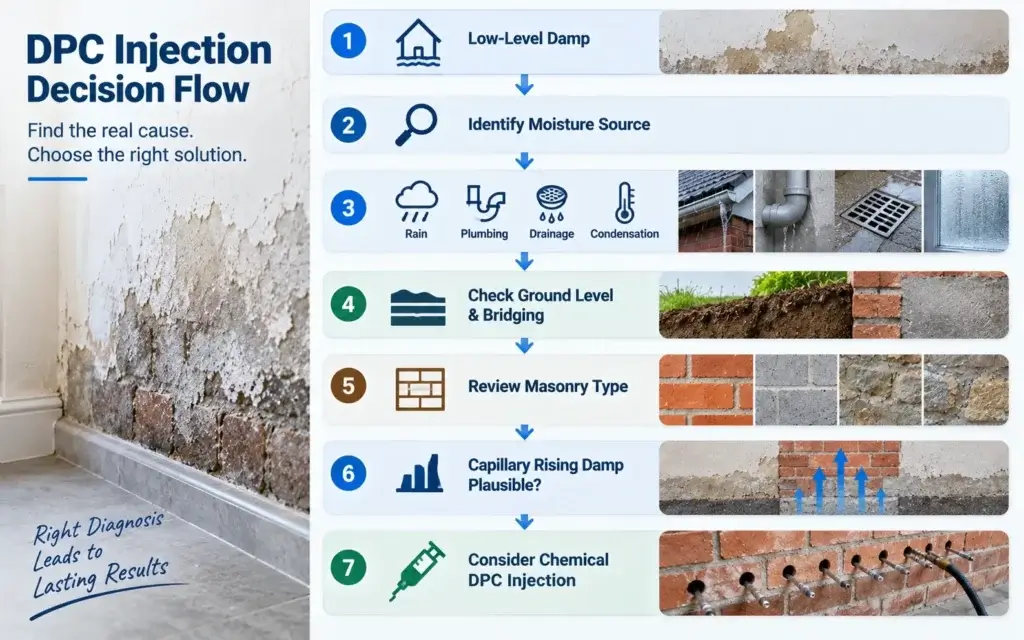
Step 1 — Confirm Rising Damp
Make sure the wall condition is genuinely consistent with capillary rising damp.
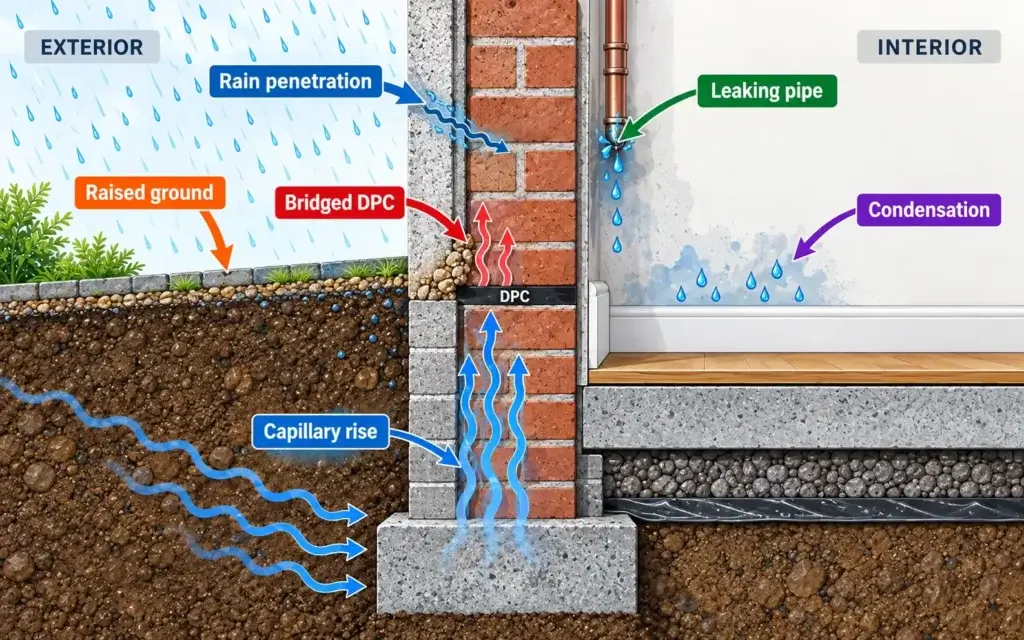
If the main problem is penetrating rain, leaking services, condensation, raised ground, or a bridged existing DPC, the first solution may be somewhere else.
Before comparing DPC materials, first confirm that the wall condition is actually consistent with ”rising damp before DPC injection”.
Step 2 — Define the Wall
Identify:
- masonry type;
- wall thickness;
- mortar structure;
- voids;
- and internal irregularity.
Step 3 — Check Moisture Conditions
Assess how wet the masonry is and whether it can dry.
This may change how a particular formulation spreads or redistributes.
Step 4 — Match the Application Method
Decide whether the contractor is better set up for:
- pressure injection;
- gravity feed;
- or cartridge application.
Step 5 — Compare the Actual Product Data
Review:
- chemistry;
- carrier;
- moisture limits;
- substrate compatibility;
- drilling requirements;
- and dosage.
Step 6 — Match the Product to the Contractor and Market
Consider:
- available equipment;
- packaging preference;
- training;
- supply format;
- and contractor familiarity.
Then choose the specific product, not just the format.
Frequently Asked Questions
Is Liquid DPC Better Than DPC Cream?
Not in every situation.
Liquid DPC can support pressure- or gravity-fed application and may fit professional injection workflows. Cream often reduces equipment requirements and simplifies per-hole placement.
The better choice depends on the product formulation, masonry, moisture condition, and installation method.
Does DPC Cream Penetrate Deep Enough for Thick Walls?
It can, depending on the product and the wall.
Wall thickness alone does not determine whether cream or liquid is suitable. Check the product’s drilling depth, dosage requirements, masonry compatibility, and installation guidance.
Can Liquid DPC Be Used Without a Pressure Pump?
Some liquid systems can.
YURU’s liquid DPC product can be applied by pressure injection or gravity feed, according to its PDS.
Other products may have different requirements, so check the manufacturer’s TDS.
Which DPC System Is Better for Rubble Stone Walls?
There is no single answer.
Rubble walls may contain variable thickness, voids, loose infill, and discontinuous mortar paths. Those conditions can affect both liquid distribution and cream placement.
Selection should be based on the actual wall construction, drilling plan, product formulation, and installation guidance.
Choosing Between Liquid DPC and DPC Cream for Your Market?
If you are evaluating DPC systems for contractor use, distribution, or private-label supply, send us:
- typical masonry type;
- wall thickness;
- moisture condition;
- contractor application method;
- available pumps or applicators;
- preferred package size;
- and current product specification.
YURU Waterproof can use this information to review whether a professional liquid DPC system fits your application and purchasing requirements.
YURU Product solutions