Why Is the Wall Still Damp After DPC Injection? Drying, Salts, or Treatment Failure?
Introduction
A wall that still looks damp after DPC injection does not automatically mean the treatment has failed.
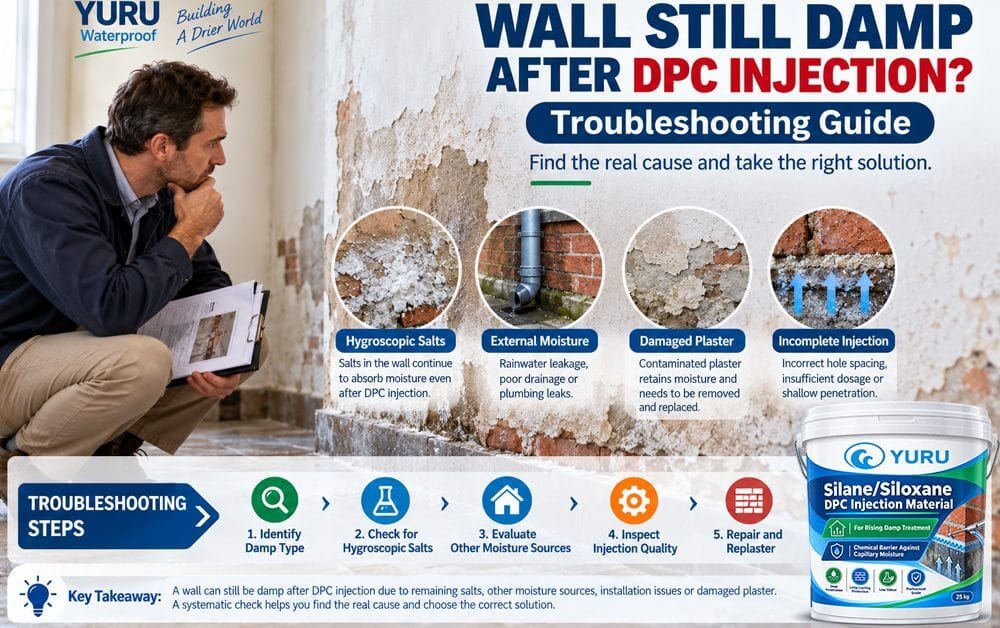
The wall may still be releasing moisture retained prior to treatment. Hygroscopic salts can keep plaster damp by absorbing moisture from the air. Old or replacement finishes may still be affected by salt contamination. The original DPC may be bridged, another source of water may still be active, or the evidence used to judge the wall may simply be incomplete.
There are also situations where the DPC application itself needs further investigation.
For contractors, this distinction matters because reinjection will not solve a salt, plaster, bridging or plumbing problem. Before recommending another treatment, the first job is to identify what is actually keeping the wall damp.
Quick Answer: Does Damp After DPC Injection Mean the Treatment Failed?
No. Damp after DPC injection is a symptom, not proof of treatment failure.
First check whether the wall is showing a gradual drying trend. Then consider hygroscopic salts and contaminated plaster, DPC bridging, leaks, rain penetration, condensation or another moisture route.
Do not base the diagnosis on one high moisture-meter reading alone. Electrical and dielectric readings can be affected by the masonry and by salts, so they need to be interpreted together with the damp pattern, changes over time and the condition of the building.
Investigate the DPC itself when these other explanations no longer fit the evidence.
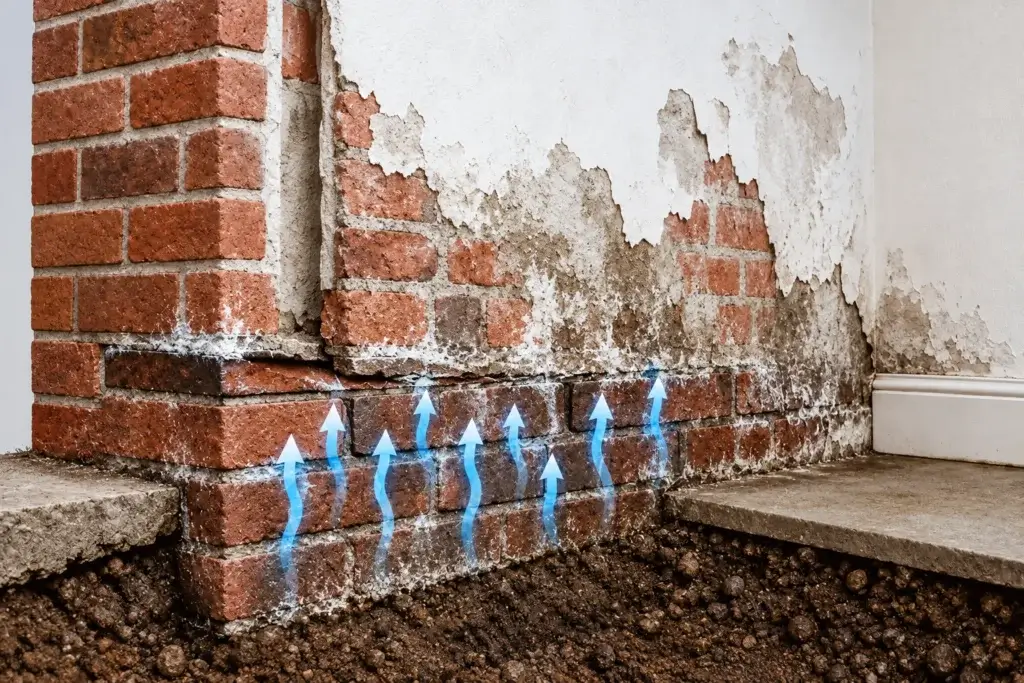
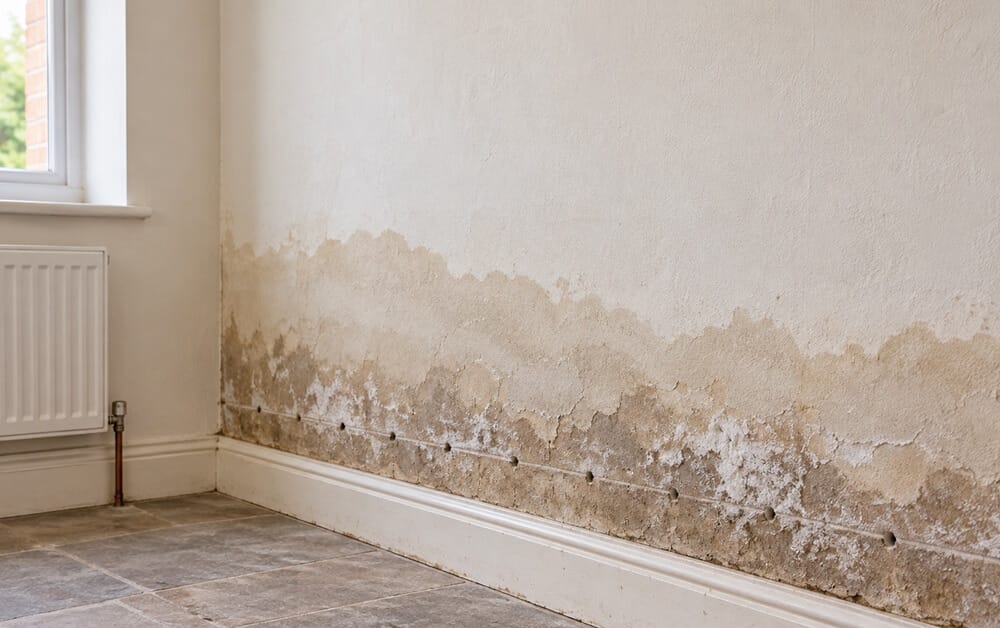
Why Can a Wall Stay Damp Even When the DPC Is Working?
A chemical DPC is designed to reduce or interrupt the upward movement of water by capillary action. It does not instantly remove moisture already stored in brick, mortar, stone or plaster.
Once the moisture source has been controlled, that stored water still has to move through the wall and evaporate.
This is why product reaction time and wall drying time are different timelines.
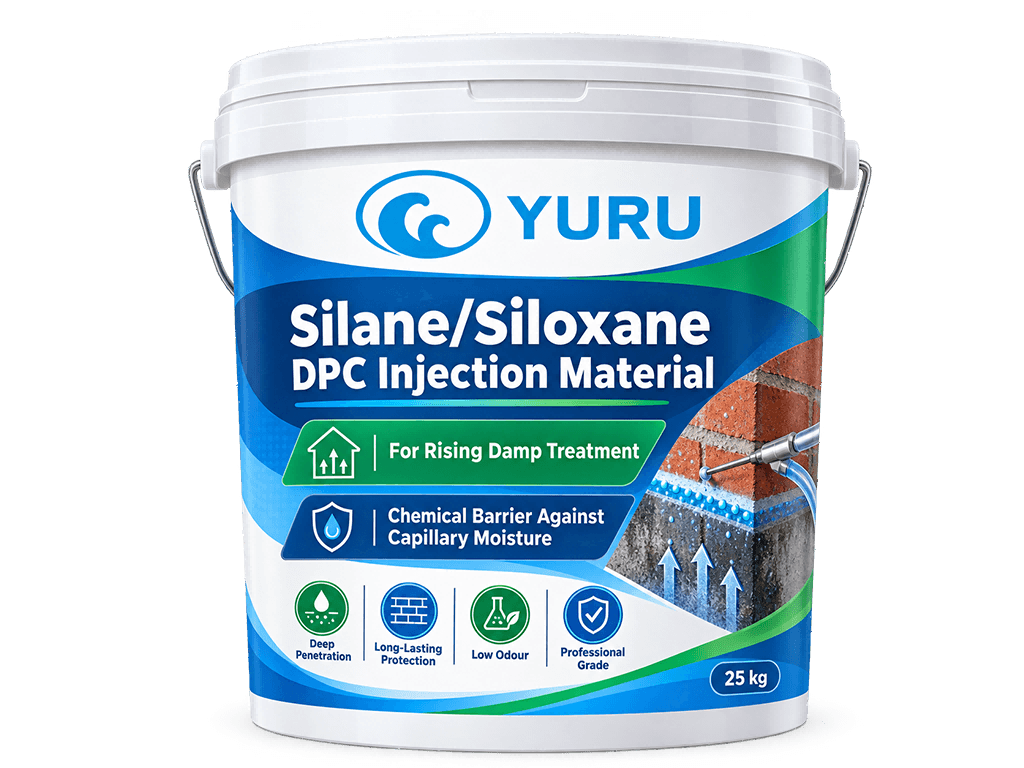
For YURU Premium Silane/Siloxane DPC Injection Material, the product data sheet gives a catalysis time of approximately 8–10 days. That figure describes the reaction of the material, not the time required for the complete wall to become dry.
The same product data states that after the chemical barrier is installed, the damp wall can begin drying naturally, with the delay varying according to wall thickness and construction material.
So a wall that is still damp after the product has reacted is not, by that fact alone, evidence of a failed DPC.
How Long Can a Wall Take to Dry After DPC Injection?
Drying after damp treatment is normally considered in months rather than days.
Current professional guidance states that damp-affected walls may take 1 to 12 months, or longer to dry. Wall thickness, permeability, heating and the presence of paints or renders can all affect the drying period.
That wide range is important. There is no universal point at which a wall suddenly changes from “normal drying” to “DPC failure.”
A thick wall may contain more stored moisture and provide a longer drying path. Dense construction may behave differently from more permeable masonry. Heating, ventilation and indoor humidity influence evaporation, while less permeable finishes can slow moisture release.
The better indicator is the direction of change.
If the wall is gradually becoming drier over repeated observations, continued drying remains a reasonable explanation. If the damp pattern shows little meaningful improvement, becomes more extensive or behaves in a way that no longer fits normal drying, the next stage of investigation becomes more important.
Recent 2026 guidance for historic buildings also recommends looking at moisture over time and in context rather than drawing conclusions from isolated observations.
Can Hygroscopic Salts Keep a Wall Damp After DPC Treatment?
Yes.
Rising damp carries soluble salts into masonry and plaster. When further capillary movement is controlled, those salts do not simply disappear.
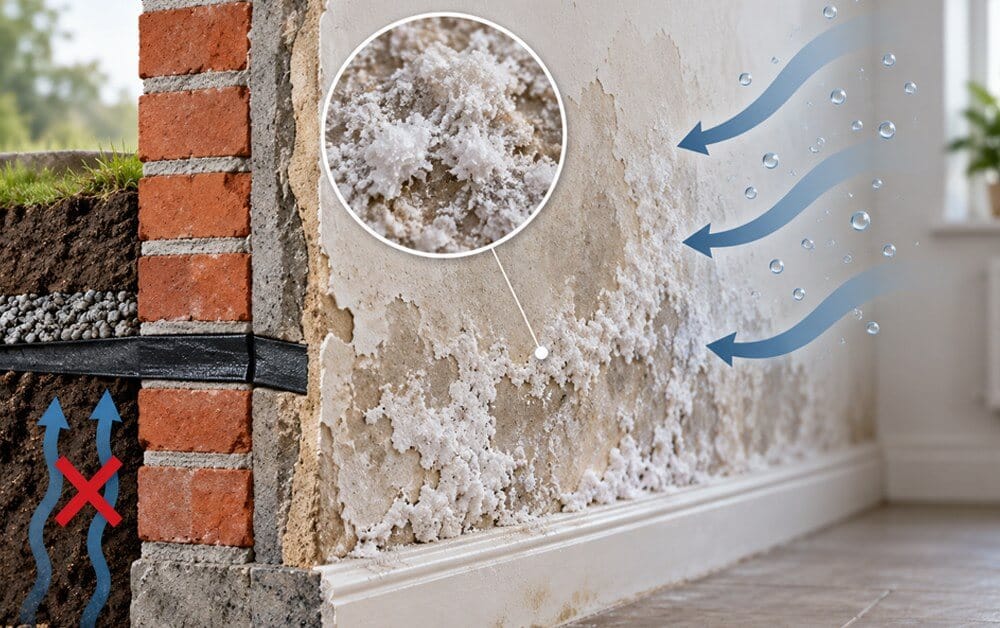
Certain chloride and nitrate salts are hygroscopic, absorbing moisture directly from ambient air. A wall may therefore appear or feel damp even when moisture is no longer supplied by ongoing capillary rise.
The sequence can look like this:
Previous rising damp → salt accumulation → DPC controls further capillary moisture → salts remain → salts absorb atmospheric moisture → surface still appears damp.
This is one of the main reasons that “still damp” and “DPC failed” should not be treated as the same diagnosis.
Salt-related dampness may become more pronounced as indoor relative humidity increases. That can be a useful clue, but it is not proof on its own because humidity also affects condensation and other moisture processes.
Visible white deposits should also be interpreted carefully. The salts most responsible for hygroscopic dampness are not necessarily the salts that are most visible on the wall. A clean-looking surface therefore does not rule out salt contamination.
Can Plaster or Wall Finishes Make the DPC Look Like It Failed?
Yes. Plaster condition and DPC performance are related but distinct considerations.
Plaster exposed to rising damp can hold salts even after the capillary moisture source is treated. If those salts continue attracting atmospheric moisture, the surface may remain stained, patchy or damp-looking.
Current guidance specifically warns that salt-contaminated walls can continue affecting new finishes and that apparent problems with replastering may occur even when free water is not obvious.
That does not mean every DPC project requires all plaster to be removed.
It means that persistent surface dampness should be checked against the plaster and salt condition before the chemical barrier itself is blamed.
A successful DPC controls the intended moisture route. It does not automatically remove historic salt contamination or restore a damaged decorative finish.
If the moisture source has been controlled and the next question is how to restore the wall finish, see when to replaster after DPC injection.
Could Another Moisture Source Still Be Active?
A chemical DPC addresses capillary rising moisture. It does not protect the wall against every possible source of water.
DPC Bridging
A DPC can be bypassed if moisture has another route around the barrier.
Examples identified in current professional guidance include raised soil or paths, plaster extending below the DPC, over-rendering, cavity or subfloor debris, solid floors and intersecting masonry.
In those situations, another injection may not solve the actual problem. The bridge itself needs to be investigated.
Other Water Sources
The wall may also be affected by a different source altogether.
Rain penetration, defective rainwater goods, leaking pipes or drains, poor drainage, groundwater and condensation can all create damp symptoms. Historic England’s 2026 guidance emphasizes investigating the building as a complete moisture system rather than assigning every damp patch to one assumed source.
The pattern can provide useful direction. Dampness that changes sharply after rainfall, appears around a local service defect or concentrates on cold surfaces should not automatically be interpreted in the same way as low-level capillary moisture.
Before investigating DPC failure, confirm that the remaining damp is actually related to the moisture route the DPC was intended to control.
If the original moisture source is still uncertain, first review how to tell whether a wall actually has rising damp before DPC injection.
Can a Moisture Meter Tell You Whether the DPC Failed?
Not by itself.
Electrical moisture meters are useful for comparing areas and identifying where further investigation may be needed, but current professional guidance states that readings in masonry are qualitative and comparative and can be affected by salts. It specifically warns that they cannot provide absolute proof of rising damp, particularly where remedial work has already taken place.
Salt contamination is particularly relevant after a history of rising damp. A 2025 experimental study found that soluble salts can significantly distort dielectric moisture measurements in heritage masonry.
A stronger post-DPC assessment combines the reading with:
- how the damp pattern changes over time;
- wall construction and thickness;
- evidence of salts or contaminated plaster;
- environmental conditions;
- possible alternative moisture sources;
- and treatment records where necessary.
A 2026 systematic review of rising-damp diagnostics in historic masonry likewise found that complementary diagnostic methods provide stronger information than relying on a single technique.
The practical rule is simple:
- Use the meter as evidence. Do not use the meter as the entire diagnosis.
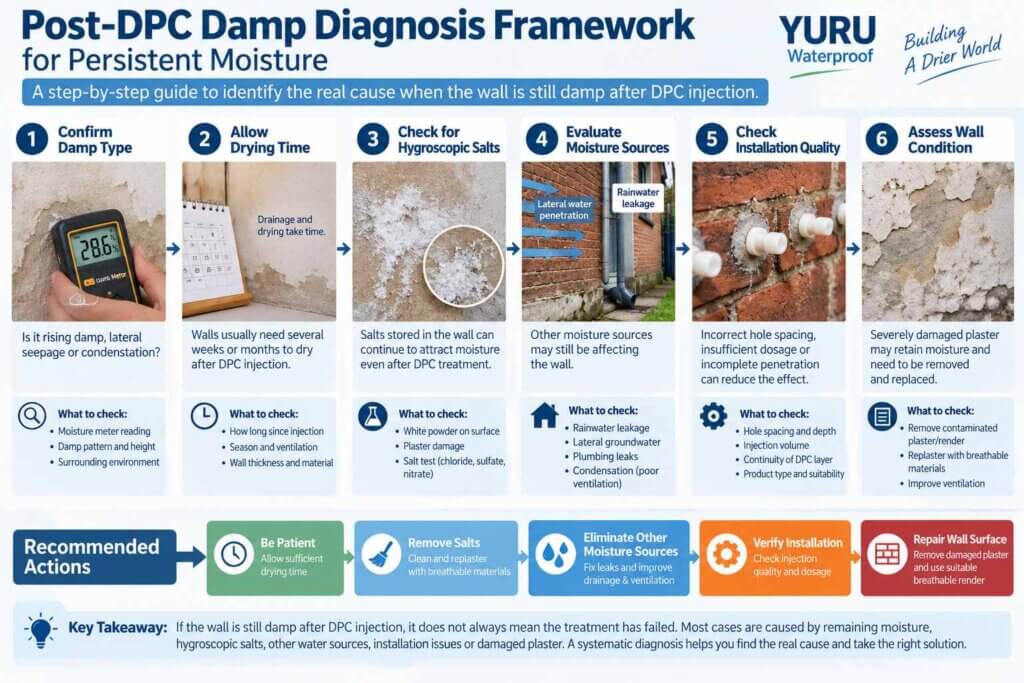
How Can You Tell Normal Drying From a Possible DPC Problem?
The main difference is not one isolated moisture reading or one fixed number of months. It is whether the overall evidence still fits a reasonable post-treatment drying process.
Normal drying remains plausible when:
The wall is showing a gradual improvement over time, the damp pattern is not spreading, another active water source is not apparent, and the remaining surface condition can reasonably be explained by stored moisture, salts or finishes.
In that situation, the next step may simply be continued monitoring.
The DPC deserves closer investigation when:
The wall has been monitored for a meaningful period but shows little improvement or a worsening pattern; salts, plaster and alternative moisture sources do not adequately explain what is happening; or project records raise questions about how completely the treatment was installed.
Irregular masonry, large internal voids or an incomplete treatment zone can also justify reviewing whether the chemical barrier developed where intended.
For the material-distribution side of this problem, see our guide to what affects liquid DPC penetration and distribution in masonry.
Recent controlled wall testing confirms that chemical DPC performance develops over time and varies between products and application arrangements, so one early surface observation is not enough to judge treatment performance.
These are reasons to investigate the DPC, not standalone proof that it has failed.
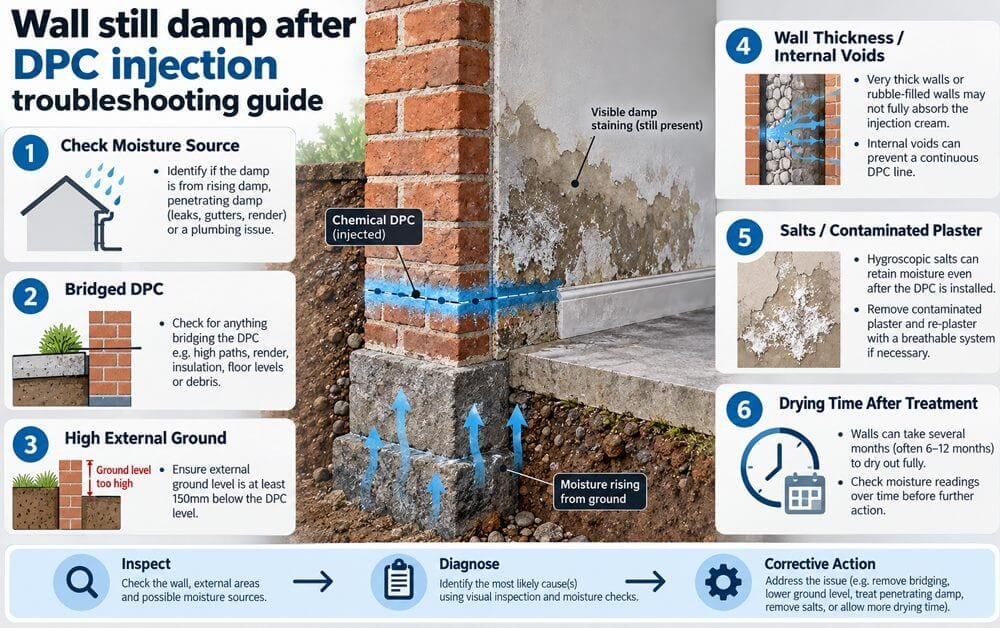
What Should You Check If the Wall Is Still Damp?
For a contractor or technical buyer, the following sequence is more useful than immediately deciding to reinject the wall.
| What you observe | What it may indicate | Recommended next step |
| Wall remains damp but the condition is gradually improving | Residual moisture is still drying | Continue monitoring |
| Dampness changes noticeably with indoor humidity or salt contamination is suspected | Hygroscopic salts / contaminated plaster | Investigate salts and finishes |
| Dampness follows rain, high ground level, a local leak or another building defect | Another moisture route remains active | Investigate and correct that source |
| The conclusion comes mainly from one meter reading or one visual symptom | Evidence is not strong enough yet | Verify the diagnosis |
| Little meaningful improvement is occurring and other causes do not explain the pattern | Application or treatment continuity may need review | Investigate DPC performance |
This sequence prevents two common mistakes.
First is reinjecting too early when the actual problem is drying, salts, plaster or another water source.
The second is the opposite: describing persistent damp as “normal drying” indefinitely when the evidence has reached the point where the treatment itself should be reviewed.
What Does This Mean for YURU Liquid DPC?
YURU Premium Silane/Siloxane DPC Injection Material is designed to form a chemical barrier against rising damp caused by capillary action. Its PDS specifies a catalysis time of approximately 8–10 days.
That period is not the expected drying time of the wall.
YURU’s technical information states that once the chemical barrier is installed, the wall can begin drying naturally, with the delay varying according to wall thickness and construction material.
If damp remains after treatment, the first response should therefore not automatically be another injection. Review the drying trend, salts and plaster, possible alternative moisture routes and the quality of the diagnostic evidence first.
If those checks do not explain the continuing damp, the original DPC application and treatment continuity can then be reviewed more closely.
Frequently Asked Questions
How Long Can a Wall Stay Damp After DPC Injection?
Current professional guidance states that damp-affected walls may take 1–12 months or longer to dry. Wall thickness, permeability, heating and surface finishes can all affect the drying period.
There is therefore no single deadline that proves success or failure. Look at the drying trend as well as the elapsed time.
Does Salt on the Wall Mean the DPC Has Failed?
No. Salts may remain from previous rising damp after the capillary source has been controlled. Hygroscopic salts can absorb moisture from the air and keep masonry or plaster damp-looking without proving that water is still rising through the wall.
Can a Moisture Meter Prove That DPC Injection Failed?
No. Moisture meters are useful diagnostic tools, but readings in masonry can be affected by salts and material conditions. They should be interpreted together with the damp pattern, trend and other building evidence.
Should DPC Be Injected Again If the Wall Is Still Damp?
Not automatically.
First determine whether the wall is still drying, whether salts or plaster explain the symptoms, whether another moisture route remains active and whether the existing evidence is strong enough to diagnose a treatment problem.
Reinjection should only be considered when the original DPC application or treatment continuity genuinely needs further investigation.
Still Seeing Damp After DPC Treatment?
If a wall remains damp after chemical DPC injection, send YURU Waterproof the treatment date, masonry type and wall thickness, application details, current damp pattern, visible salts or plaster damage, moisture readings, relevant ground conditions and project photos.
We can review the available project information to help identify whether the next step should focus on continued drying, salts and finishes, another moisture source, verification of the diagnosis, or the DPC application itself.
YURU Product solutions