Damp Proof Injection: How a Chemical DPC Protects Your Home from Rising Damp
Moisture appearing near the bottom of a wall is easy to notice. Working out why it is there is harder.
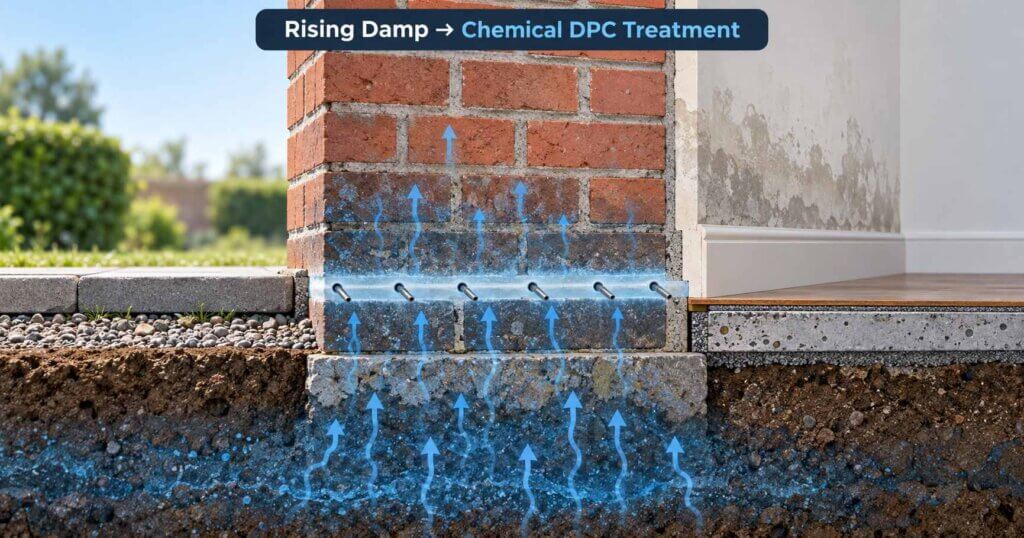
When the problem really is rising damp, moisture from the ground is moving upward through the porous structure of the masonry. An effective damp proof course is meant to interrupt that route. In an older building, however, the original DPC may be missing, damaged, ineffective or no longer doing the job it was designed to do.
Damp proof injection is one way of creating a remedial chemical DPC without physically cutting a new membrane through the wall.
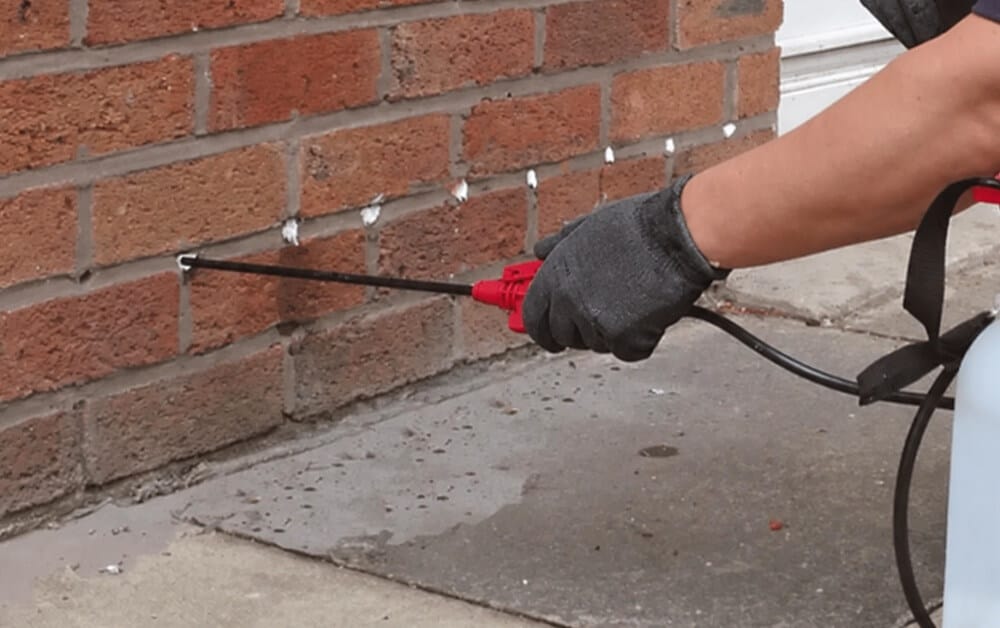
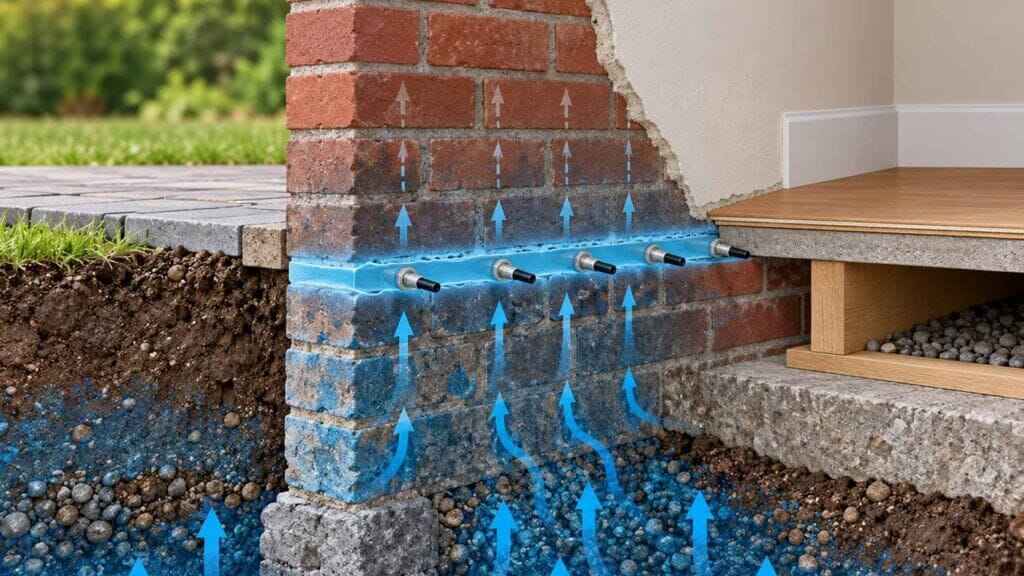
The treatment is introduced into the lower part of the masonry, where it develops a water-repellent zone. Its purpose is to make continued capillary movement of ground moisture more difficult.
That sounds straightforward, but the material does not simply “fill the wall with waterproofing.” What happens inside the masonry matters just as much as putting the product into it.
How Does Damp Proof Injection Work?
A chemical DPC works inside the wall rather than on its visible surface.
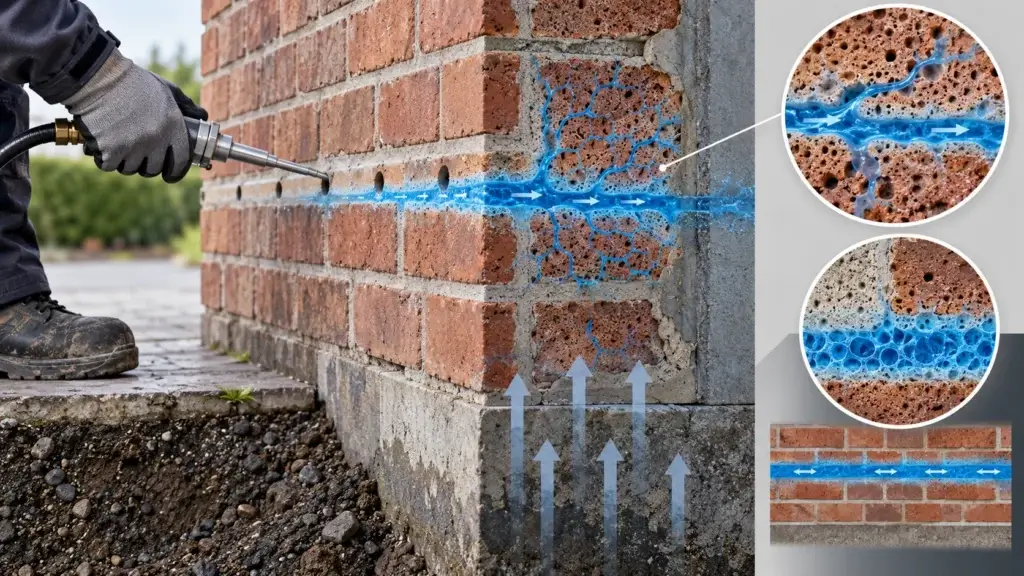
Treatment goes into a selected area near the base of the masonry. Then it needs to penetrate the porous material around it and develop water-repellent properties to control capillary moisture.
The process can be pictured quite simply:
Ground moisture enters the lower wall → Water moves upward through connected pores → Chemical DPC treatment develops in the masonry → The treated zone becomes more water-repellent
↓
Further capillary rise is reduced
That is different from applying a waterproof coating to the face of a wall. A chemical DPC works within the masonry, across the route that rising moisture would otherwise continue to use.
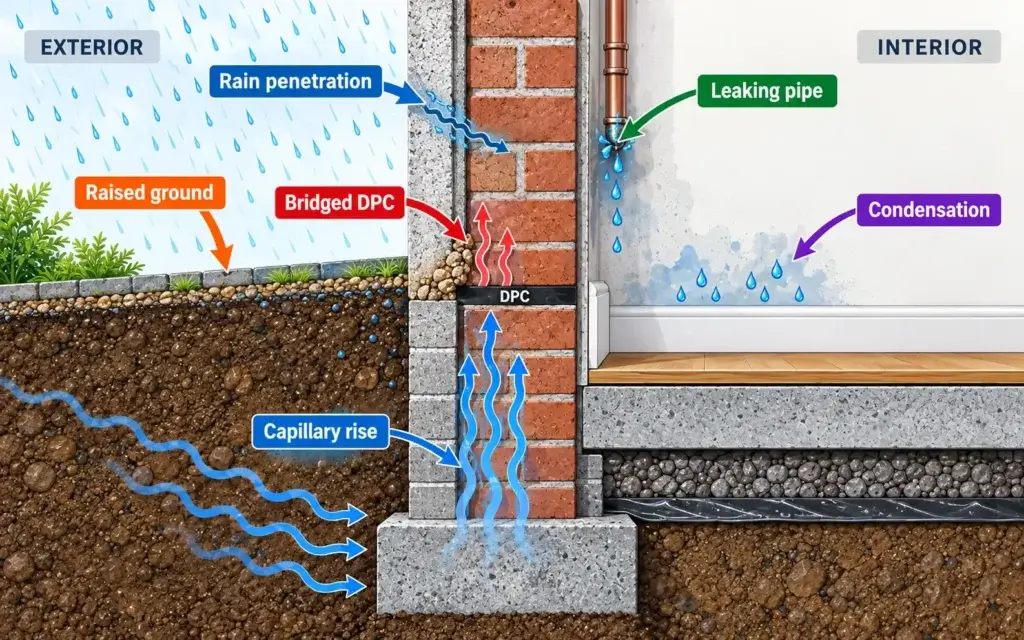
It also has a specific job. If water is entering through cracked render, bad drainage, a leaking pipe, or condensation — DPC injection won’t remove those causes.
Why Can Water Rise Through Brick and Masonry?
Brick and mortar look solid — but under a microscope, they’re full of pores.
Some of those pores are connected. When the lower part of a wall remains in contact with moisture from the ground, water can be drawn into those spaces and move upward.
Different walls behave differently.
A dense brick, a soft historic brick, mortar, concrete block and natural stone do not absorb or transport water in exactly the same way. Wall thickness, moisture level and internal construction also affect what happens.
This is one reason a damp patch near floor level should not automatically lead to a DPC injection.
Before choosing a material, the source of the moisture needs to make sense. If the diagnosis is uncertain, identifying rising damp before DPC injection is a better starting point than choosing the product first.
What Happens to the Chemical DPC Inside the Wall?
For a liquid injection system, the material enters the porous masonry and moves into the surrounding treatment area.
How far and how evenly it moves depends partly on the wall.
A regular brick wall is completely different inside from rubble-filled stonework. Even two walls of the same brick can behave differently if one is wetter, thicker, or more deteriorated.
With a silane/siloxane DPC system, the aim is to develop water repellency within the treated masonry. The intention is not to fill every pore solid. Instead, the treatment changes how readily liquid water can continue moving through that part of the wall.
YURU’s current DPC material is a single-component, high-fluidity liquid silane/siloxane system intended for professional rising damp treatment. Its formulation is designed for good wetting and penetration into porous masonry.
Once the treatment develops, the wall is still masonry. It hasn’t become an impermeable plastic layer or suddenly protected from every possible water source.
The job of the chemical DPC is narrower: reduce the capillary route used by rising ground moisture.
Why Isn't Injecting Material Into the Wall Enough?
Because putting material into a wall and treating the wall effectively are not quite the same thing.
The material has to reach enough of the masonry around the injection area for the treatment to act across the moisture route.
If most of the material stays concentrated around isolated entry points, sections of untreated masonry may remain between them.
Water can continue to find connected capillary paths through those areas.
So the real work happens around and between the points where the material enters.
Wall porosity, internal voids, moisture condition and construction all influence liquid DPC penetration and distribution in masonry.
That’s also why the same DPC material may need more technical attention in a rubble-filled wall than in regular brickwork.
Does Damp Proof Injection Always Mean DPC Cream?
No.
DPC cream has become very familiar in the rising damp market, especially in the UK. It is one way of introducing a chemical damp proof course, but it is not the only one.
Liquid DPC systems are also used.
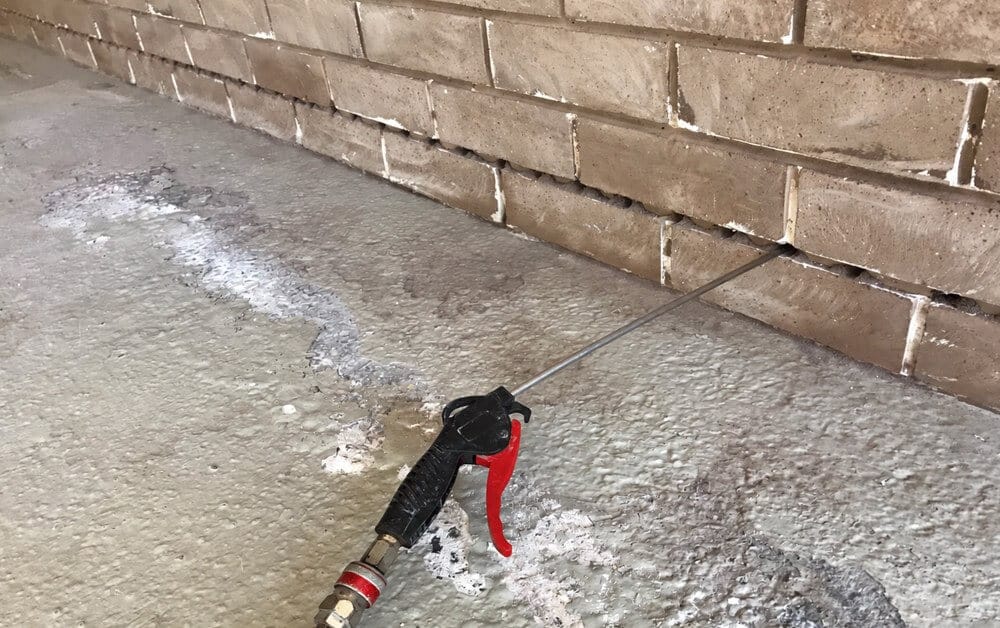
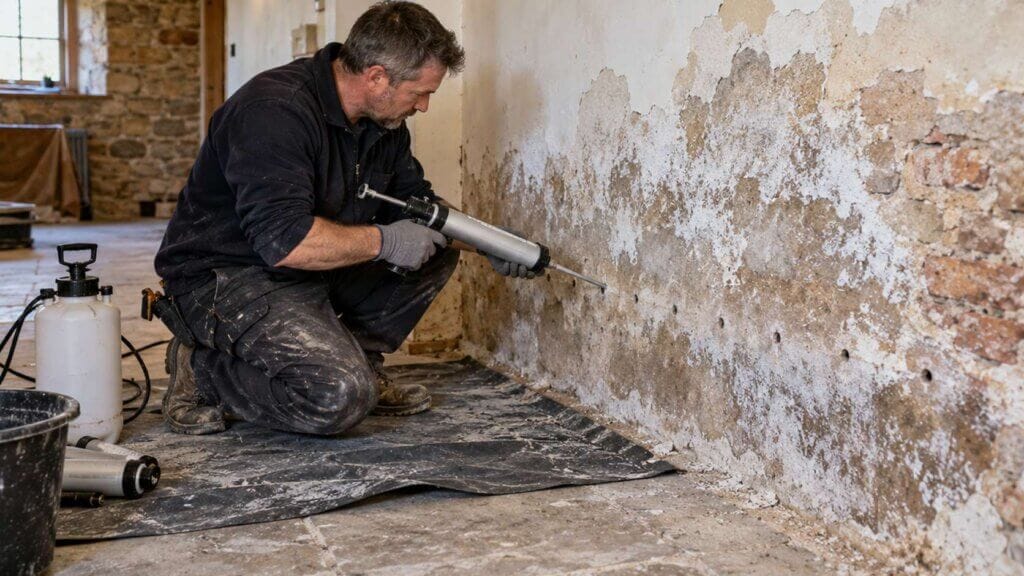
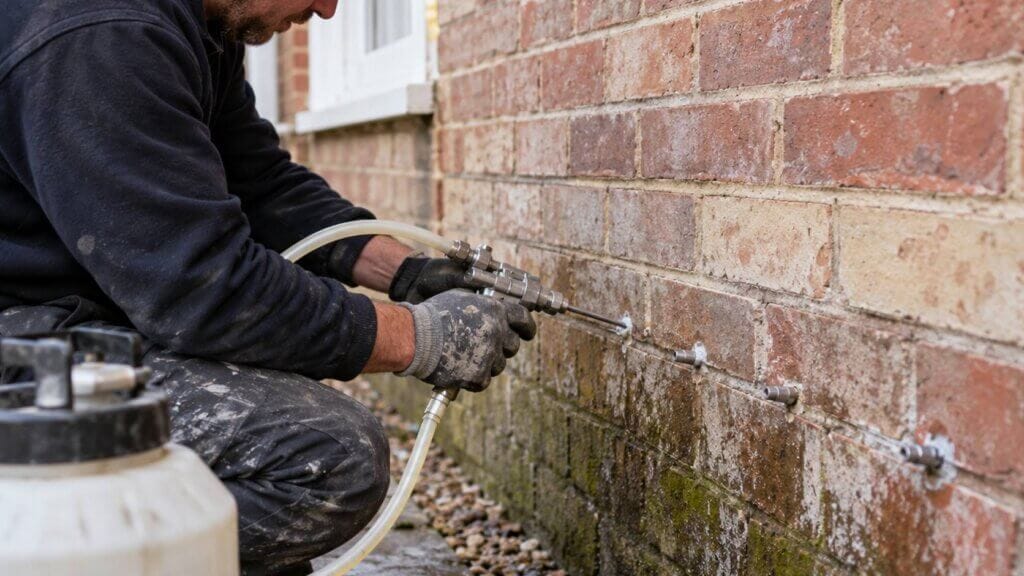
Depending on the product and project, liquid material may be introduced using pressure equipment, gravity feed or another system specified by the manufacturer.
YURU’s DPC product is a high-fluidity liquid, rather than a paste or cartridge-type cream. The current product supports pressure injection and gravity application.
There is little value in treating “liquid” and “cream” as if one format must always be better.
They are different material and application systems. The better question is whether the selected system suits the masonry, moisture condition and way the project will actually be carried out.
If the format itself is the decision you are making, liquid DPC injection vs DPC cream deserves to be compared separately.
What Can Affect the Result of a Chemical DPC?
The first factor is diagnosis.
Chemical DPC injection is for capillary rising damp. It won’t solve condensation in a poorly ventilated room or stop rain coming through a damaged exterior wall.
The second factor is the wall itself.
Regular brickwork is usually easier to understand than irregular stonework with cavities, rubble or large internal voids. A product can suit a masonry type — but not every wall made from that material behaves the same way.
Then there is the treatment system. The product needs to be used in the way it was designed to be used.
Once the moisture source, wall construction and material are clear, the application plan can be based on the actual project rather than a generic DPC rule.
Where the wider treatment decision is still uncertain, the broader question of damp proof injection for rising damp should be resolved before moving into product selection.
Will the Wall Be Dry Once the Chemical DPC Has Reacted?
Usually not.
Two different things are happening after treatment:
the chemical DPC is developing
and
the existing moisture is leaving the wall.
Those timelines are not the same.
For the current YURU liquid DPC system, the stated catalysis period is approximately 8–10 days. That refers to the material reaction period. It should not be read as “the wall will be dry in 8–10 days.”
Moisture already present within brick, mortar, or stone requires additional time to leave.
A thick wall can hold more moisture than a thin one. Dense masonry may behave differently from highly porous masonry. Temperature, ventilation and the finishes on the wall can also influence drying.
So a wall can still look or feel damp even though the chemical treatment is starting to work.
If that continues, why a wall may still be damp after DPC injection should be investigated before deciding that the treatment has failed.
Where Does YURU Liquid DPC Fit?
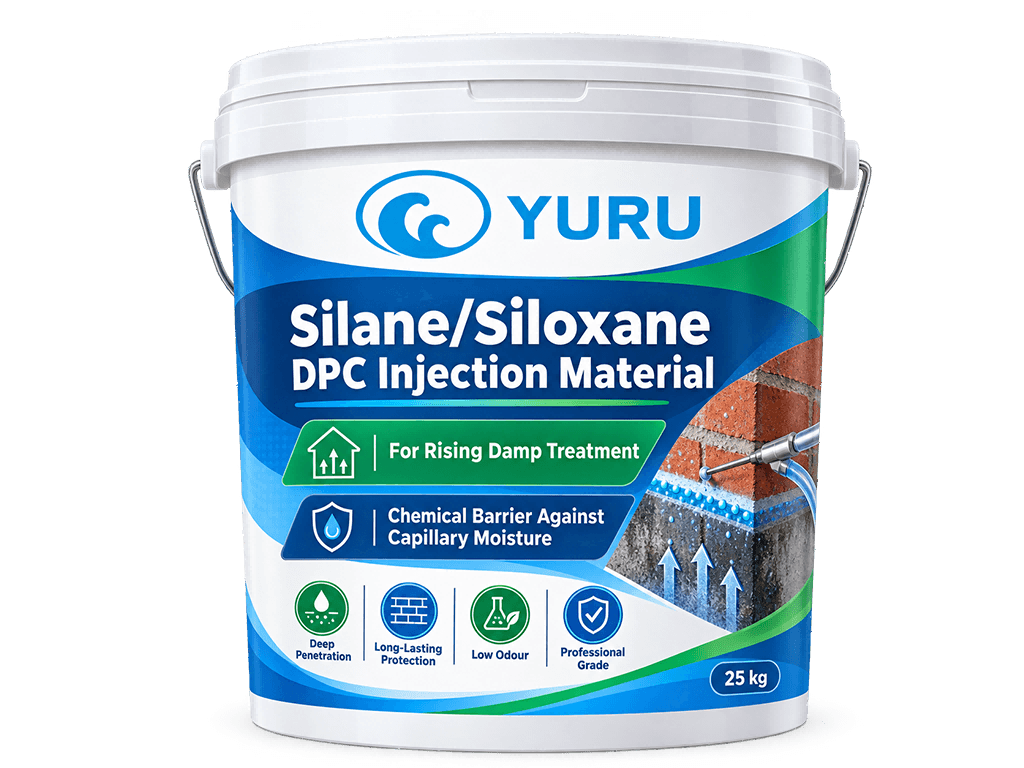
YURU Premium Silane/Siloxane DPC Injection Material is designed for professional treatment of capillary rising damp.
It is a single-component, high-fluidity liquid based on reactive siloxane chemistry. The product is intended to enter porous masonry and develop a water-repellent treatment within the lower part of the wall.
The current product guidance includes masonry such as brick, concrete blocks, stone and other compatible porous wall materials. Pressure injection and gravity application are both supported.
For a regular wall, the product guidance gives the contractor a clear starting point.
Irregular construction needs more thought.
If the wall contains rubble, large voids, cavities or major changes in thickness, those conditions should be understood before the normal application guidance is repeated across the whole project.
That is the difference between checking whether a product is compatible with masonry and checking whether the application plan makes sense for a particular wall.
What Should You Know Before Choosing a DPC Injection Material?
I would not start with litres, price or drilling equipment.
Start with the wall.
Essential information includes wall composition, approximate thickness, whether construction is solid or irregular, and whether the moisture pattern genuinely indicates rising damp.
For contractors, distributors, and technical buyers, a limited set of project details is typically sufficient to initiate a productive product discussion:
- wall material;
- approximate wall thickness;
- solid, cavity or rubble construction;
- visible moisture condition;
- available site photos;
- planned professional application method, if already known.
Material selection should follow wall assessment, not precede it.
Once these fundamentals are established, product quantity, application parameters, and technical documentation become substantially easier to evaluate.
Frequently Asked Questions
Does damp proof injection make the whole wall waterproof?
No.
A chemical DPC treats a selected zone near the lower part of the wall. It is intended to reduce capillary moisture moving upward through that area.
It does not stop rain penetration, plumbing leaks or every other possible form of moisture entering a building.
Is damp proof injection the same as DPC cream?
No.
DPC cream is one form of chemical damp proof treatment. Liquid DPC systems are another.
YURU’s current system is a high-fluidity liquid rather than a paste-type injection cream.
Does the wall dry as soon as the DPC treatment reacts?
No.
The chemical treatment and wall drying are separate processes.
For YURU’s current liquid DPC, the product catalysis period is approximately 8–10 days, but moisture already stored in the wall still needs additional time to leave.
Can damp proof injection treat condensation?
No.
Condensation comes from a different moisture mechanism. The same applies to rain penetration and leaking pipes.
Damp proof injection is intended for capillary rising damp where a remedial chemical DPC is appropriate.
Evaluating a Chemical DPC for a Project?
If you are considering a liquid DPC for an existing masonry wall, send us the wall material, approximate thickness, construction type, moisture condition and several site photos.
YURU can use that information to review whether the liquid DPC system fits the application before moving into material quantity, application guidance and technical documentation.
YURU Product solutions