Damp Proof Injection for Rising Damp: How It Works, When It Fits, and What to Check
Damp proof injection is a remedial way of installing a chemical damp-proof course to control rising damp. It is not a treatment for every damp wall, and it does not refer to one specific injection cream.
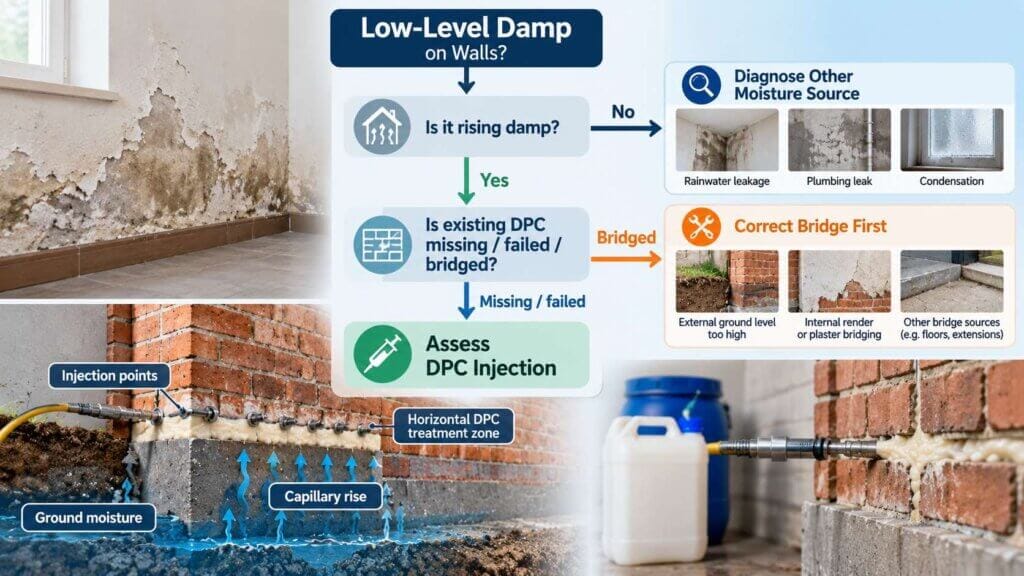
Before selecting a system, three questions need to be answered: Is the moisture actually rising damp? Is a new remedial DPC really required? Is the proposed system suitable for this particular wall?
Those questions come before the choice between cream and liquid, pressure and gravity, or any specific product.
Quick Answer: What Is Damp Proof Injection?
Damp proof injection is a remedial method used to create a chemical damp-proof course in a wall where capillary rising damp has been correctly identified and an injected DPC is appropriate.
A suitable damp-control material is introduced into a planned treatment zone. The material then distributes and/or reacts according to its formulation so that the treated zone can reduce further capillary moisture movement.
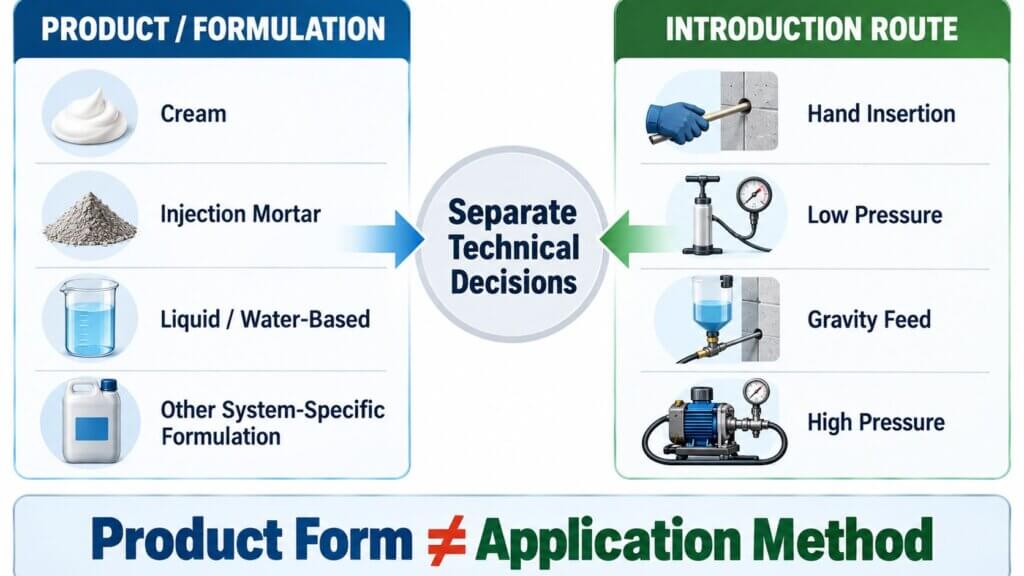
Injection cream is one common chemical-DPC product format, but it is not the whole category. Chemical DPC materials vary both in product formulation and in how the material is introduced into the wall, and these are separate selection decisions. PCA guidance, for example, distinguishes hand insertion, low-pressure injection, gravity feed and high-pressure injection as application routes.
Before treatment, the moisture source, existing DPC condition, possible bridging and wall construction should all be checked.
What Problem Is Damp Proof Injection Designed to Solve?
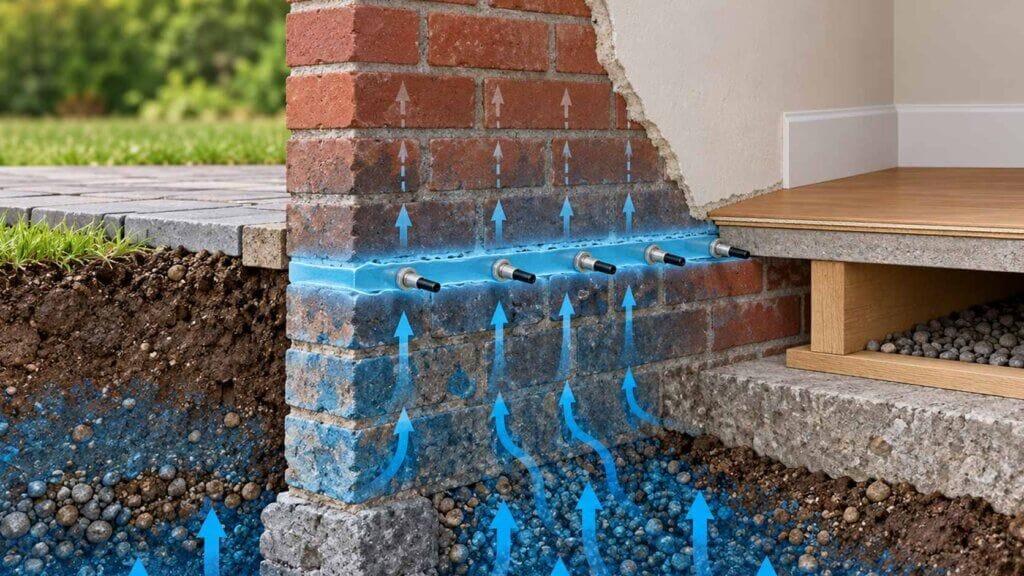
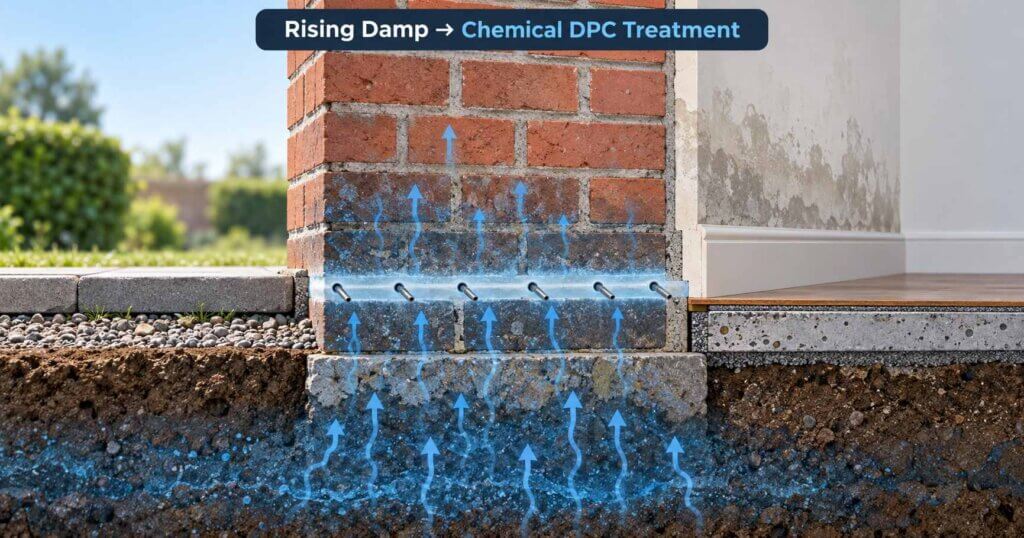
Damp proof injection is intended to control rising damp, where ground moisture moves upward through porous wall materials by capillary action.
The PCA Code defines rising damp as the capillary movement of water in masonry from below to above ground level. SPAB similarly distinguishes rising damp from moisture problems such as rain penetration and condensation, which require different responses.
Low-level dampness alone is therefore not enough to establish that a new chemical DPC is required.
If the actual moisture source is penetrating rain, condensation, leaking services or another form of water ingress, injecting a DPC will not correct that source simply because the lower part of the wall is wet.
Confirm that capillary rising moisture is actually the problem before selecting a DPC material.
Where the cause remains uncertain, investigate the moisture mechanism first. A treatment decision based on the wrong diagnosis can leave the original moisture route unchanged.
If the moisture source is still uncertain, first check how to identify rising damp before DPC injection.
When Is Damp Proof Injection Actually Appropriate?
Damp proof injection becomes relevant after two questions have been answered:
Is the moisture really rising damp?
and
Is a new remedial DPC actually required?
Chemical DPC treatment may be considered where rising damp has been properly identified and the existing building no longer has an effective damp-proof barrier for the condition being treated. The wall construction and the proposed system must then be assessed before treatment is specified.
PCA guidance puts diagnosis and investigation ahead of remedial treatment selection. It also notes that age, construction type and heritage significance can affect the appropriate approach.
A useful sequence is:
Rising damp identified → existing DPC assessed → need for remedial DPC established → wall suitability checked → DPC system selected.
This keeps the treatment decision tied to the building condition rather than starting with a product and assuming the wall is suitable for it.
When Is Another DPC Injection Not the First Step?
Visible moisture does not automatically mean an existing DPC has failed.
The Existing DPC May Be Bridged
A damp-proof course can remain present while moisture bypasses it through another part of the construction.
PCA guidance identifies higher ground levels, bridging plaster or render, and debris within cavities as examples that can compromise an existing DPC. Where the bridge can be removed, correcting it may be sufficient to control the capillary moisture route.
A bridged DPC is not the same as a failed DPC.
If an otherwise functioning barrier is being bypassed, another chemical DPC may not correct the actual defect. The bridge and the condition of the existing barrier should be investigated first.
Another Moisture Source May Be Active
Rain penetration, condensation, leaking services and other moisture sources can produce symptoms that overlap with rising damp.
Where another source remains plausible, identify and correct that source before assuming another DPC is needed. Chemical DPC injection is intended to control capillary rising moisture; it cannot substitute for repairing an unrelated route of water entry.
Traditional Construction May Need a Different Assessment
Older and traditionally constructed buildings require greater caution.
SPAB advises against treating retrospective DPC installation as a routine response in pre-c.1919 traditional buildings. Its guidance advises avoiding physical and chemical DPCs in earth buildings and notes particular treatment difficulties in flint and rubble-cored walls.
That does not create a universal prohibition on chemical DPC treatment in every old building. It means that construction type, building behaviour and heritage significance form part of the suitability assessment.
How Does Damp Proof Injection Work Inside a Wall?
The exact mechanism depends on the chemical DPC material being used.
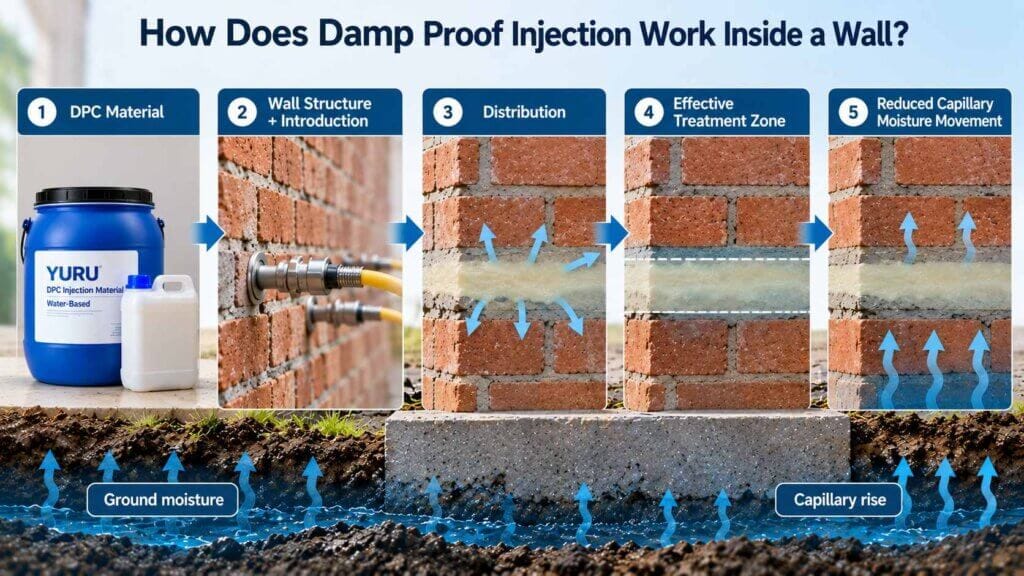
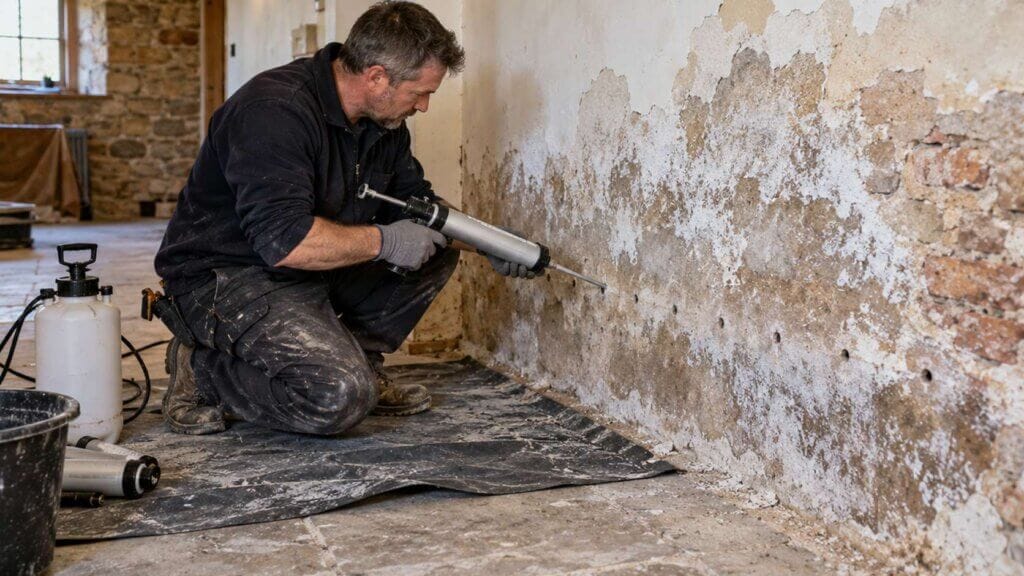
At a general level, a treatment zone is selected according to the wall construction and the product specification. The chosen DPC material is then introduced into that zone using an application route appropriate to the system.
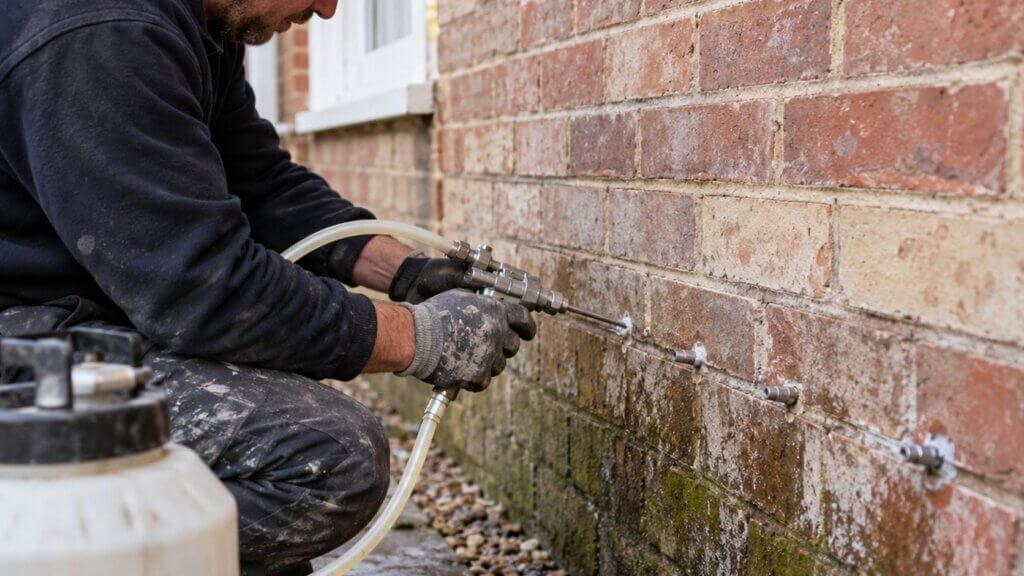
PCA groups chemical DPC application into four broad routes: hand insertion, low-pressure injection, gravity feed and high-pressure injection.
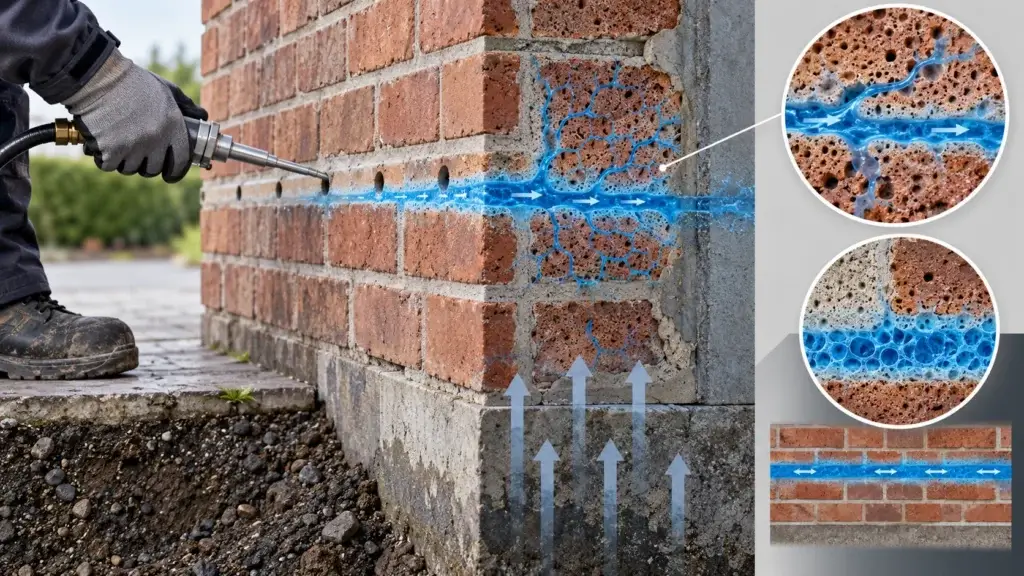
Once introduced, the material distributes and/or reacts according to its formulation and the characteristics of the substrate. Some cream-based silane or siloxane systems are designed to spread from their application points and subsequently develop water-repellent properties within the treated zone. That mechanism should not be assumed to describe every chemical DPC formulation in exactly the same way.
The engineering objective is to develop an effective treated zone that limits further capillary moisture movement.
Why Treatment Continuity Matters?
Successful treatment depends on the DPC system developing an effective treatment zone, not simply on drilling holes and introducing chemical.
The relationship can be summarized as:
Formulation + wall construction + introduction route → distribution → treatment continuity → capillary moisture control
Wall geometry, mortar condition, voids, thickness and product characteristics can all affect distribution. In thick, mixed or irregular masonry, these variables can become especially important when determining whether the selected system can treat the intended part of the wall effectively.
For a deeper technical explanation, see what affects liquid DPC penetration and distribution in masonry.
Is Damp Proof Injection Always a Cream?
No.
DPC injection cream is one common product format used in chemical damp control, but chemical DPC products are not limited to cream.
PCA’s current surveyor syllabus refers to commonly used chemical damp-control products including creams, injection mortars, and solvent- and water-based variants. Separately, PCA treatment guidance categorizes material introduction as hand insertion, low-pressure injection, gravity feed or high-pressure injection.
This creates two distinct technical questions:
What formulation or product system is being specified?
and
How is that material intended to be introduced into the wall?
A cream may be designed for hand insertion. A liquid system may support pressure, gravity or another manufacturer-specified application method.
Damp proof injection therefore describes the treatment route; injection cream is one product format used within that route.
If the project has reached the formulation-selection stage, compare liquid DPC injection vs DPC cream before choosing the material system.
Which Damp Proof Injection Methods Are Used?
Chemical DPC materials can be introduced in several ways. PCA groups the principal routes into hand insertion, low-pressure injection, gravity feed and high-pressure injection. Hand insertion is commonly associated with thixotropic products, while other systems may use pressure or gravity according to the formulation and wall conditions.
These categories describe how the material enters the wall. They are not a best-to-worst ranking.
Higher pressure does not automatically mean better treatment, and gravity is not automatically suitable because the equipment is simpler. The appropriate route depends on the selected material, the construction and the manufacturer’s application requirements.
The application route should therefore be selected as part of the complete DPC system rather than as an isolated equipment choice.
For projects considering liquid systems, the next decision may be whether pressure injection or gravity feed better matches the wall and equipment.
Does Damp Proof Injection Fit Every Type of Wall?
No single chemical DPC system should be assumed to fit every wall.
Predictable brick or block construction may present different treatment conditions from thick stone walls, mixed masonry, rubble cores, cavities or construction containing significant internal voids.
The distinction between material compatibility and whole-wall suitability is particularly important.
A product may be compatible with brick, stone or rubble as a material, while the actual wall still presents challenges because of its thickness, internal geometry, mortar condition, void structure or construction history.
Traditional buildings add further considerations. SPAB advises a cautious approach to retrofit DPC work in old construction and specifically identifies earth, flint and rubble-cored walls as cases where normal remedial assumptions may not apply.
The project question is therefore broader than:
- Can this chemical be used on this masonry material?
It is:
- Can the complete DPC system be applied and develop an effective treatment zone in this particular wall?
What Should Contractors and Buyers Check Before Choosing a DPC Injection Material?
For contractors, distributors and technical buyers, product selection should begin with the wall and moisture condition.
| Check | Why It Matters |
| Moisture diagnosis | Confirms that the product is being used for the moisture mechanism it is designed to control |
| Existing DPC and bridging | Establishes whether a new remedial DPC is actually required |
| Wall construction | Thickness, masonry type, cavities and internal geometry can affect suitability |
| Product formulation | Cream, liquid, mortar and other systems have different handling and distribution characteristics |
| Introduction route | The product may require hand insertion, gravity or pressure-based application |
| Treatment and distribution requirements | The selected system must be capable of developing an effective treatment zone in the real wall |
| Technical documentation | TDS, SDS and application instructions define product-specific parameters, handling and limitations |
PCA advises contacting the manufacturer where the suitability of a particular chemical DPC system is uncertain.
Product selection should therefore combine site conditions with the manufacturer’s technical documentation rather than relying only on concentration, marketing claims or price.
What Happens After Damp Proof Injection?
A correctly specified and installed chemical DPC is intended to reduce further capillary moisture rise. It does not remove moisture already retained within the masonry; immediate wall drying should therefore not be anticipated.
If the capillary route is controlled and no significant alternative water source remains, the masonry keeps drying over time. Drying rate depends on wall construction, moisture load, environmental conditions, and finishes.
Salt contamination stays relevant after treatment too. Ground moisture leaves hygroscopic salts in masonry and plaster, and these salts keep affecting surface moisture. PCA treats control of capillary moisture and management of hygroscopic salts as two separate considerations in rising-damp treatment.
Assess existing plaster and finishes by actual condition. Salt contamination, plaster deterioration, wall construction, and the restoration system all affect whether the next step is continued drying, local repair, or replastering.
If damp symptoms persist after treatment, the cause should be investigated before concluding that the injected DPC has failed. See why a wall may still be damp after DPC injection for the main post-treatment checks.
Damp Proof Injection Decision Framework
The decision becomes clearer when diagnosis and building conditions are considered before product selection.
| Wall or Project Condition | Next Step |
| Moisture mechanism is still uncertain | DIAGNOSE FIRST |
| An existing DPC is being bypassed or another moisture route remains | CORRECT THE MOISTURE ROUTE FIRST |
| Rising damp is confirmed, a remedial DPC is genuinely required and the wall is suitable | PROCEED TO DPC SYSTEM SELECTION |
| Traditional, historic, earth, highly irregular or otherwise difficult construction changes treatment suitability | SPECIALIST / CONSERVATION REVIEW |
Where the moisture diagnosis or route remains unresolved, investigate before selecting a chemical product. Once rising damp and the need for a remedial DPC have been established, formulation, application route and treatment-distribution requirements can be evaluated.
Buildings with construction or heritage conditions that materially change treatment suitability may require specialist assessment before a retrofit DPC is specified.
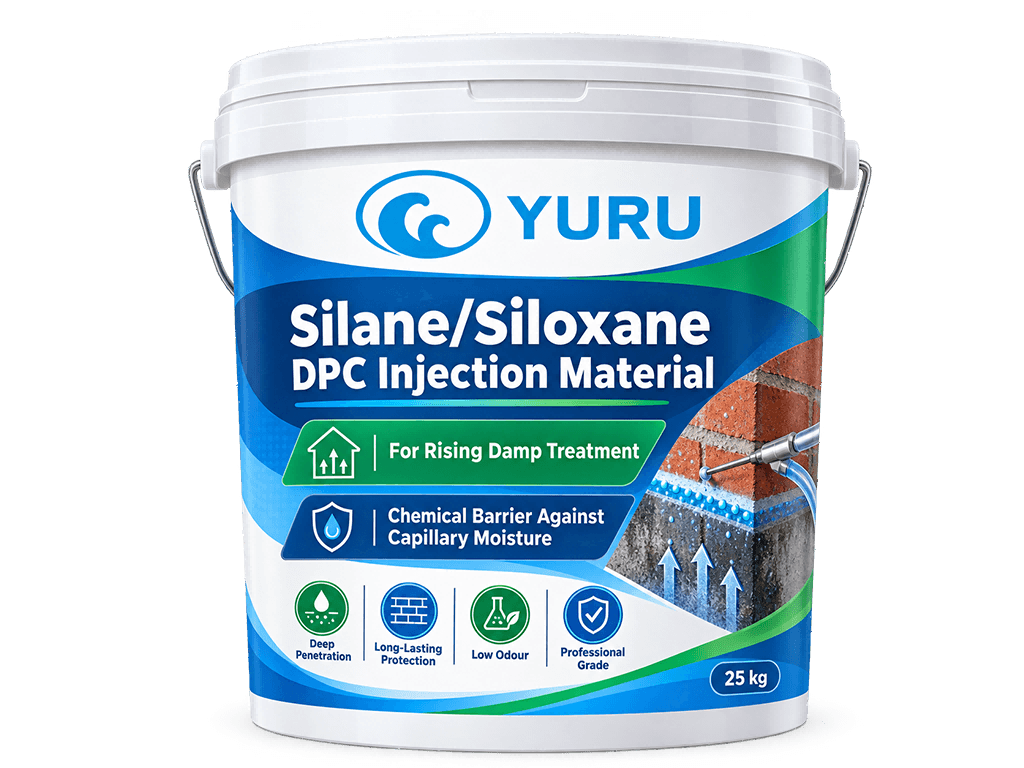
YURU Liquid DPC: A Liquid Silane/Siloxane Option Within Chemical DPC Injection
YURU Premium Silane/Siloxane DPC Injection Material is a high-fluidity liquid/emulsion system based on reactive polydimethylsiloxanes. Its product data sheet states that the material is designed to form a chemical barrier against rising damp caused by capillary action and gives a product-specific catalysis period of approximately 8–10 days.
YURU product supports both pressure and gravity application, using suitable injection equipment for the selected route.
This provides a practical example of why product formulation and introduction route are different technical variables. The characteristics above apply to the YURU product and should not be treated as universal parameters for every chemical DPC system.
Frequently Asked Questions
Is Damp Proof Injection the Same as DPC Injection Cream?
No.
DPC injection cream is one product format used within chemical damp-proofing. PCA training material also recognizes injection mortars and solvent- and water-based chemical variants. Hand insertion, pressure and gravity describe how a selected product may be introduced rather than defining the product formulation itself.
Does Damp Proof Injection Work for Every Damp Wall?
No.
Damp proof injection is intended for capillary rising damp where a remedial DPC is appropriate. Penetrating rain, condensation, plumbing leaks, lateral moisture and bypassed existing DPCs require diagnosis and treatment that address those specific moisture routes.
Wall construction can also change whether a retrofit chemical DPC is suitable or whether more specialist assessment is needed.
How Long Does Damp Proof Injection Take to Work?
There is no universal time that applies to every product and every wall.
Chemical reaction and treatment development depend on the selected formulation and manufacturer specification. Whole-wall drying is a different process because moisture already stored within the masonry still has to dissipate after further capillary supply has been controlled.
Product reaction time and wall drying time are therefore not the same measurement.
Can a Wall With an Existing DPC Be Injected Again?
Potentially, but the reason for the continuing moisture should be established first.
An existing DPC may genuinely require remedial treatment, but it may also be bypassed by raised ground, plaster, render, cavity debris or another moisture route. PCA guidance specifically recommends investigating such bridging and indicates that removing the bridge may be sufficient where it is the cause of the capillary moisture problem.
A new injected DPC should therefore follow diagnosis of the existing barrier and moisture route rather than being specified solely because an older DPC is present.
Need Help Choosing a DPC Injection System for a Project?
Before selecting a chemical DPC material, send YURU Waterproof the wall material and approximate thickness, building type or age where relevant, observed moisture condition, information about any existing DPC, intended application method and project photos.
We can review the available project information and help determine whether the next step is further moisture investigation, correction of an existing bypass, selection of an appropriate chemical DPC system, or more detailed technical assessment of the wall.
YURU Product solutions